Kinosaki Onsen Yukata Stroll Season
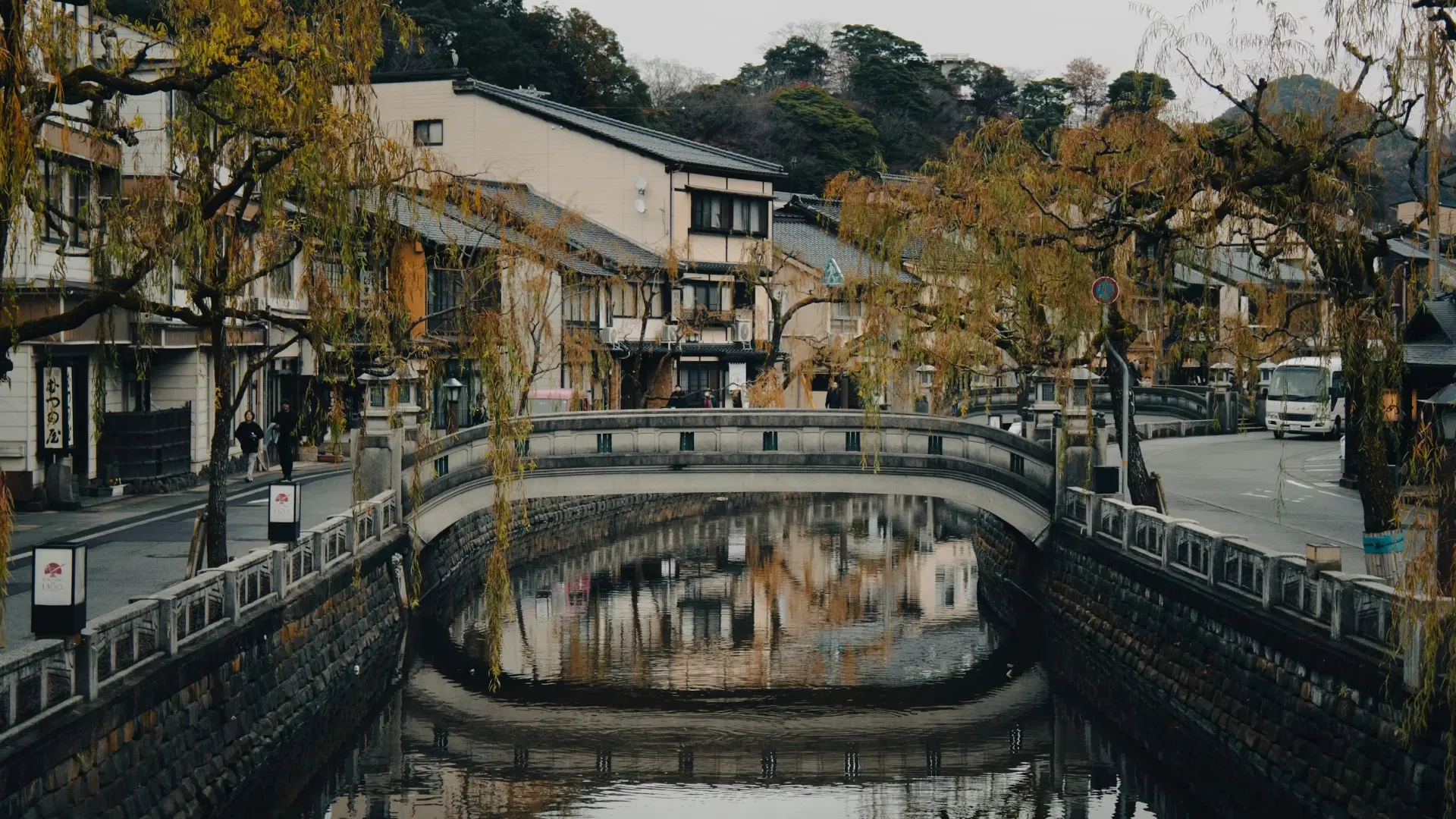
城崎温泉ゆかたシーズンKinosaki Onsen is the rare place in Japan where the yukata is not a costume but a uniform, not a novelty but the natural state of being. From April through November, the town's visitors and many of its residents move through the willow-lined streets and across the stone bridges of this compact hot spring town in cotton robes and wooden geta, their unhurried progress between the seven public bathhouses constituting an evening ritual that has defined Kinosaki's character for over a thousand years. The sotoyu-meguri, the practice of strolling from bath to bath in yukata, transforms the entire town into a single extended onsen whose corridors are streets, whose rooms are bathhouses, and whose atmosphere of relaxation permeates every encounter from the first step outside the ryokan door.
What distinguishes Kinosaki from the hundreds of other onsen towns across Japan is the totality of the commitment to this walking culture. The town was designed, and has been continually refined, to support the experience of moving between baths on foot: the distances are short, the streets are paved in stone that accommodates geta, the willow trees along the Otani River provide shade and beauty, and the seven public bathhouses are spaced at intervals that encourage exploration without exhaustion. The click of wooden sandals on stone, the flutter of cotton sleeves in the evening breeze, and the faint sulfurous warmth drifting from bathhouse doorways create a sensory environment that envelops the visitor from arrival to departure.
The season from April through November encompasses the full arc of the Japanese year outside winter, and each month brings its own quality to the stroll. Spring evenings carry the fragrance of the cherry blossoms that line the river. Summer nights are alive with the sounds of festivals and the sight of fireworks reflected in the water. Autumn turns the surrounding mountains into tapestries of red and gold visible above the rooftops. Throughout these seasons, the essential experience remains constant: the warmth of the water, the coolness of the air on damp skin, and the simple pleasure of walking through a beautiful town with no purpose beyond the next bath.
Kinosaki Onsen is the rare place in Japan where the yukata is not a costume but a uniform, not a novelty but the natural state of being.
History & Significance
Kinosaki's hot springs were, according to legend, discovered in the seventh century when a stork was observed healing its wounded leg in the thermal waters, a founding myth that gave the town its original name and established the association between the springs and physical restoration that persists today. The formal development of the town as an onsen destination began in the eighth century, and by the Edo period Kinosaki had become one of the most celebrated bathing towns in western Japan, its reputation attracting poets, scholars, and aristocrats who recorded their visits in literature that established the town's cultural identity as firmly as its thermal identity.
The sotoyu-meguri tradition evolved naturally from the town's geography and the distribution of its springs. With multiple sources of hot water emerging at different points across the compact settlement, the construction of separate bathhouses at each source was a practical necessity that became a cultural opportunity. The practice of visiting multiple baths in a single evening, changing from one mineral composition to another and experiencing the distinct architectural character of each bathhouse, transformed bathing from a singular act into a journey whose pleasure lay as much in the movement between baths as in the immersion itself. The yukata became the garment of this journey, practical in its ease of removal and replacement, beautiful in its simplicity, and symbolic of the temporary equality that the onsen confers upon all bathers regardless of their status in the clothed world beyond.
What to Expect
The seven public bathhouses, each with its own architectural style, mineral properties, and atmosphere, are distributed along the main street and the river, their locations creating a natural circuit that most visitors complete over two or three evenings. Satono-yu, the largest and most modern, offers multiple pools including an outdoor bath. Ichino-yu features a cave-like interior whose stone walls create an atmosphere of geological intimacy. Mandara-yu provides an outdoor garden bath whose landscaping changes with the seasons. Gosho-no-yu, Kouno-yu, Jizo-yu, and Yanagi-yu each offer their own distinctive character, and the pleasure of the stroll lies partly in discovering which bath best suits one's own temperament.
The evening stroll typically begins after the ryokan dinner service, when guests emerge into the street in their yukata and geta, the sound of wooden sandals announcing their entry into the communal space. The ryokan provides the yukata, the geta, and the sotoyu-meguri pass that grants admission to all seven bathhouses, and the transition from private room to public street is accomplished by simply stepping through the front door. The streets fill gradually as evening deepens, the paper lanterns of the ryokan and the soft lighting of the bathhouse facades creating a warm, amber atmosphere that encourages lingering. Small shops along the route sell ice cream, local sake, and souvenirs, and the intervals between baths are as much a part of the experience as the baths themselves.
The experience changes meaningfully with the seasons. Spring brings cherry blossoms along the river, their petals drifting onto the water and the shoulders of strollers. Summer evenings extend the stroll into the late hours, the heat making each bath's cool aftermath especially pleasurable. Autumn colors frame the town in warmth before the mountains' winter dormancy, the contrast between the cooling air and the hot water sharpening the sensory pleasure of each immersion.