Kinosaki Onsen
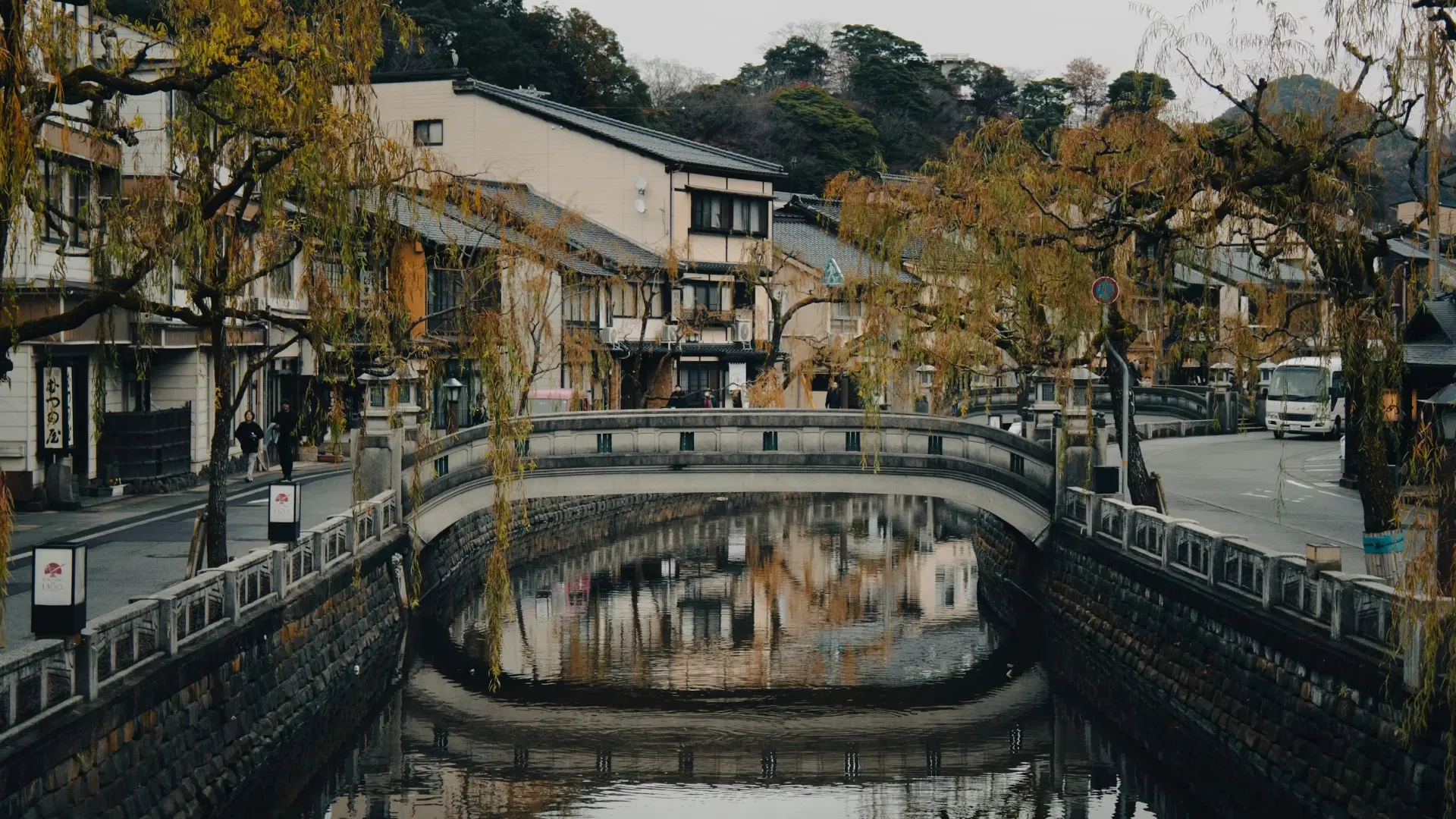
城崎温泉Kinosaki Onsen is the onsen town that the literary imagination of Japan has sanctified as the ideal of the genre. When Shiga Naoya, one of the foremost novelists of the twentieth century, convalesced here in 1913 following a near-fatal accident and subsequently wrote "At Kinosaki," the short story that became one of the most studied works in Japanese literature, he captured something about the town that transcends personal memoir: the quality of a place where hot water, willow-lined canals, and the slow passage of days in wooden ryokan produce a contemplative stillness that heals not through medical intervention but through the accumulated effect of beauty, warmth, and unhurried time.
The town stretches along the Otani River in a narrow valley that leads from the foothills of the mountains of northern Hyogo to the Japan Sea coast, its seven public bathhouses, or sotoyu, arranged along the river and its tributaries in a sequence that invites the practice of sotoyu-meguri, the ritual of visiting each bathhouse in succession while wearing yukata and wooden geta sandals. This practice, which is the defining experience of Kinosaki, transforms bathing from a private act into a public ritual, the streets between the bathhouses serving as an open-air corridor where the boundary between interior and exterior, private and communal, is dissolved by the shared uniform of the yukata and the shared purpose of the journey.
The architectural character of the town reinforces this sense of permeability. The ryokan that line the river are built in the traditional style of northern Hyogo, their wooden facades and tiled roofs creating a streetscape that has changed in character, if not in every specific building, since the Edo period. The willow trees that shade the canal bridges, their branches trailing in the water like calligraphic strokes, provide the vegetative counterpoint to the geometric lines of the architecture, and the combined effect, particularly at dusk when the paper lanterns of the ryokan begin to glow and the steam from the bathhouses rises against the darkening sky, is of a place that exists at the intersection of reality and reverie.
Kinosaki Onsen is the onsen town that the literary imagination of Japan has sanctified as the ideal of the genre.
Highlights
The sotoyu-meguri, the circuit of the seven public bathhouses, is not merely an activity but the organizing principle of a Kinosaki stay. Each bathhouse has its own architectural character, its own water temperature and mineral composition, and its own atmosphere, ranging from the cave-like enclosure of Ichino-yu to the elevated panoramic views of Mandara-yu. The circuit can be completed in a single ambitious day or spread across a more leisurely multi-day stay, and most ryokan provide their guests with a sotoyu-meguri pass that allows unlimited access to all seven baths. The walk between bathhouses, through streets where the click of wooden geta on stone pavement provides a rhythmic soundtrack and the sight of fellow bathers in colorful yukata creates a moving tapestry of pattern and color, is as much a part of the experience as the bathing itself.
The Onsenji Temple, accessed by ropeway from the center of town, sits atop the mountain that overlooks the valley and provides the spiritual anchor for the town's bathing culture. Legend attributes the discovery of Kinosaki's hot springs to the monk Dochi Shonin in 717 AD, and the temple he founded has served as the guardian shrine of the waters for over 1,300 years. The ropeway ascent provides aerial views of the town laid out along the river below, the clustering of ryokan roofs and the threads of steam rising from the bathhouses revealing the town's intimate scale and its total dedication to the practice of bathing.
The Kinosaki Literary Museum, modest in size but rich in content, documents the town's remarkable literary heritage. Shiga Naoya is the most famous of the writers who found inspiration here, but the list includes Shimaki Kensaku, Yoshii Isamu, and numerous other literary figures who were drawn to Kinosaki by the same qualities that draw contemporary visitors: the slowing of time, the sensory richness of the bathing ritual, and the beauty of a landscape whose human and natural elements exist in rare harmony.
Culinary Scene
Kinosaki's culinary calendar is defined by the Japan Sea, whose cold, nutrient-rich waters provide a seasonal procession of marine ingredients that reaches its pinnacle in winter with the arrival of Matsuba crab. The Matsuba-gani, the regional name for the male snow crab landed at the ports of northern Hyogo, is the centerpiece of the winter kaiseki served at Kinosaki's ryokan, its preparation spanning the full range of Japanese crab cookery: sashimi of raw leg meat whose sweetness and texture are most purely expressed without cooking; grilled legs whose charred shells release an aroma of sea and smoke; kani-suki hot pot where the crab is simmered with vegetables in a delicate dashi broth; and the concluding zosui rice porridge cooked in the enriched broth, a dish that concentrates the meal's accumulated flavors into a final, comforting course.
Beyond crab, the ryokan kitchens of Kinosaki work with the full palette of Japan Sea seafood: sweet shrimp served as sashimi, the translucent flesh arranged on ice; local oysters cultivated in the bays along the coast; yellowtail whose winter fattiness makes it ideal for both sashimi and teriyaki preparation; and the various small fish and shellfish that appear in the appetizer courses of kaiseki meals, each one a miniature expression of the season and the sea.
Tajima beef, from the same bloodline that produces Kobe beef but raised in the mountainous interior of northern Hyogo, appears on many ryokan menus as a supplement or alternative to seafood. The marbling is comparable to its more famous cousin, the flavor perhaps slightly more rustic, and the experience of eating Tajima beef in a Kinosaki ryokan, accompanied by local sake and followed by a walk through the lamplit streets to the next bathhouse, embodies the integration of food, place, and ritual that defines the finest Japanese travel experiences.
Ryokans in Hyogo
There are no ryokans in our guide listed in Kinosaki Onsen. See our selection across Hyogo.
View ryokans in Hyogo