Akashi Kaikyo Bridge Illumination
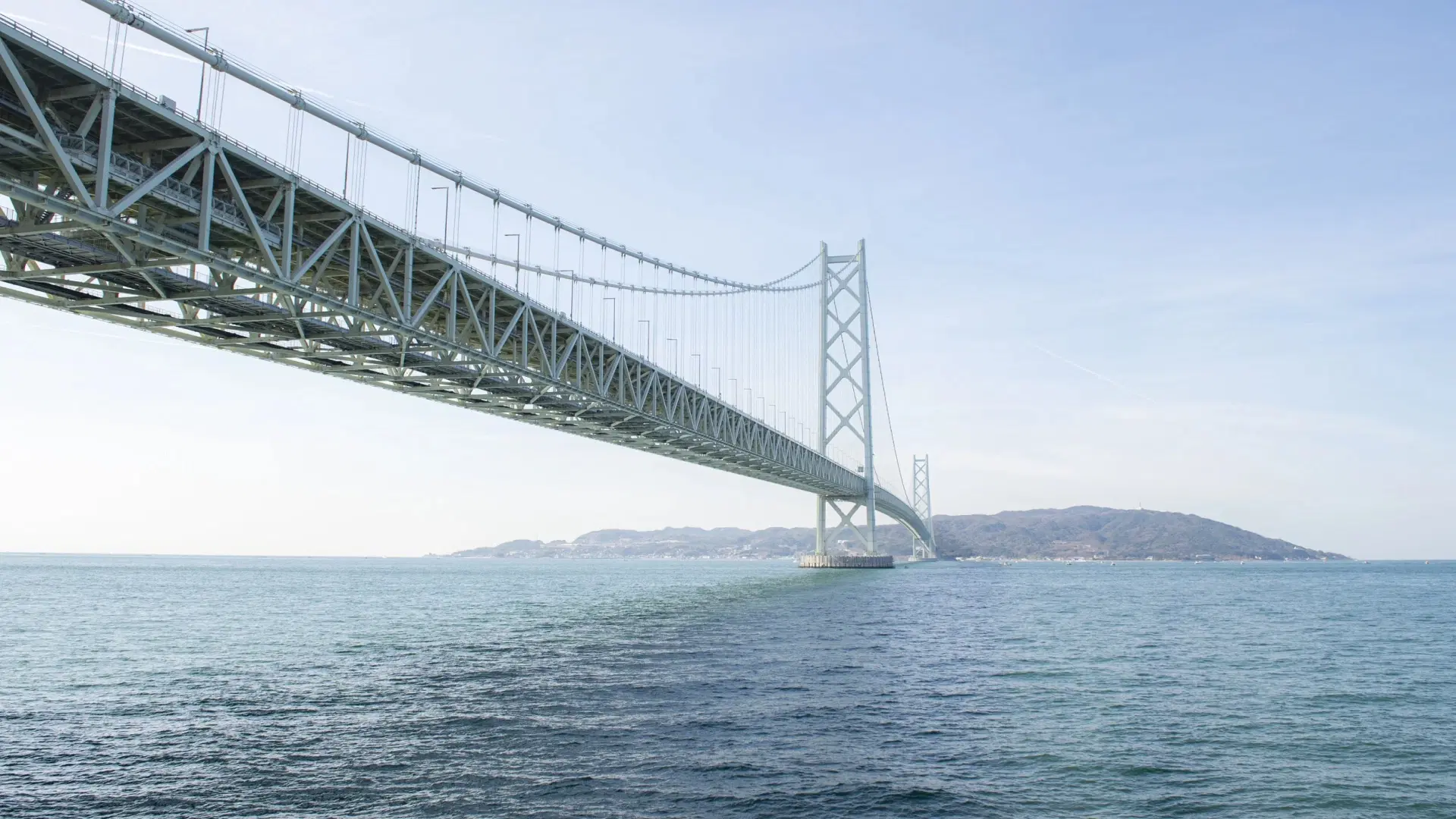
明石海峡大橋ライトアップThe Akashi Kaikyo Bridge, the longest suspension bridge in the world, becomes each evening a work of light art whose scale dwarfs every other illumination in Japan. Spanning 3,911 meters across the Akashi Strait between Kobe and Awaji Island, the bridge's twin towers and sweeping cable lines are fitted with 1,084 LED units and 28 floodlights whose programmable patterns transform the engineering marvel into a canvas of color that changes with the seasons, the calendar, and the hour. The nightly illumination, which begins at sunset and continues until midnight, paints the strait in compositions that range from cool pearl on ordinary evenings to vivid celebrations of color for holidays and special occasions, the bridge's enormous span ensuring that the display dominates the coastal landscape from vantage points spread across kilometers of shoreline.
The experience of witnessing this illumination is one of confrontation with scale. The bridge is so large that it redefines the landscape around it, its towers rising 298 meters above the water, its cables describing parabolas that the eye follows across a distance that seems to belong to geography rather than to engineering. When these enormous forms are outlined in light against the night sky, the effect is not merely decorative but sublime in the original sense of the word: the viewer is made aware of a magnitude that exceeds comfortable comprehension, the beauty of the light inseparable from the awe that the structure itself inspires.
The strait beneath the bridge is one of the most dramatic waterways in Japan, its powerful tidal currents and the mountainous coastlines of Honshu and Awaji Island creating a natural landscape of considerable grandeur. The illumination draws this landscape into the evening experience, the bridge's lights reflected in the moving water and the surrounding hills silhouetted against the glow, the natural and the engineered fusing into a nocturnal panorama that has no equivalent elsewhere in the country.
The Akashi Kaikyo Bridge, the longest suspension bridge in the world, becomes each evening a work of light art whose scale dwarfs every other illumination in Japan.
History & Significance
The Akashi Kaikyo Bridge was completed in 1998 after ten years of construction, its engineering driven by the challenge of spanning a strait notorious for powerful tidal currents, typhoons, and seismic activity. The bridge survived the Great Hanshin Earthquake of 1995 while still under construction, the event occurring when the two halves of the bridge had not yet been connected. The earthquake shifted the towers approximately a meter apart, requiring adjustments to the design that extended the bridge's total length. This survival, and the successful adaptation that followed, gave the bridge a symbolic significance that transcends its transportation function: it became an emblem of resilience, a structure that endured the same catastrophe that devastated Kobe and emerged not diminished but enlarged.
The illumination system was integrated into the bridge from its completion, the designers understanding that a structure of this prominence would be experienced as much by night as by day and that the quality of its nocturnal presence would define its relationship with the surrounding communities. The original lighting system has been upgraded over the years with advances in LED technology that have expanded the range of colors and patterns available while reducing energy consumption. The current system allows for twenty-eight different lighting patterns that are deployed according to a seasonal and calendrical program: blue and white for winter, green for spring, warm tones for summer, and special compositions for national holidays, local festivals, and commemorative occasions.
What to Expect
The standard evening illumination begins at sunset and presents the bridge in one of its programmed seasonal patterns, the colors shifting through a cycle that typically lasts thirty minutes before repeating. The effect is best appreciated from a distance that allows the full span to be seen in a single view, and several vantage points along the Kobe and Awaji coastlines provide this perspective. The Maiko Marine Promenade, a walkway enclosed within the bridge's structure at the Kobe end, offers a unique interior perspective, the visitor walking along the strait 47 meters above the water with views through the transparent floor to the currents below and through the windows to the illuminated cables above.
The Bridge World tour, available on selected dates, takes visitors to the top of the bridge's main tower, 298 meters above sea level, for a perspective that encompasses the strait, the cities of Kobe and Awaji, and on clear days the distant outlines of Osaka and Shikoku. The evening tours, timed to coincide with the illumination, place visitors at the summit of the structure as the lights activate around them, the cables stretching into the darkness below like luminous threads connecting the tower to the water.
Holiday and special event patterns provide reasons to return throughout the year. New Year, Valentine's Day, the spring equinox, Golden Week, Tanabata, Christmas, and local Hyogo festivals each receive dedicated lighting programs whose colors and rhythms reflect the character of the occasion. The rainbow pattern, deployed for celebrations and commemorative events, is the most spectacular, all seven colors progressing along the bridge's span in a wave that takes several seconds to travel from one shore to the other, the scale of the movement making the bridge feel momentarily alive.