Noboribetsu
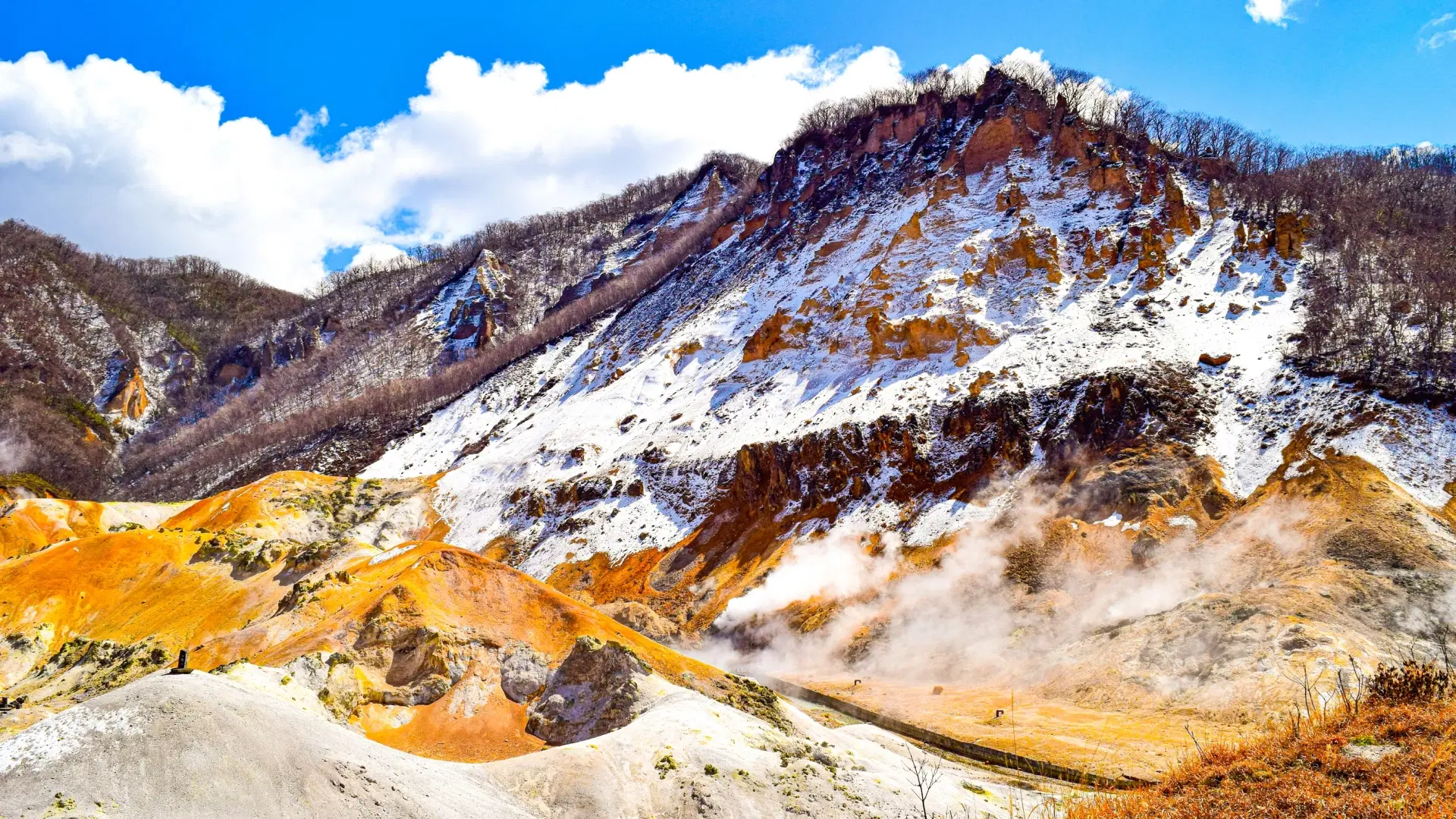
登別Noboribetsu is Hokkaido's preeminent onsen town, a place where the volcanic forces that shaped the island remain violently present at the surface. The town's hot spring district sits at the mouth of Jigokudani, the "Hell Valley," a collapsed volcanic crater whose barren, sulfur-encrusted walls steam perpetually with vents and fumaroles that push mineral-laden water to the surface at temperatures exceeding 80 degrees Celsius. The valley's name is accurate in its theatricality: the landscape is hellish in the geological sense, a terrain of scalded rock and hissing gas where nothing grows and the air carries the sharp, unmistakable scent of hydrogen sulfide.
From this infernal source flows one of Japan's most diverse collections of thermal waters. Noboribetsu's distinction among onsen destinations lies not merely in the volume or temperature of its springs but in the variety of their mineral compositions. Nine distinct water types emerge from the volcanic substrate, including sulfur springs, iron-rich springs, salt springs, and acidic springs, each with different therapeutic properties and bathing characteristics. The major ryokan and hotels of the town channel these waters into their bathing facilities, and several properties offer guests the opportunity to experience multiple water types in a single stay, a comparative immersion that illuminates the subtle differences between springs that untrained senses might otherwise overlook.
The town itself is modest in scale, its single main street climbing from the JR station toward the valley entrance, lined with souvenir shops and restaurants whose demon-themed decorations reference the hellish landscape above. But Noboribetsu's appeal is not urban. The surrounding forest, a mix of broadleaf and coniferous trees that erupts with autumn color in October, provides hiking trails that connect the valley to Lake Kuttara, a pristine caldera lake whose clarity rivals Lake Mashu. The landscape is a reminder that volcanic destruction and natural beauty are not opposites but expressions of the same geological energy.
Noboribetsu is Hokkaido's preeminent onsen town, a place where the volcanic forces that shaped the island remain violently present at the surface.
Highlights
Jigokudani, the Hell Valley, is the essential Noboribetsu experience. The walking trail along the crater rim passes observation points where the scale of the volcanic activity becomes viscerally apparent: pools of boiling, mineral-stained water; vents releasing columns of steam into the forest canopy; ground so hot that snow melts on contact even in the depths of winter. The adjacent Oyunuma, a hot water lake whose surface temperature reaches 50 degrees Celsius, feeds a natural foot bath along its outflow river where visitors can immerse their feet in the thermal stream while surrounded by forest. The trail connecting these features forms a loop of approximately two kilometers that can be walked in an hour but rewards a slower pace.
Dai-ichi Takimotokan, the town's most historic bathing facility, offers a public bathing hall of extraordinary scale, with over thirty pools drawing from seven different spring sources. The experience of moving between pools of different temperatures, mineral compositions, and settings, some indoors, some open to the sky, some overlooking the forested valley, constitutes a masterclass in onsen culture. The contrast between a sulfur spring's milky opacity and an iron spring's amber clarity becomes a sensory education.
Bear Park, accessible by ropeway from the town center, maintains a population of Hokkaido brown bears, the Ussuri subspecies that is Hokkaido's largest terrestrial predator and a figure of profound significance in Ainu culture. The ropeway ascent provides panoramic views of the Pacific coastline and the volcanic landscape. The adjacent Ainu cultural village, Yukara no Sato, offers exhibitions and performances that contextualize the region's indigenous heritage.
Culinary Scene
Noboribetsu's dining culture is shaped by the ryokan tradition, where multi-course kaiseki meals served in the privacy of guest rooms represent the primary culinary experience. The best ryokan kitchens in Noboribetsu draw on Hokkaido's marine and agricultural abundance, incorporating hairy crab, scallops, salmon, and sea urchin alongside mountain vegetables and Hokkaido beef in seasonal menus that shift with the calendar. The emphasis on local sourcing is not merely philosophical but practical: the proximity to both the Pacific coast and the island's interior farmland means that ingredients can arrive at the kitchen within hours of harvest.
Outside the ryokan, the town's restaurant district along the main street offers more casual dining, including Hokkaido-style ramen, grilled lamb Genghis Khan, and izakaya serving the seafood that arrives daily from the nearby port of Muroran. Noboribetsu's onsen tamago, eggs slow-cooked in the mineral springs until the whites turn translucent and the yolks achieve a creamy consistency, are a local specialty that connects the act of eating to the volcanic landscape itself. The black eggs, boiled in the sulfurous waters until their shells darken, are sold as souvenirs but taste best eaten warm at the valley's edge.