Yoshino Cherry Blossom Season
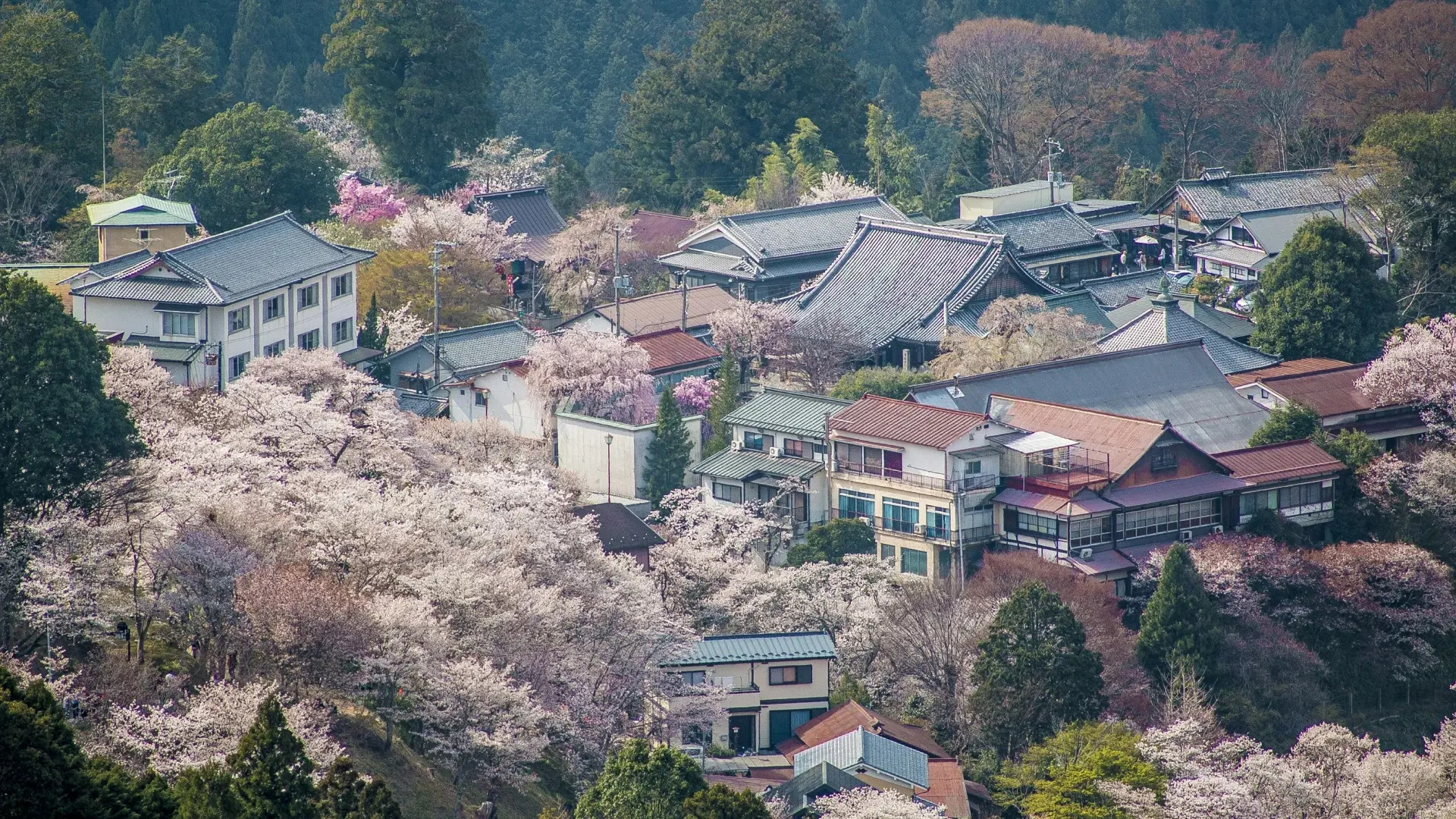
吉野桜シーズンThe cherry blossom season at Yoshino is the supreme hanami experience in Japan, a claim that is not subjective but historical: for over 1,300 years, since the Shugendo ascetics of the seventh century first planted cherry trees on these mountain slopes as offerings to the deity of the peaks, Yoshino has been acknowledged as the first and finest cherry blossom destination in the country, its approximately 30,000 trees, predominantly the mountain cherry yamazakura, transforming the entire mountainside into a cascade of pink and white bloom that is visible from the plains below like a cloud descended upon the earth. No other hanami site in Japan approaches Yoshino's combination of scale, spiritual significance, historical depth, and pure visual grandeur.
The Yoshino cherry is not the Somei Yoshino that lines the rivers and parks of modern Japanese cities, a hybrid cultivar developed in the Edo period for its reliable, simultaneous bloom. The yamazakura of Yoshino is the original, wild mountain cherry, each tree genetically distinct, blooming at its own pace in response to its particular exposure, altitude, and age, the flowers opening alongside the young leaves that emerge simultaneously in shades of bronze and green that give the yamazakura its visual complexity. Where the Somei Yoshino presents a uniform canopy of pure pink against bare branches, the yamazakura offers a richer, more varied tapestry in which pink and white blossoms intermingle with red-bronze and fresh green foliage, the overall effect more painterly and less singular, a landscape rather than a decoration.
The experience of Yoshino's blossom season is shaped by the mountain's topography, which organizes the bloom into four ascending zones, each blooming approximately a week after the one below as spring climbs the slopes from base to summit. This natural staging means that the blossom season at Yoshino extends over three to four weeks, a duration unmatched by any lowland hanami site, and that visitors who time their arrival to catch a particular zone in full bloom will simultaneously see the zones below in late bloom or petal fall and the zones above in bud or early bloom, the entire arc of the cherry blossom lifecycle visible in a single upward glance.
History & Significance
The planting of cherry trees on Yoshino's slopes began in the seventh century with the establishment of the Shugendo mountain religion, whose founder, En no Gyoja, is said to have carved the image of Zao Gongen, the wrathful protector deity of the Omine mountains, from a cherry tree, thereby sacralizing the species and inspiring subsequent practitioners to plant cherry trees as religious offerings. Over the following centuries, the plantings expanded from devotional clusters around the temples to the comprehensive coverage of the mountainside that defines the contemporary landscape, each generation of monks and pilgrims adding trees whose growth was understood not as horticultural improvement but as spiritual accumulation.
The secular appreciation of Yoshino's blossoms developed in parallel with the religious tradition, the mountain becoming a destination for aristocratic and imperial hanami excursions from the Heian period onward. The most legendary of these visits was Toyotomi Hideyoshi's grand cherry blossom viewing party in 1594, when the supreme military ruler of Japan brought an entourage of approximately 5,000 courtiers, warriors, and attendants to Yoshino for a celebration whose extravagance reflected both his personal love of spectacle and his desire to demonstrate that the beauty of Japan's most sacred mountain was, like everything else in the country, subject to his will. The event was documented in paintings and literary accounts that established Yoshino's blossoms as a national symbol, their beauty carrying not only aesthetic but political and spiritual weight.
The modern era has brought both preservation and challenge. The cherry trees of Yoshino require active maintenance, their health threatened by disease, climate change, and the soil compaction caused by the millions of footsteps that traverse the mountain each spring. Conservation organizations, temple communities, and local government collaborate on replanting and care programs that seek to sustain the mountain's blossom density for future generations, their work a contemporary expression of the same devotional impulse that led the first Shugendo practitioners to plant the earliest trees.
What to Expect
The blossom season at Yoshino typically begins in early April in the Shimo-Senbon (lower thousand trees) zone and progresses upward through Naka-Senbon (middle thousand) and Kami-Senbon (upper thousand) to Oku-Senbon (inner thousand) over the following two to three weeks. The timing varies by year depending on winter and early spring temperatures, and the sakura forecasts issued by the Japan Meteorological Agency and private weather services provide reasonably accurate predictions of peak bloom dates for each zone.
The ascent from the lower to the upper groves follows a path that winds through the mountain's temple and shrine precincts, each level offering views that increase in grandeur as the altitude rises. The Shimo-Senbon area, accessible from the ropeway station or the walking trail from Yoshino Station, provides the first immersion in blossom cover, the trees lining the approach road and surrounding the lower temples. The Naka-Senbon area, centered on the massive Kinpusenji temple and the Yoshimizu Shrine viewpoint, offers the most celebrated panoramas, the blossoms extending across the valley in a pink and white tide that fills the visual field. The Kami-Senbon area, reached after a steeper climb, provides increasingly dramatic perspectives as the trees thin and the views open to reveal the mountain ridges beyond. The Oku-Senbon area, the most remote and least visited, rewards the extended walk with a quieter, more contemplative experience of blossoms in a wilder setting.
The experience of Yoshino during peak bloom is one of total immersion in cherry blossom beauty, but it is also an experience of crowds. The mountain draws hundreds of thousands of visitors during the peak weeks, and the walking paths, particularly through the Naka-Senbon area, can become congested. Early morning arrivals, weekday visits, and the willingness to climb beyond the most popular zones all help to secure moments of relative solitude. The evening illumination of certain sections of the mountain, when spotlights pick out individual trees and the darkness amplifies the blossoms' luminosity, provides an alternative temporal strategy, the night crowds smaller and the atmosphere more contemplative than the daytime bustle.