Yanagawa Sagemon Meguri
柳川さげもんめぐりThe Yanagawa Sagemon Meguri is one of Japan's most visually enchanting regional traditions, a celebration of the Hina Matsuri doll festival that the canal town of Yanagawa has elevated into something uniquely its own through the practice of sagemon, handmade hanging ornaments whose cascading forms fill homes, shops, and public spaces with color throughout the late winter and early spring. Each sagemon is a chandelier of small, individually crafted fabric figures suspended from a ring, the figures representing animals, flowers, dolls, and auspicious symbols that collectively express a family's prayers for a daughter's health, happiness, and prosperity. The result is a town transformed, every storefront and riverbank decorated with these delicate, swaying compositions whose beauty lies not in any single piece but in the cumulative effect of hundreds displayed together across the winding waterways of one of Kyushu's most atmospheric small cities.
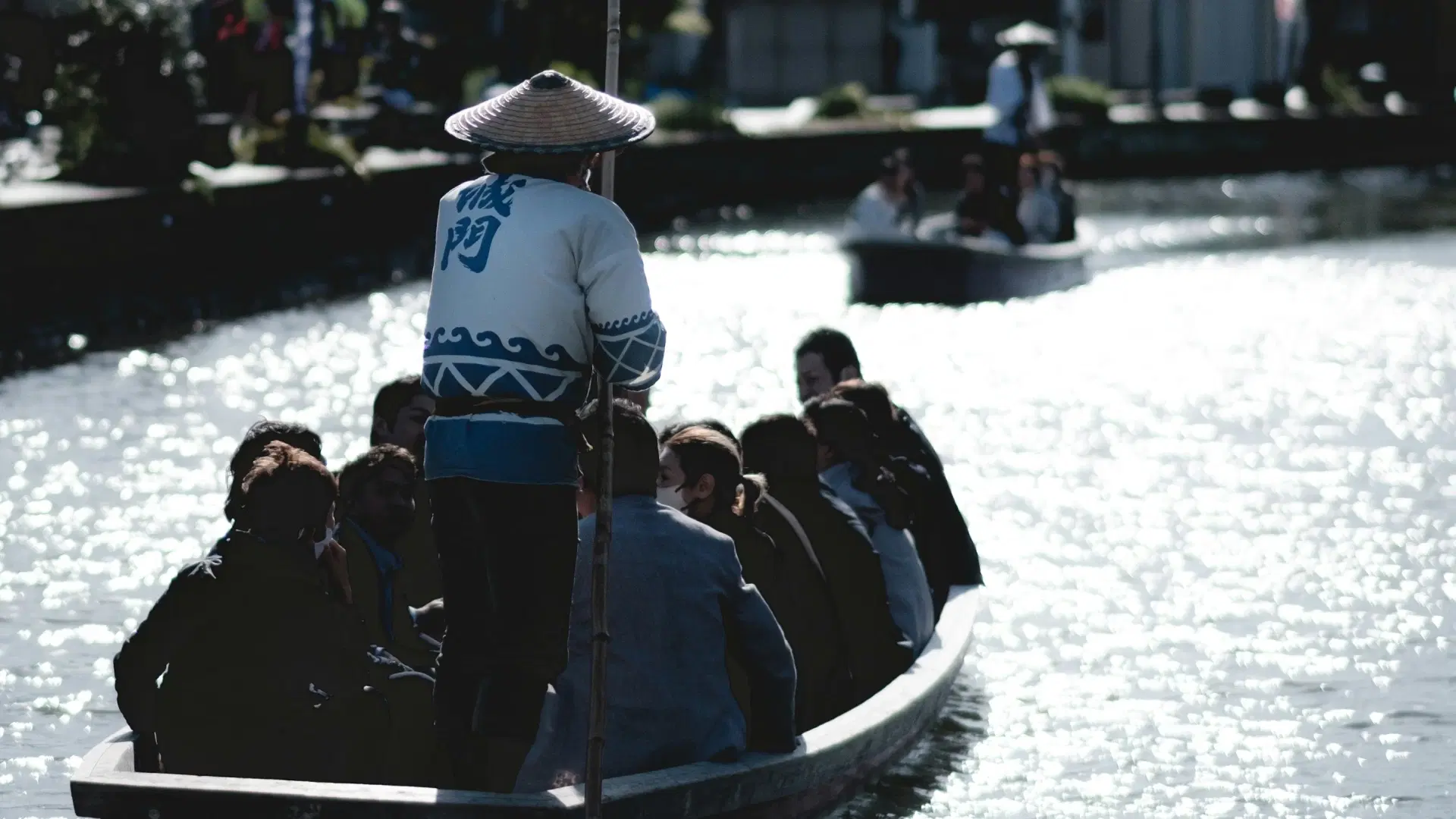
Yanagawa is defined by its canals, a network of waterways originally constructed for castle defense and irrigation during the feudal era that now serve as the town's primary scenic and cultural resource. During the Sagemon Meguri, these canals become corridors of celebration, the sagemon displayed along their banks and in the windows of the traditional homes that line them. The traditional donko-bune punting boats that carry visitors through the canals pass beneath the ornaments and alongside the Hina doll displays arranged in the waterside buildings, the journey combining the pleasure of the water with the intimacy of peering into decorated interiors from the slow-moving boat.
The tradition is distinctly local, a practice that belongs to Yanagawa and nowhere else, its techniques passed from grandmother to mother to daughter through generations of patient handwork. Each figure in a sagemon is crafted from scraps of kimono silk, chirimen crepe fabric, and cotton padding, the materials humble but the skill required to shape them into recognizable forms considerable. The making of sagemon is itself a ritual of preparation and love, the months of sewing that precede a daughter's first Hina Matsuri representing a tangible investment of time and care that the finished ornament visually preserves.
History & Significance
The sagemon tradition in Yanagawa developed during the late Edo period, when the practice of celebrating a girl's first Hina Matsuri with elaborate displays of dolls and decorations was well established among the samurai and merchant classes. The sagemon evolved as a complement to the traditional tiered doll display, the hanging ornaments filling the space around the platform dolls with additional symbols of good fortune. The practice was particularly strong among the samurai families of the Tachibana domain, whose modest stipends encouraged the creation of handmade decorations that could match the visual impact of the expensive purchased dolls without requiring equivalent expenditure. What began as an economy became an art, the sagemon's handmade character valued not as a substitute for purchased finery but as an expression of maternal devotion that no commercial product could replicate.
The formalization of the Sagemon Meguri as a public event dates to 1994, when the city recognized the tourism potential of a tradition that had been practiced privately for generations. The decision to encourage the public display of sagemon and to organize the viewing into a structured itinerary transformed the event from a domestic custom into one of Kyushu's most distinctive cultural festivals. The response exceeded expectations, and the Sagemon Meguri has grown steadily in reputation, drawing visitors who discover in Yanagawa's decorated canals an experience that no other destination in Japan can provide.
What to Expect
The festival unfolds across the town of Yanagawa, with sagemon displayed in private homes, public buildings, temples, shops, and purpose-built exhibition spaces along the canal network. The main exhibition at the Yanagawa Cultural Hall presents the most elaborate and historically significant examples, including antique sagemon that demonstrate the evolution of the craft over generations. Walking routes connect the major display sites, and the pleasure of the festival lies partly in the surprises encountered between the official venues: a shop window suddenly ablaze with color, a private doorway revealing a glimpse of hanging ornaments in an interior beyond.
The donko-bune canal boat tour is the essential Yanagawa experience, and during the Sagemon Meguri it acquires an additional dimension. The flat-bottomed boats, propelled by a boatman standing at the stern with a long pole, glide through the narrow canals at a pace that allows unhurried appreciation of the bankside decorations. The boatmen, many of whom have poled these canals for decades, provide commentary that weaves together the history of the waterways, the stories behind particular displays, and the songs traditionally associated with the boat journey, their practiced narration as much a part of the experience as the visual spectacle.
The Ohina-sama Suijogyo Retsu, a waterborne procession held during the festival period, brings costumed participants onto the canals in decorated boats, the procession recreating the atmosphere of the Edo-period celebrations that gave birth to the sagemon tradition. The sight of the boats passing beneath bridges hung with ornaments, the participants in period dress framed by the traditional architecture of the canal district, collapses the distance between past and present in a way that the static displays alone cannot achieve.