Hakata Dontaku
博多どんたくHakata Dontaku is the largest festival in Japan by attendance, drawing over two million visitors to the streets of Fukuoka over its two days during Golden Week. Yet the scale of the event, which fills the city's main avenues with a continuous parade of dance troupes, floats, musicians, and costumed performers from morning until evening, does not diminish its warmth. Dontaku has the spirit of a neighborhood celebration expanded to metropolitan proportions, its participants ranging from polished corporate dance teams to groups of elderly women in matching happi coats to children bouncing on parents' shoulders, all united by the simple intention to fill the streets with movement and joy.
The name "Dontaku" derives from the Dutch word "Zondag," meaning Sunday or holiday, a linguistic relic of the centuries of Dutch trade through Nagasaki that left scattered traces in the vocabulary of western Japan. The festival's roots lie in the Matsubayashi, a New Year celebration in which Hakata merchants would visit homes and businesses to perform auspicious dances, a tradition documented from at least 1179. The modern Dontaku, reorganized in the postwar period as a civic celebration during Golden Week, retains elements of the Matsubayashi while expanding the concept of public celebration to include virtually any group willing to assemble a performance and join the parade.
The result is a festival whose charm lies in its democratic inclusivity. There are no exclusive traditions to master, no hereditary roles to inherit, no barriers of class or origin to navigate. The streets belong to anyone who wishes to dance, and the boundary between performer and spectator dissolves repeatedly throughout the two days, as onlookers are drawn into the processions by the music, the energy, and the infectious conviction that the highest purpose of a spring holiday is to move through the streets of one's city in the company of others.
Hakata Dontaku is the largest festival in Japan by attendance, drawing over two million visitors to the streets of Fukuoka over its two days during Golden Week.
History & Significance
The Matsubayashi tradition from which Dontaku evolved was a New Year observance in which groups of performers would visit the castle of the ruling Kuroda lords and the homes of prominent merchants, performing dances and songs meant to bring good fortune for the coming year. The practice was suppressed during the Meiji period as part of the government's broader effort to modernize and rationalize public life, but the spirit of communal celebration proved more durable than the regulations that attempted to contain it, and the festival was revived in 1891 as the Dontaku.
The postwar reconstruction of the festival, reorganized in 1946 as part of the broader effort to rebuild civic morale and community identity, established the format that persists today: a two-day parade along the main thoroughfares of the city during Golden Week, open to any group that registers to participate. The shift from New Year to May was pragmatic, taking advantage of the national holiday period to maximize attendance, but it also gave the festival a spring energy that suits its character. The growth of participation from dozens of groups in the early postwar years to more than eight hundred in the contemporary festival reflects both the event's enduring appeal and the city's instinct for inclusive celebration.
The Dontaku's relationship to the Yamakasa, held six weeks later, is complementary rather than competitive. Where the Yamakasa is fierce, exclusive, and steeped in centuries of precise ritual, the Dontaku is gentle, inclusive, and spontaneous. Together, they define the range of Fukuoka's festival temperament, from the sacred intensity of the dawn sprint to the democratic joy of the springtime dance.
What to Expect
The main parade route runs along Meiji-dori, the broad avenue that connects Hakata Station to the Tenjin commercial district, and the procession moves along this corridor continuously throughout both days. Performing groups appear in sequence, each occupying a stretch of the avenue for the duration of their passage, and the variety of performances ensures that the experience changes constantly: a taiko drumming ensemble gives way to a corporate dance team, which yields to a group of kindergarten children in matching costumes, followed by a float carrying musicians playing festival songs that echo off the surrounding buildings.
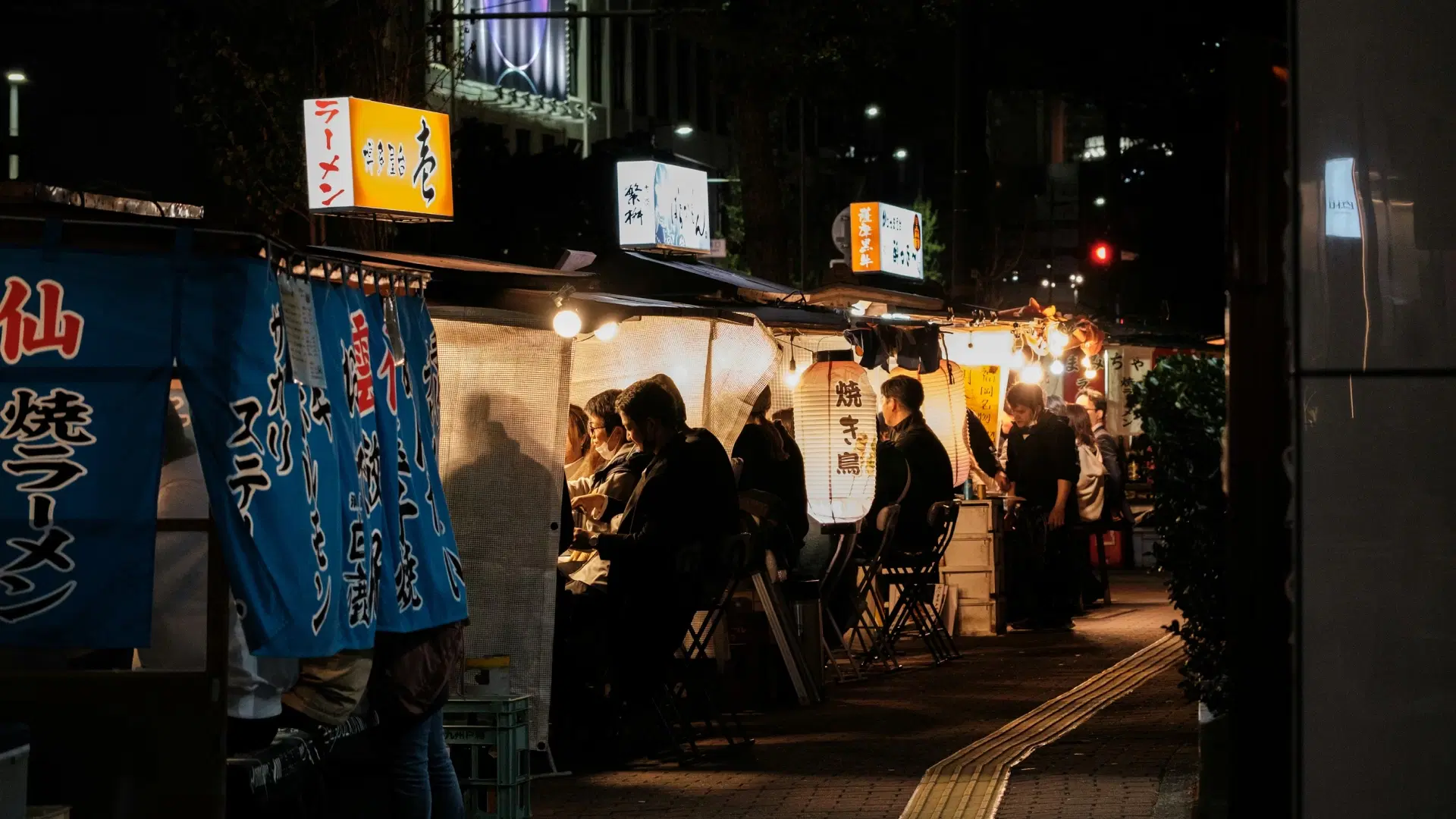
Stages erected at several points along the route and in the surrounding parks and plazas provide fixed performance venues where groups perform in rotation. The Tenjin area, in particular, becomes a network of stages, food stalls, and gathering spaces whose combined energy creates a festival atmosphere that extends well beyond the parade route itself. The food stalls offer the full range of Fukuoka's street food culture, from Hakata ramen and yakitori to mentaiko-stuffed onigiri and the festival-specific treats that appear only during this period.
The most distinctive Dontaku tradition is the shamoji, the rice paddle that participants carry and strike rhythmically as they dance. The sound of hundreds of shamoji creating a collective rhythm is the festival's sonic signature, a percussive undercurrent that ties together the diverse performances into a unified celebration. Visitors are often offered shamoji to join the parade, and accepting the invitation, stepping off the sidewalk and into the river of movement, transforms the experience from observation to participation.