Dazaifu
太宰府Dazaifu was once the capital of everything west. From the seventh through the twelfth century, this modest town on the Fukuoka plain served as the administrative headquarters for all of Kyushu and the western provinces, a role whose weight and grandeur far exceeded the scale of the settlement itself. The Dazaifu Government Offices, whose stone foundations now lie in a field of grass and silence, coordinated the defense of the western frontier, managed diplomatic relations with the Korean and Chinese courts, and administered the trade that flowed through the ports of northern Kyushu. It was, in every meaningful sense, Japan's second capital, the seat from which imperial authority projected itself across the western domains and toward the continent beyond.
The town's other great claim, inseparable from its administrative history, centers on the figure of Sugawara no Michizane, the brilliant scholar-politician of the Heian court who was exiled to Dazaifu in 901, a victim of political conspiracy at the height of his influence. Michizane's death in exile two years later, and the series of natural disasters and political calamities that were subsequently attributed to his angry spirit, led to his posthumous deification as Tenjin, the god of learning and literature. The Dazaifu Tenmangu shrine, built over the site of his grave, is now the most visited of the twelve thousand Tenjin shrines in Japan, a place of pilgrimage for students, scholars, and anyone who seeks the blessing of the deity whose earthly life demonstrated both the rewards and the terrible costs of intellectual brilliance.
The landscape around the shrine carries the memory of Michizane's story with botanical precision. The plum trees, estimated at six thousand across the shrine grounds, honor the poet's famous love for the ume blossom, and the legend of the "flying plum," a tree said to have uprooted itself from Michizane's Kyoto garden and flown to Dazaifu to be near its master, gives the grove its mythic dimension. When the plums bloom in February and March, their fragrance filling the cold air with a sweetness that seems to argue against the harshness of the world, Dazaifu achieves a beauty that is both historical and immediate.
Dazaifu was once the capital of everything west.
Highlights
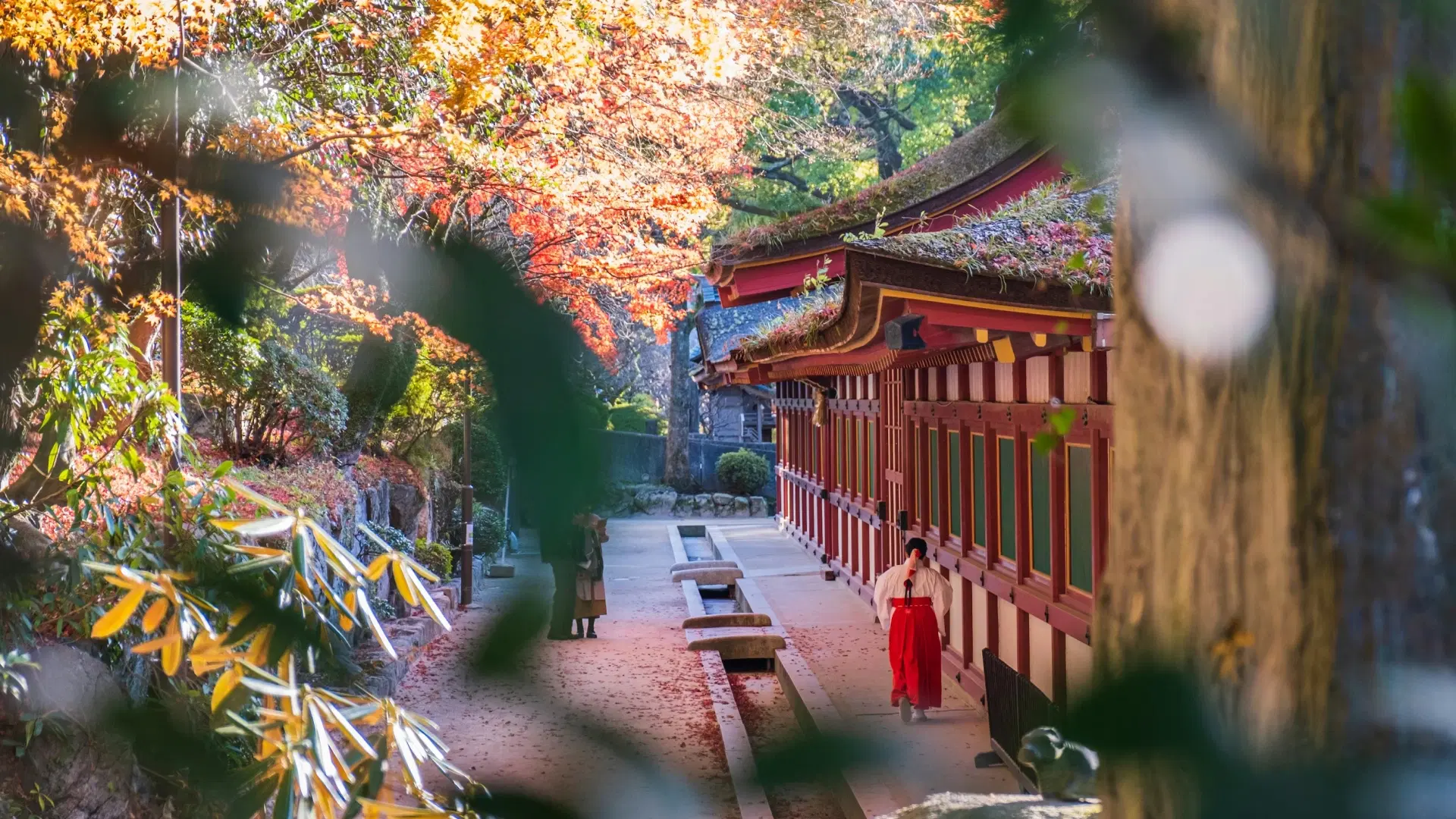
Dazaifu Tenmangu is the orienting monument of any visit, its vermilion structures and arched bridges composed against a backdrop of camphor and plum trees that has been refined over a millennium of continuous worship. The approach, through a long avenue of stone lanterns and souvenir shops, crosses a series of bridges over a pond said to represent the past, present, and future, and the main hall, rebuilt in its present form in 1591, houses the spirit of Michizane with a solemnity that the crowds of exam-season students cannot diminish. The treasure house adjacent to the main hall contains calligraphy, documents, and artifacts connected to Michizane's life and the shrine's history.
The Kyushu National Museum, opened in 2005 on the hillside behind Tenmangu and connected to the shrine grounds by a covered escalator through the forest, is one of Japan's four national museums and the most architecturally striking. The building, designed by Kikuchi Takeo, is a vast, curving structure whose glass and steel surfaces reflect the surrounding forest, and its permanent exhibition, devoted to the history of cultural exchange between Japan and the Asian continent, gives Dazaifu's historical role as a gateway to the wider world a comprehensive and beautifully presented narrative. The collection's strength in ceramics, Buddhist sculpture, and documents of diplomatic exchange provides the cultural context that deepens any visit to the region.
The Dazaifu Government Office ruins, a short walk south of the shrine, preserve the stone foundations and earthwork platforms of the administrative complex that governed western Japan for five centuries. The site is vast, its open expanse communicating the scale of the operation it once housed, and the absence of standing structures, paradoxically, heightens the sense of historical weight. Walking the perimeter of the ancient compound, surrounded by nothing but grass and sky and the distant outline of the mountains, one feels the presence of the past with an intensity that restored buildings rarely achieve.
Culinary Scene
Umegae Mochi, the grilled rice cake stamped with a plum blossom design and filled with sweet azuki paste, is Dazaifu's signature confection and one of the oldest continuously produced sweets in Japan. The tradition of offering umegae mochi to visitors to Tenmangu dates to the shrine's earliest centuries, and the small shop beside the shrine approach has been producing them over charcoal with an unhurried attention that transforms a simple snack into a cultural artifact. Eaten warm from the griddle, the crisp exterior giving way to the soft, subtly sweet interior, the mochi provides a moment of simple pleasure that requires no elaboration.
The tea houses within and around the shrine grounds serve matcha and seasonal confections in settings that invite contemplation, and the combination of powdered tea and umegae mochi, consumed beneath the plum trees during the blossom season, is a pairing of flavor and atmosphere that approaches the ideal. The restaurants along the approach road offer Hakata-influenced cuisine, including mentaiko preparations, grilled chicken, and udon served in the Hakata style with soft, yielding noodles in a clear dashi broth.
For visitors continuing to Fukuoka, Dazaifu serves as a prelude to the city's deeper culinary offerings, but the discipline of the umegae mochi tradition, its refusal to diversify or modernize, its insistence that a single preparation made well for centuries needs no improvement, carries its own culinary lesson.
Ryokans in Fukuoka
There are no ryokans in our guide listed in Dazaifu. See our selection across Fukuoka.
View ryokans in Fukuoka