Yanagawa
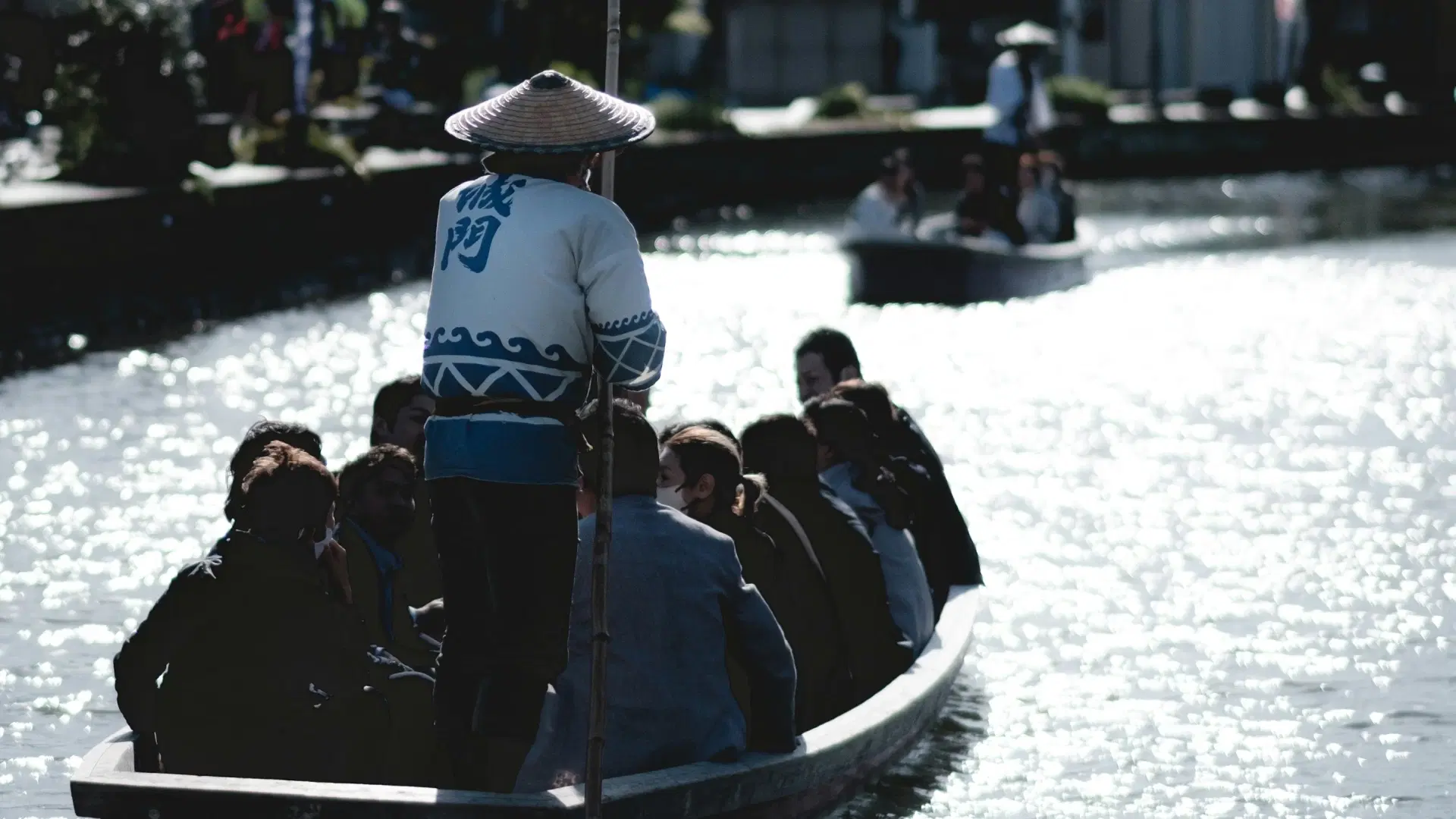
柳川Yanagawa is a city built on water. The network of canals that threads through this castle town on the Chikugo River plain was constructed in the sixteenth and seventeenth centuries for irrigation, defense, and transport, and the waterways that once served samurai and merchant alike now define the most distinctive urban landscape in Kyushu. To glide through Yanagawa's canals on a traditional punt, steered by a boatman who narrates the passage with the practiced ease of someone for whom these channels are as familiar as corridors, is to experience a form of travel that exists almost nowhere else in Japan: slow, intimate, and framed at every turn by the walls of samurai residences, the branches of overhanging willows, and the reflections that double the world in the still water below.
The canals, totaling some 930 kilometers in combined length, create a grid that structures the entire town. They vary in width from broad channels that once accommodated commercial traffic to narrow passages barely wider than the punt itself, and the journey between them creates a constantly shifting interplay of light, shadow, and enclosure. The stone walls that line the larger canals retain the austerity of their military origins, while the smaller waterways, bordered by gardens and the rear walls of private homes, reveal the domestic life of the town with a proximity that feels almost confessional.
Yanagawa's literary fame owes much to Kitahara Hakushu, one of modern Japan's greatest poets, who was born here in 1885 and whose work drew endlessly on the watery landscape of his childhood. His poems of the canals, the willows, the quality of light on still water, gave Yanagawa a literary identity that has attracted visitors since the early twentieth century, and the preserved Hakushu birthplace, a handsome merchant house near the canal, anchors the town's cultural life to its most famous son.
Highlights
The canal boat tour is Yanagawa's defining experience, a journey of approximately seventy minutes that winds through the heart of the old town along waterways that pass beneath brick bridges, through the shadows of storehouse walls, and beneath canopies of willow, cherry, and seasonal flowers that vary the passage's character through the year. The boatmen, who steer with a single long pole and whose commentary blends historical narration with practiced humor, are themselves part of the attraction, their skill in navigating the narrowest passages and lowest bridges a demonstration of physical mastery refined over a lifetime on the water. In spring, the cherry blossoms that arch over the canals create tunnels of pink reflected in the water below. In summer, the irises and hydrangeas line the banks in overlapping waves of purple and blue. In autumn, the maples redden, and in winter, the kotatsu boats, fitted with heated tables beneath quilted blankets, allow the journey to continue in warmth against the cold air.
The Ohana villa, the former residence of the Tachibana clan who governed Yanagawa for over three centuries, provides the town's most refined architectural experience. The Shoto-en garden, designed in the Meiji period in a style that blends traditional Japanese garden arts with Western influences, faces onto a broad canal and is composed around a central pond whose reflections of the villa's elegant facades create the illusion of a building floating on water. The Western-style reception hall, with its period furnishings and views across the garden, communicates the cosmopolitan aspirations of the Meiji-era elite while remaining rooted in the waterborne aesthetics of Yanagawa.
The Kitahara Hakushu Memorial Museum, housed in and adjacent to the poet's birthplace, documents the life and work of the man whose verse transformed a provincial canal town into a landscape of national literary significance. The preserved merchant house, with its storerooms and interior garden, provides a physical context for the poetry, and the museum's collection of manuscripts, photographs, and personal effects brings the poet's world into tangible proximity.
Culinary Scene
Unagi is Yanagawa's culinary signature, and the town's eel cuisine is regarded as among the finest in Japan. The preparation that defines Yanagawa's approach is seiro-mushi, steamed eel over rice, a technique in which grilled unagi is laid over seasoned rice in a bamboo steamer and heated until the flavors of the tare sauce, the rice, and the eel merge into a unified whole. The steaming process gives the eel a tenderness that grilling alone cannot achieve, the flesh yielding to the lightest touch of chopsticks, and the rice beneath absorbs the rich, caramelized juices that descend during cooking. The result is a dish of profound simplicity and equally profound satisfaction.
The eel restaurants of Yanagawa line the streets near the canal boarding points, and the aroma of charcoal-grilled unagi, sweet and smoky and almost narcotically appealing, hangs in the air along the approach. The best establishments have been perfecting their tare, the sweetened soy glaze that is applied during grilling and that forms the flavor bridge between the eel's richness and the rice's neutrality, for generations, each restaurant guarding its recipe with the seriousness of a family inheritance. Accompanying the seiro-mushi, the clear soup and pickled vegetables that complete the meal provide the necessary counterpoints of acidity and brine.
Yanagawa's proximity to the Ariake Sea also provides access to the distinctive marine products of this shallow, tidal body of water, including mutsugoro, the blue-spotted mudskipper that is a local delicacy, grilled whole on skewers.