Okinawa
沖縄Okinawa is Japan and is not Japan: a distinction that matters profoundly to those who live there. For nearly five centuries, the Ryukyu Kingdom operated as an independent maritime state, trading with China, Southeast Asia, Korea, and Japan, developing a culture, language, and aesthetic sensibility distinct from all of them. The kingdom's absorption into Japan in 1879, the devastating Battle of Okinawa in 1945, and the subsequent American military occupation until 1972 have layered the islands' identity with complexity that resists simple characterization.
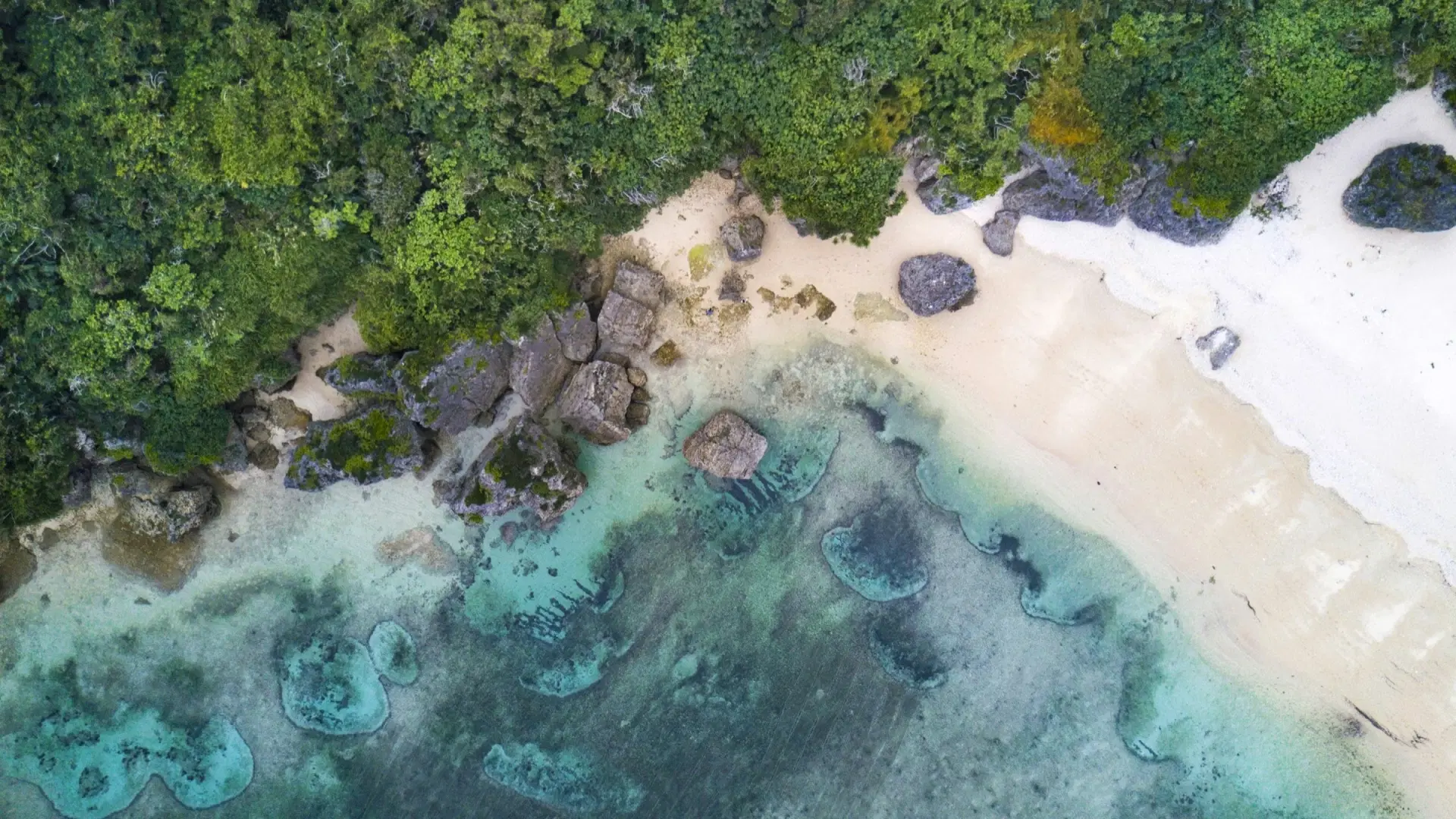
What the visitor encounters, beyond this history, is a place of extraordinary natural beauty and cultural warmth. The main island's coast alternates between white sand beaches lapped by water of improbable turquoise clarity and rugged limestone headlands where sacred groves (utaki) have been sites of prayer since before memory. The Kerama Islands, thirty minutes by fast ferry from Naha, offer coral reefs of global significance and a transparency of water that makes snorkeling feel like flying. Farther south, Miyako-jima and the Yaeyama archipelago (Ishigaki, Taketomi, Iriomote) present increasingly remote expressions of subtropical island life, where mangrove estuaries, star-sand beaches, and traditional red-tile villages exist in a rhythm governed by tides and seasons rather than train schedules.
Okinawa's accommodation culture differs fundamentally from the ryokan tradition of the mainland. Here, hospitality draws from the Ryukyuan concept of ichariba chode (once we meet, we are family) expressed through an openness and directness that contrasts with Honshu's more formal omotenashi. The finest island resorts integrate this warmth with settings of genuine splendor: clifftop infinity pools overlooking the East China Sea, private villas shaded by fukugi trees, and dining programs built on the longevity cuisine that has made Okinawa one of the world's Blue Zones.
Okinawa is Japan and is not Japan: a distinction that matters profoundly to those who live there.
Geography
The Okinawa archipelago stretches across roughly one thousand kilometers of the East China Sea, from the Amami Islands in the north to Yonaguni (Japan's westernmost point, closer to Taipei than to Tokyo) in the south. The islands are the exposed peaks of a submerged mountain range, their geology predominantly uplifted coral limestone that creates the distinctive karst topography visible in the caves, sinkholes, and jagged coastal formations found throughout the chain. The absence of continental-shelf rivers means the surrounding waters remain exceptionally clear, supporting coral reef ecosystems of remarkable biodiversity.
Iriomote, the largest of the Yaeyama Islands, is ninety percent covered in subtropical jungle and mangrove forest: a landscape so wild and ecologically significant that it received UNESCO World Heritage status in 2021. The island's rivers, navigable by kayak through cathedral-like mangrove canopies, support populations of the critically endangered Iriomote cat, found nowhere else on earth. Miyako-jima's flat coral platform produces the stunning Sunayama and Yonaha Maehama beaches, while Ishigaki's Kabira Bay (its emerald water dotted with forested islets) ranks among the most beautiful seascapes in the Pacific. The main island of Okinawa itself combines the urbanized south around Naha with the rural, less-developed north, where the Yanbaru forest harbors endemic species and the coastline remains largely unspoiled.
Culture
Okinawan culture is Ryukyuan culture: related to but fundamentally distinct from the Japanese traditions of the mainland. The sanshin, a three-stringed instrument derived from the Chinese sanxian and ancestor of the Japanese shamisen, provides the musical foundation for a performance tradition that ranges from classical court dance to the raucous communal singing of kachashi celebrations. Ryukyuan classical dance, recognized as an Intangible Cultural Property, combines the measured grace of Chinese court influence with an expressiveness that reflects the islands' more open, less hierarchical social structure.
The Shuri Castle complex in Naha (the seat of the Ryukyu kings, destroyed and rebuilt multiple times, most recently after the devastating fire of 2019) symbolizes both the grandeur and the resilience of Okinawan civilization. Its architectural fusion of Chinese and Japanese elements, executed in Okinawa's distinctive red limestone, represents a cultural synthesis found nowhere else. The islands' textile traditions (bingata stencil dyeing with its vivid tropical palette, the indigo kasuri of Miyako and Yaeyama, the gossamer bashofu banana fiber cloth of Kijoka) constitute a heritage of extraordinary richness. The spiritual life of Okinawa centers on the noro priestesses and the utaki sacred groves, a form of indigenous worship that predates and persists alongside Buddhism and Shinto, tended almost exclusively by women in a tradition that inverts mainland religious gender dynamics.
Cuisine
Okinawan cuisine shares more with Southeast Asia and southern China than with the dashi-and-soy palate of Honshu. The foundational protein is pork, used in its entirety: the islanders say they eat everything but the oink. Rafute, pork belly braised for hours in awamori spirit, brown sugar, and soy until it achieves a melting, lacquered tenderness, is the archipelago's signature dish. Soki soba (wheat noodles in a clear pork and bonito broth, crowned with slow-cooked spare ribs) is the daily staple, found in every neighborhood shop and eaten at any hour. Goya champuru, the bitter melon stir-fry with tofu, egg, and pork, embodies the dietary philosophy that has contributed to Okinawa's remarkable longevity statistics.
The islands' unique ingredients include tofuyo (tofu fermented in awamori and red koji into a pungent, cheese-like delicacy that divides opinion but rewards persistence) and umibudo, the "sea grape" seaweed whose tiny translucent spheres burst with brine on the tongue. Awamori, Okinawa's indigenous spirit distilled from Thai indica rice and aged in clay pots, is the islands' defining drink, its oldest vintages (kusu aged for decades) developing a complexity that rivals fine cognac. The food culture here is communal, celebratory, and deeply tied to the concept of nuchigusui (literally "life medicine") the belief that what you eat and how you eat it, in company and with gratitude, is the foundation of a long and contented life.