Koyasan
高野山Koyasan exists at an altitude and in a register that separates it from every other destination in Japan. Eight peaks encircle a mountain plateau at roughly 800 meters above sea level, and within that natural amphitheater, the monk Kukai established a monastic community in 816 that has never ceased to function. Over twelve hundred years later, more than a hundred temples still operate on the mountain, their morning sutra chanting audible through the cedar forests before dawn, their monks sweeping stone paths in darkness before the first visitors arrive. This is not a heritage site that evokes religion through architecture alone; it is a living ecclesiastical city where the routines of Shingon Buddhist practice govern the rhythm of every day and every season.
Kukai, known posthumously as Kobo Daishi, chose this mountain with the spatial instinct of a visionary. The plateau's enclosure by eight ridges suggested to him the petals of a lotus flower, the most sacred botanical form in Buddhism, and the dense cryptomeria forests that covered the slopes provided both building material and the atmosphere of primordial seclusion that monastic life requires. He returned from his studies in Tang Dynasty China carrying the esoteric teachings that would become Shingon Buddhism, a school whose emphasis on ritual, mantra, and the direct experience of enlightenment through physical and sensory practice demanded a landscape of immersive power. Koyasan provided that landscape, and the symbiosis between doctrine and topography has deepened across the centuries until the mountain itself has become inseparable from the faith it houses.
For the contemporary traveler, Koyasan offers something that has largely vanished from the modern world: the experience of sleeping, eating, and walking within the precincts of a working religious community whose hospitality is not a commercial service but an extension of spiritual practice. The temple lodgings, or shukubo, receive guests into rooms overlooking moss gardens and ancient trees, serve vegetarian cuisine prepared according to Buddhist precepts, and invite participation in the predawn prayer services that have begun each day on this mountain for more than a millennium.
Koyasan exists at an altitude and in a register that separates it from every other destination in Japan.
Highlights
Okunoin is the spiritual heart of Koyasan and one of the most extraordinary sacred landscapes in the world. The two-kilometer approach to the mausoleum of Kobo Daishi passes through a forest of immense cryptomeria trees, their trunks rising like columns in a cathedral whose roof is the sky, and flanking the path on both sides are more than 200,000 stone memorial markers, tombstones, and cenotaphs that span over a thousand years of Japanese history. Feudal lords, samurai, poets, monks, and commoners lie together in a democracy of the dead that transcends the rigid social hierarchies they observed in life. The largest monuments belong to the great daimyo families: the Maeda, the Shimazu, the Date, the Tokugawa, their mossy stone structures asserting even in death the scale of their earthly power. Between them, smaller markers disappear into the forest floor, their inscriptions effaced by centuries of rain and lichen.
The Danjo Garan, the central temple complex where Kukai established his original monastery, concentrates the architectural and artistic achievements of Shingon Buddhism into a precinct of extraordinary density. The Konpon Daito, the Great Pagoda, rises 48.5 meters above the plateau, its vermillion form visible from multiple approaches, its interior housing a mandala of carved and gilded Buddhas arranged according to the esoteric cosmology that Kukai brought from China. The pagoda represents the center of a cosmic mandala that extends across the entire mountain, a spatial theology in which every temple, every path, every tree participates in a unified sacred diagram.
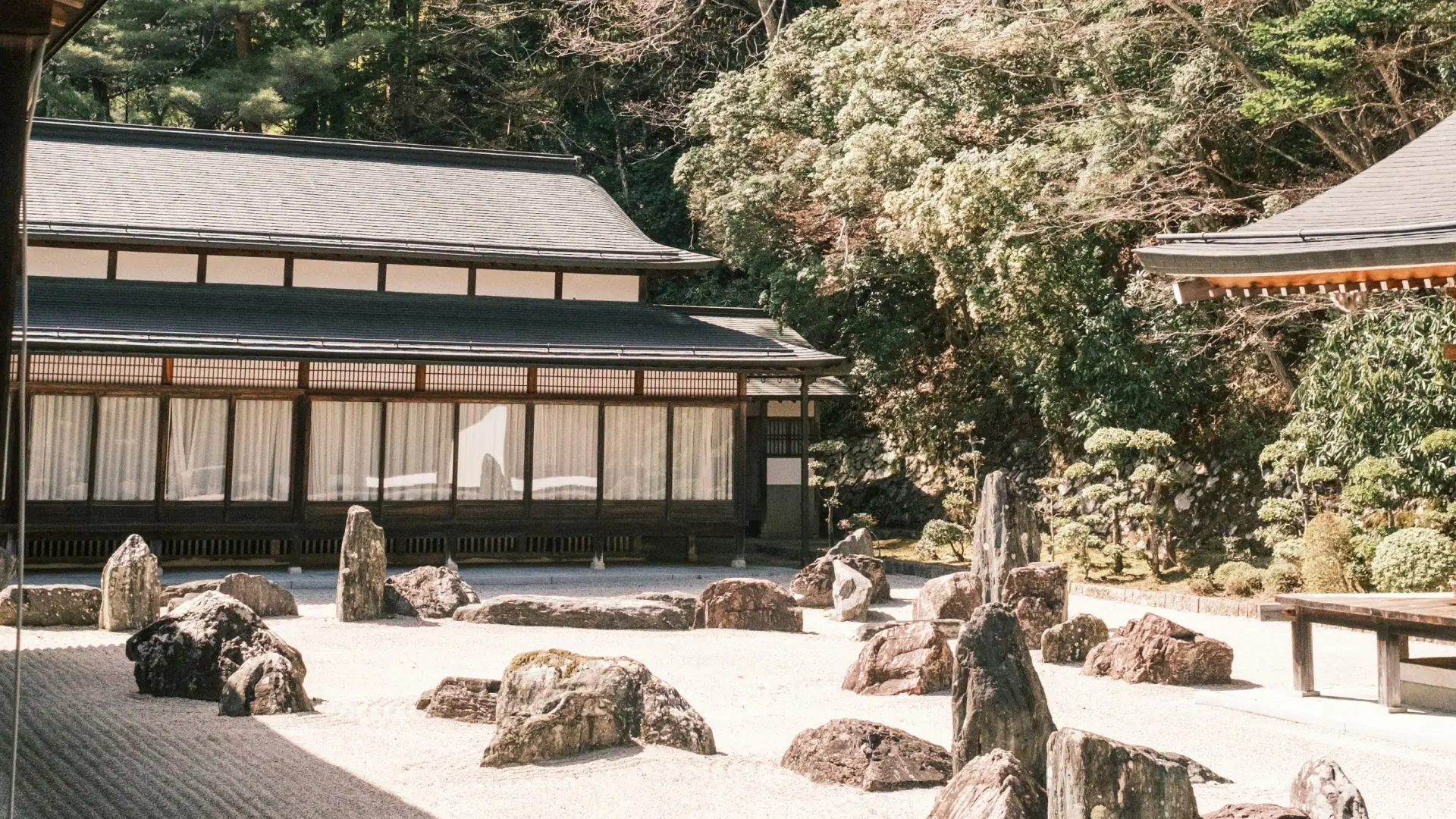
Kongobuji, the administrative headquarters of the Shingon sect, contains the largest rock garden in Japan, a composition of 140 granite stones arranged on a field of white sand that represents a pair of dragons emerging from clouds to protect the temple. The garden's scale, sweeping across the full width of the building's southern facade, creates a landscape of abstraction that rewards prolonged contemplation, the stones shifting in apparent arrangement as the light changes through the day. The temple's interior fusuma paintings, executed by masters of the Kano school, depict cranes, willows, and landscapes in gold leaf and mineral pigments that glow with undiminished intensity.
Culinary Scene
Shojin ryori, the Buddhist vegetarian cuisine served at Koyasan's temple lodgings, is not a limitation but a discipline that has produced, over centuries of refinement, one of Japan's most sophisticated culinary traditions. The prohibition against meat and fish, and the additional Shingon restriction against pungent vegetables such as garlic and onion, forces the temple kitchen to extract maximum flavor and textural variety from a pantry of tofu, mountain vegetables, seaweed, mushrooms, sesame, root vegetables, and the wild plants that grow in the forests surrounding the plateau. The result is a cuisine of remarkable range and subtlety, each course constructed to demonstrate that the renunciation of animal products is not a sacrifice but a liberation into a different register of flavor.
The evening meal at a shukubo is typically served on individual trays in the guest's room, the courses arriving in lacquered vessels and ceramic dishes that honor the food with the same attention given to kaiseki presentation. Goma-dofu, sesame tofu made by grinding sesame seeds with kuzu starch into a preparation of silken texture and deep, nutty flavor, is the signature dish of Koyasan and arguably the finest single vegetarian preparation in Japan. Tempura of seasonal mountain vegetables, simmered dishes of daikon and shiitake, pickles fermented according to temple recipes, and rice cooked with care that reflects its status as a sacred offering rather than a mere staple compose a meal whose restraint is its luxury.
Breakfast follows the morning prayer service and continues the vegetarian discipline with rice porridge, miso soup, pickled vegetables, and small dishes of prepared tofu and seaweed. The simplicity is deliberate, the meal designed to sustain the body for meditation and study without inducing the heaviness that richer food produces. Eating at Koyasan is a form of practice, each meal a reminder that sustenance and spirituality are not separate categories but expressions of a single attention to the present moment.
Ryokans in Wakayama
There are no ryokans in our guide listed in Koyasan. See our selection across Wakayama.
View ryokans in Wakayama