Katsuura
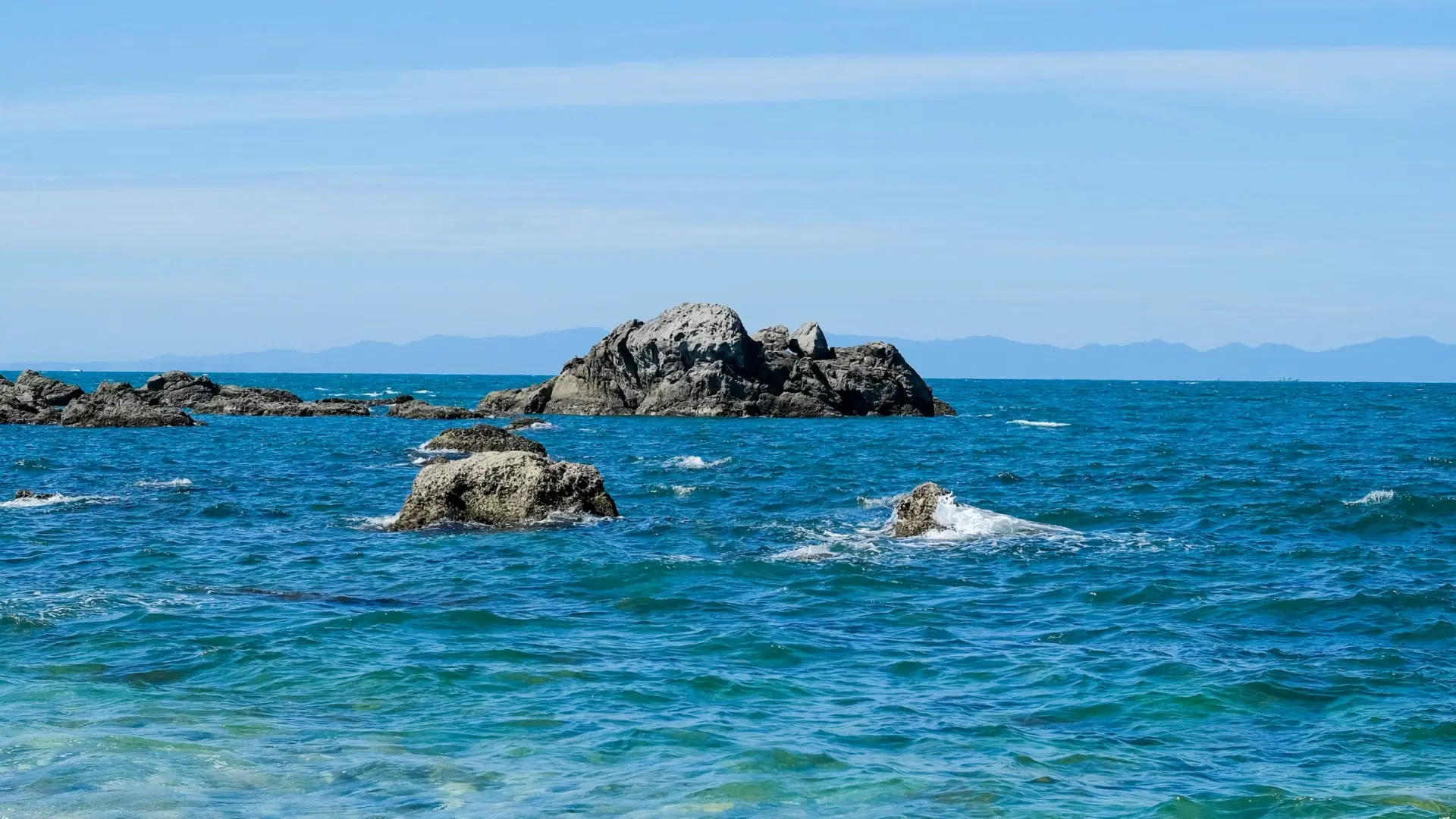
勝浦Katsuura is a town built around one of the most dramatic natural harbors on the Pacific coast of Japan, a deep inlet studded with more than 130 small islands and rock formations whose forested surfaces and wave-carved bases create a seascape of painterly complexity. The harbor served for centuries as a refuge for fishing fleets working the rich waters where the Kuroshio Current sweeps past the southern tip of the Kii Peninsula, and that maritime heritage persists today in a tuna auction that rivals Tsukiji and Toyosu in quality if not in scale. Katsuura handles the largest volume of fresh tuna in Japan, the morning auction at the town's cooperative fish market a spectacle of speed, expertise, and oceanic bounty that begins before most travelers have finished their first cup of tea.
The town's onsen heritage is concentrated not along the shore but within the landscape of the harbor itself. Several of the islets and headlands that dot the bay contain thermal springs, their waters heated by the same volcanic geology that created the rugged coastline, and the most celebrated ryokan of Katsuura are built upon these natural features, their outdoor baths perched on cliff edges or tucked into sea caves where the hot mineral water and the salt spray of the Pacific mingle in an experience unique to this geography. The sensation of bathing in a cave onsen while the ocean surges through the rocks below is a conjunction of geological forces that few other places on earth can offer.
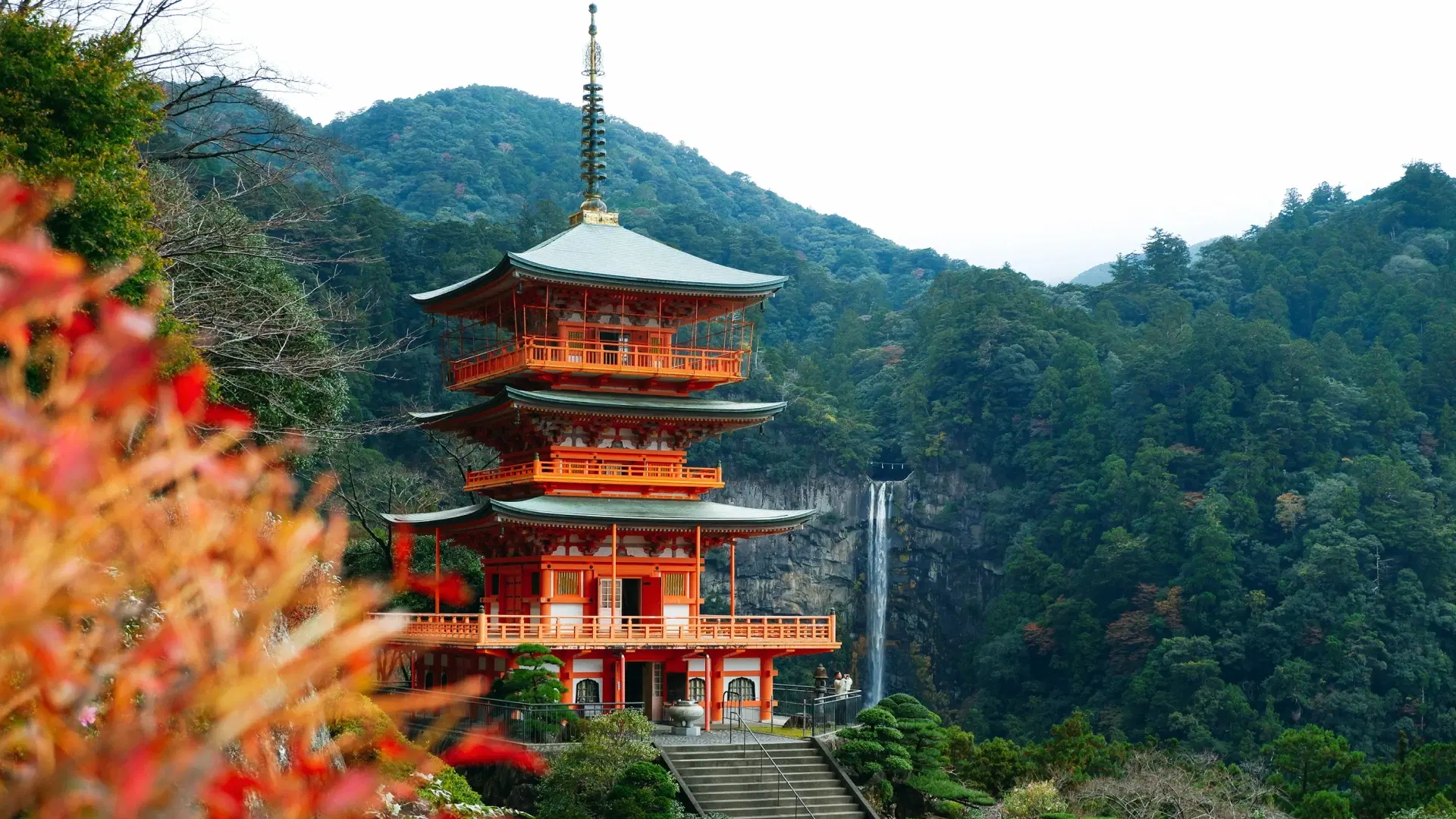
Katsuura also serves as a gateway to the Kumano Sanzan, the three great shrines of the Kumano faith that have drawn pilgrims to this region for over a thousand years. Kumano Nachi Taisha, with its adjacent pagoda framing the 133-meter Nachi Falls, is less than thirty minutes from the town center, and the pilgrimage trails that thread through the surrounding mountains descend to the coast at Katsuura's doorstep. The town thus occupies a position between the sacred and the secular, between the mountainous interior where pilgrims walked and the maritime frontier where fishermen worked, and this dual identity gives it a character richer and more layered than its modest size might suggest.
Katsuura is a town built around one of the most dramatic natural harbors on the Pacific coast of Japan, a deep inlet studded with more than 130 small islands and rock formations whose forested surfaces and wave-carved bases create a seascape of painterly complexity.
Highlights
Nachi Falls, at 133 meters the tallest single-drop waterfall in Japan, is the defining natural monument of the Katsuura region and one of the most sacred sites in Shinto cosmology. The falls have been worshipped as a manifestation of divine power since before recorded history, the thunder of their descent and the mist that rises from their base inspiring a reverence that predates the organized religion that would later claim them. Kumano Nachi Taisha, the grand shrine built on the mountainside above the falls, and Seigantoji, the Buddhist temple whose vermillion three-story pagoda frames the most iconic view of the cascade, represent the syncretic fusion of Shinto and Buddhist belief that characterizes the Kumano faith. The view of the pagoda against the white thread of the waterfall, set within a wall of ancient forest, is one of the most reproduced images in Japanese iconography, yet its power in person exceeds any photograph.
The harbor itself, explored by boat, reveals a miniature archipelago whose beauty has earned comparisons to Matsushima Bay in Miyagi. The islands range from substantial forested landmasses to solitary rock pillars crowned with single pines, their forms sculpted by the Pacific into natural monuments that the Japanese eye reads as compositions rather than accidents. Several of the larger islands host temples, shrines, and ryokan, their structures integrated into the natural topography so completely that they appear to have grown from the rock rather than been placed upon it.
The Daimon-zaka stone stairway, a section of the ancient Kumano Kodo pilgrimage trail lined with enormous cryptomeria trees whose age exceeds 800 years, provides the most atmospheric approach to Nachi Falls and the shrine complex. The 267 stone steps rise through a forest canopy so dense that the passage feels subterranean, the light filtering through the branches in shafts that illuminate the moss-covered stones and the gnarled root systems that grip the earth on either side of the path.
Culinary Scene
Tuna is the foundation upon which Katsuura's culinary identity rests, and the town's relationship with this fish is not merely economic but cultural, a bond forged by generations of fishermen whose expertise in tracking, catching, and handling the species has produced a standard of freshness and quality that defines excellence in Japan. The morning auction at the cooperative fish market, where the day's catch of maguro bluefin, kihada yellowfin, and mebachi bigeye tuna is laid out on the concrete floor for inspection by buyers whose practiced eyes assess quality through the color, sheen, and texture of the flesh visible at the tail cut, is a ritual of evaluation that distills centuries of accumulated knowledge into seconds of judgment.
The sashimi and sushi served at Katsuura's restaurants benefit from a proximity to source that no urban establishment can match. Tuna that was swimming in the Pacific at dawn appears on the cutting board by noon, its flesh displaying a vitality, a translucence, and a sweetness that deteriorate with every hour of transport and storage. The local preparation called maguro no kama, the collar section grilled over charcoal until the fat renders and the surface caramelizes, reveals a dimension of tuna flavor that the refined slices of sashimi only partially capture, the richness of the collar meat providing a robust counterpoint to the clean elegance of the loin.
Beyond tuna, the Kuroshio Current delivers a rotating cast of seasonal fish to the local fleet: katsuo bonito in spring and autumn, ise-ebi spiny lobster from October through April, and the smaller species of the deep reef whose names are known only to local fishermen and the chefs who await their arrival each morning. The ryokan dinners in Katsuura incorporate these catches into kaiseki sequences where the opening sashimi course alone may feature four or five species, each expressing a different facet of the ocean's seasonal offering.
Ryokans in Wakayama
There are no ryokans in our guide listed in Katsuura. See our selection across Wakayama.
View ryokans in Wakayama