Sado Island
佐渡島Sado Island lies in the Sea of Japan off the coast of Niigata like a world set slightly apart from the rest of the country, its isolation having preserved traditions, landscapes, and a quality of light that the mainland has largely lost. The island, roughly the size of Okinawa's main island and shaped like a flattened letter S, is defined by two parallel mountain ranges separated by a central rice plain, a geography that creates microclimates ranging from the alpine to the subtropical and supports a biodiversity that includes the Japanese crested ibis, the toki, a bird that was once extinct in the wild and has been reintroduced here in a conservation effort that has become one of the island's defining narratives. To visit Sado is to encounter a Japan that operates at a different speed, where the ferry crossing itself serves as a decompression chamber between the urgency of the mainland and the island's more deliberate rhythms.
Sado's history is layered with contradiction. It was both a place of exile for political prisoners and fallen aristocrats, including the Emperor Juntoku and the Buddhist monk Nichiren, and a source of immense wealth, its gold and silver mines having financed the Tokugawa shogunate for nearly three centuries. The exiles brought with them the refined arts of Kyoto and Kamakura, and these cultural imports took root in the island's soil with a tenacity that produced, over generations, a performing arts tradition of remarkable depth. Noh theater, which on the mainland became the exclusive preserve of the warrior class, was democratized on Sado; farmers performed it on open-air stages after the rice harvest, and more than thirty noh stages survive on the island today, more than in any other single municipality in Japan.
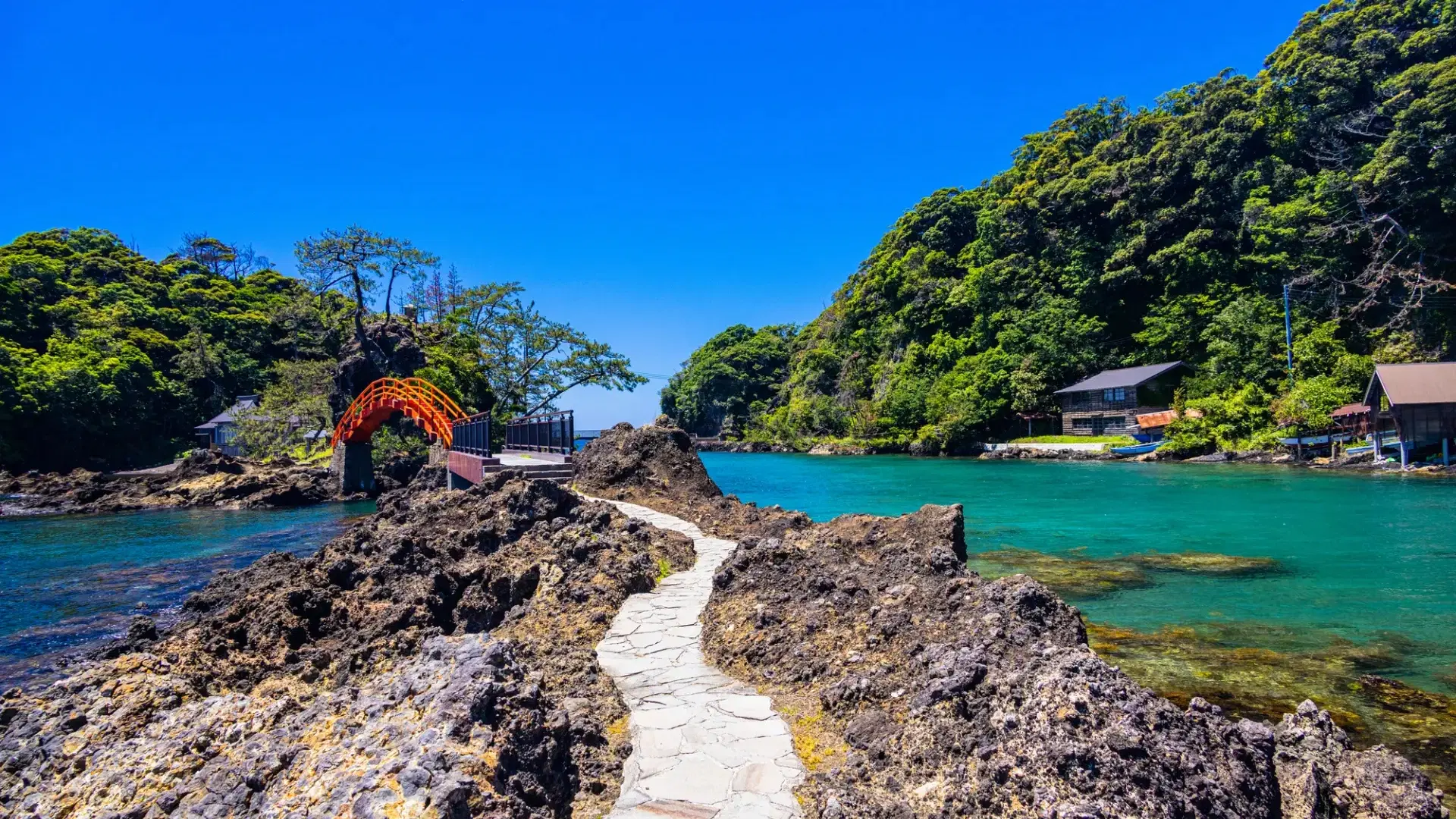
The landscape itself carries this double character of austerity and abundance. The Osado mountains along the northern coast plunge into the sea in dramatic cliffs and rocky coves, while the Kosado hills to the south are gentler, their slopes given over to terraced rice paddies and orchards. The central Kuninaka plain, the island's agricultural heart, produces rice of exceptional quality, its paddies flooded with mountain water and tended with the care of a community that understands cultivation not merely as an economic activity but as a cultural practice inseparable from identity.
Sado Island lies in the Sea of Japan off the coast of Niigata like a world set slightly apart from the rest of the country, its isolation having preserved traditions, landscapes, and a quality of light that the mainland has largely lost.
Highlights
The Sado Kinzan gold mine, which operated from 1601 until 1989, is the island's most visited historical site and a candidate for UNESCO World Heritage inscription. The mine's vast network of tunnels, some extending hundreds of meters into the mountainside, and the adjacent open-pit Doyu no Wareto, a mountain literally split in two by centuries of excavation, testify to the scale of extraction that sustained the Tokugawa regime. The museum within the mine uses life-sized mechanical figures to recreate the working conditions of the Edo-period miners, but the deeper impression is made by the tunnels themselves, their dripping walls and narrow passages conveying the physical reality of the labor more powerfully than any exhibit.
The noh stages of Sado offer an experience unavailable anywhere else in Japan. Several of these stages, set in shrine precincts surrounded by ancient cedar trees, host performances during the spring and summer months, and the experience of watching noh performed outdoors, on stages where the planks have been worn smooth by centuries of dancers' feet, with the sounds of frogs and cicadas providing a natural accompaniment, collapses the distance between the art form's medieval origins and the present moment. The Takigi Noh performances, lit by bonfires, are particularly atmospheric.
The Sotokaifu Coast along Sado's northwestern shore is a landscape sculpted by the Sea of Japan's relentless energy. Rock formations, sea caves, and natural arches carved by wind and wave stretch for kilometers, accessible by sightseeing boat, sea kayak, or the taraibune, the distinctive round tub-boats that were originally designed for harvesting seaweed and shellfish in the island's sheltered coves. Paddling a taraibune in the clear waters of Ogi harbor, guided by a local obaasan in traditional dress, is an experience that is both genuinely practical in its origins and indelibly memorable in its execution.
Culinary Scene
Sado's cuisine reflects its position as an island with both agricultural abundance and access to the rich fishing grounds of the Sea of Japan. The seafood is extraordinary in its variety and freshness: yellowtail, squid, abalone, turban shells, and the winter specialty of cold-water buri, a yellowtail whose flesh firms and fattens in the frigid currents, arriving on the table within hours of being pulled from the water. The sushi and sashimi served at the island's better restaurants and ryokans rival anything available in mainland Niigata, with the added dimension of species and preparations unique to the island's own fishing traditions.
The rice grown on Sado's central plain benefits from the same clean water and temperature differentials that produce the mainland's celebrated Koshihikari, and the island's commitment to toki-friendly farming practices, which limit pesticide use to protect the ibis population, has produced rice that is both ecologically responsible and exceptionally flavorful. This grain forms the foundation of the island's food culture, appearing not only as steamed gohan but as the base for the local sake, which several small breweries produce with water drawn from the island's mountain springs. The sake tends toward a clean, mineral character that reflects the island's volcanic geology and pairs naturally with the seafood that dominates the local table.
Okesa persimmons, dried slowly in the sea winds of autumn, are Sado's most distinctive fruit, their concentrated sweetness and chewy texture making them a prized accompaniment to tea and a sought-after gift. The island's igoneri, a jelly made from seaweed and served with a vinegar-soy dressing, is a humble preparation that speaks to Sado's resourcefulness, transforming the most common ingredient in the surrounding waters into a dish of quiet, clean-flavored elegance.
Ryokans in Niigata
There are no ryokans in our guide listed in Sado Island. See our selection across Niigata.
View ryokans in Niigata