Kamikochi
上高地Kamikochi is the valley that the Japanese mountaineering tradition holds as sacred, a high alpine basin at 1,500 meters elevation in the heart of the Northern Alps where the Azusa River flows through marshland and old-growth forest beneath peaks that rise to over 3,000 meters in every direction. The valley was made known to the outside world by the British missionary Walter Weston, who explored its mountain approaches in the 1890s and whose writings introduced the concept of recreational mountaineering to a culture that had previously understood mountains primarily as objects of religious veneration. A bronze relief of Weston, set into a boulder beside the Azusa River, marks the point where this cultural shift began.
The valley's preservation is the result of strict environmental management that restricts private vehicle access, limits accommodation, and maintains the trails and facilities with a care that treats the landscape as a living entity rather than a resource to be consumed. The result is a mountain environment whose clarity of air, purity of water, and abundance of wildlife set it apart from the more accessible mountain destinations of Japan. Japanese macaques, serow, ptarmigan, and the occasional bear inhabit the surrounding slopes, and the Azusa River's transparency, its water so clear that every stone on the riverbed is visible through meters of depth, serves as a measure of the environment's health.
For the traveler, Kamikochi offers encounters with the alpine sublime that are rare in a country as densely settled as Japan. The scale of the peaks, the silence of the forests, the cold brilliance of the water create a sensory environment that strips away the accumulated noise of the lowland world and replaces it with something older and simpler. This is not wilderness in the North American sense, the trails are maintained, the lodges are comfortable, and the experience is managed with Japanese precision, but the mountains themselves are untamed, their glacial cirques and knife-edge ridges reminding the visitor that the landscape's beauty is inseparable from its indifference.
Kamikochi is the valley that the Japanese mountaineering tradition holds as sacred, a high alpine basin at 1,500 meters elevation in the heart of the Northern Alps where the Azusa River flows through marshland and old-growth forest beneath peaks that rise to over 3,000 meters in every direction.
Highlights
The Kappa Bridge, an iconic wooden suspension bridge spanning the Azusa River at the center of the valley, provides the quintessential Kamikochi view: the turquoise river flowing beneath the bridge toward the pyramidal form of Mount Hotaka, whose snow-streaked peak dominates the southern horizon. The bridge's name derives from the kappa, the water sprites of Japanese folklore, and the clarity of the river below, its stones visible through water of startling blue-green transparency, suggests why the mythological imagination placed supernatural beings in these waters. On clear mornings, when the mountain's reflection fills the river's surface and the only sound is the water's passage over stones, the bridge becomes a threshold between the ordinary world and something luminous.
The Taisho Pond, formed in 1915 when an eruption of nearby Mount Yake-dake dammed the Azusa River, provides one of the most photographed landscapes in the Japanese Alps. Dead trees, their bleached trunks standing in the shallow water like the columns of a drowned temple, create a foreground that frames the Hotaka range with an austerity that combines natural disaster and natural beauty in a single composition. The pond is most dramatic in early morning, when mist rises from the water's surface and the mountains emerge gradually from cloud, and in autumn, when the surrounding larch forests turn gold and reflect in the still water.
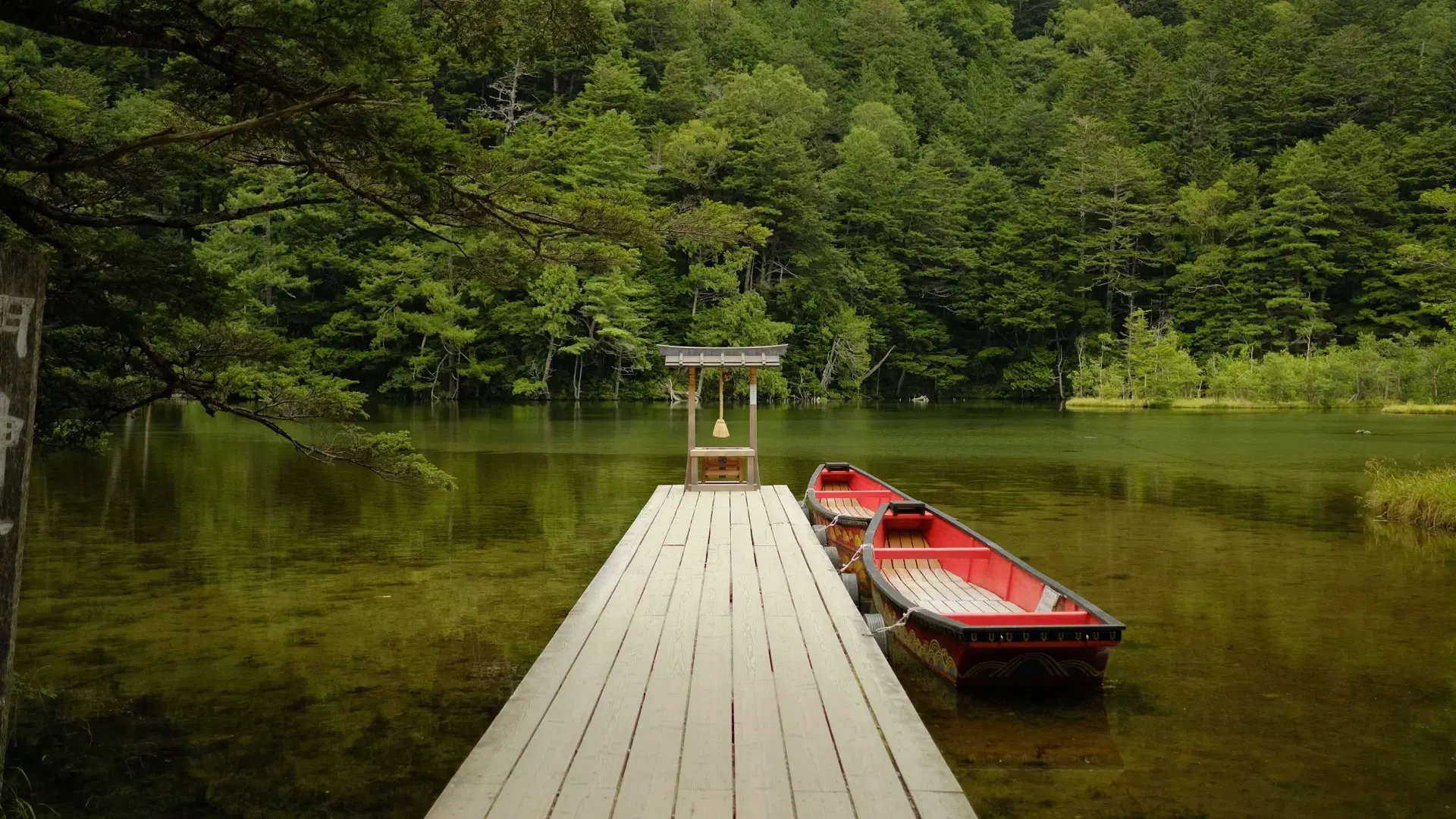
The Myojin Pond, reached by a riverside trail of approximately one hour from Kappa Bridge, occupies a forested setting at the base of Mount Myojin whose atmosphere of sacred quietude explains why a Shinto shrine has stood here for centuries. The pond's water, fed by underground springs, maintains a clarity that seems to purify the gaze itself, and the shrine's vermillion torii gate, reflected in the water against a backdrop of ancient forest and mountain, composes a scene that crystallizes the Japanese understanding of landscape as a place where the natural and the spiritual are indistinguishable.
Culinary Scene
Kamikochi's mountain lodges serve hearty meals designed to sustain hikers and restore those returning from the peaks. The cuisine is straightforward and generous, built around Shinshu ingredients: soba noodles, mountain vegetable tempura, Shinshu salmon, and rice cooked with the precision that altitude and clean water make possible. The dining rooms of the Kamikochi Imperial Hotel, established in 1933 as a log cabin-style lodge inspired by the mountain hotels of the European Alps, serve a more refined menu that bridges Western and Japanese cooking traditions, their wine lists featuring Nagano vintages alongside French and Italian selections.
The simplicity of the mountain table is part of the Kamikochi experience. Onigiri rice balls, thermos tea, and seasonal fruit carried in a pack and eaten at a riverside clearing or a mountain viewpoint, the food framed by the landscape rather than by a dining room, achieve a satisfaction that more elaborate meals cannot replicate. The lodges' evening meals, served communally in timber-framed dining halls warmed by woodstoves, create an atmosphere of alpine fellowship that recalls the mountain hut traditions of the European Alps, the shared table encouraging conversations among strangers united by the day's experiences in the mountains.
Ryokans in Nagano
There are no ryokans in our guide listed in Kamikochi. See our selection across Nagano.
View ryokans in Nagano