Bessho Onsen
別所温泉Bessho Onsen is the oldest hot spring in the Shinshu region, its thermal waters flowing from the eastern slopes of the mountains above the Ueda Basin for over a thousand years, and the village that grew around these springs has accumulated layers of religious, architectural, and cultural history that give it a depth unusual for a settlement of its modest size. The village is sometimes called "the Kamakura of Shinshu" for the concentration of Buddhist temples and Shinto shrines that were established here during the Kamakura period, when Bessho served as a center of religious authority in the region and attracted monks, scholars, and pilgrims whose presence elevated the hot spring village into a place of spiritual significance.
Three public bathhouses serve the village, each drawing from distinct source springs whose mineral compositions produce subtly different bathing experiences. Oyu, the principal bathhouse, occupies a position at the center of the village that echoes the soyu tradition of other Hokuriku onsen towns, its function as communal gathering place as important as its role as bathing facility. The architecture of the bathhouses, simple wooden structures that have been rebuilt on the same sites over centuries, maintains a scale and modesty that resist the temptation toward spectacle, understanding that the value of the experience lies in the water and the community that shares it rather than in the building that contains them.
The surrounding landscape of the Ueda Basin, with its terraced rice fields, apple orchards, and views across the valley to the volcanic cone of Mount Asama, provides a pastoral setting that enhances the village's atmosphere of retreat. Bessho is not remote in the way that mountain onsen villages can be, the railway connection to Ueda and the Shinkansen beyond placing it within easy reach of Tokyo, but it maintains a quality of unhurried intimacy that more famous hot spring destinations have traded for accessibility and scale.
Highlights
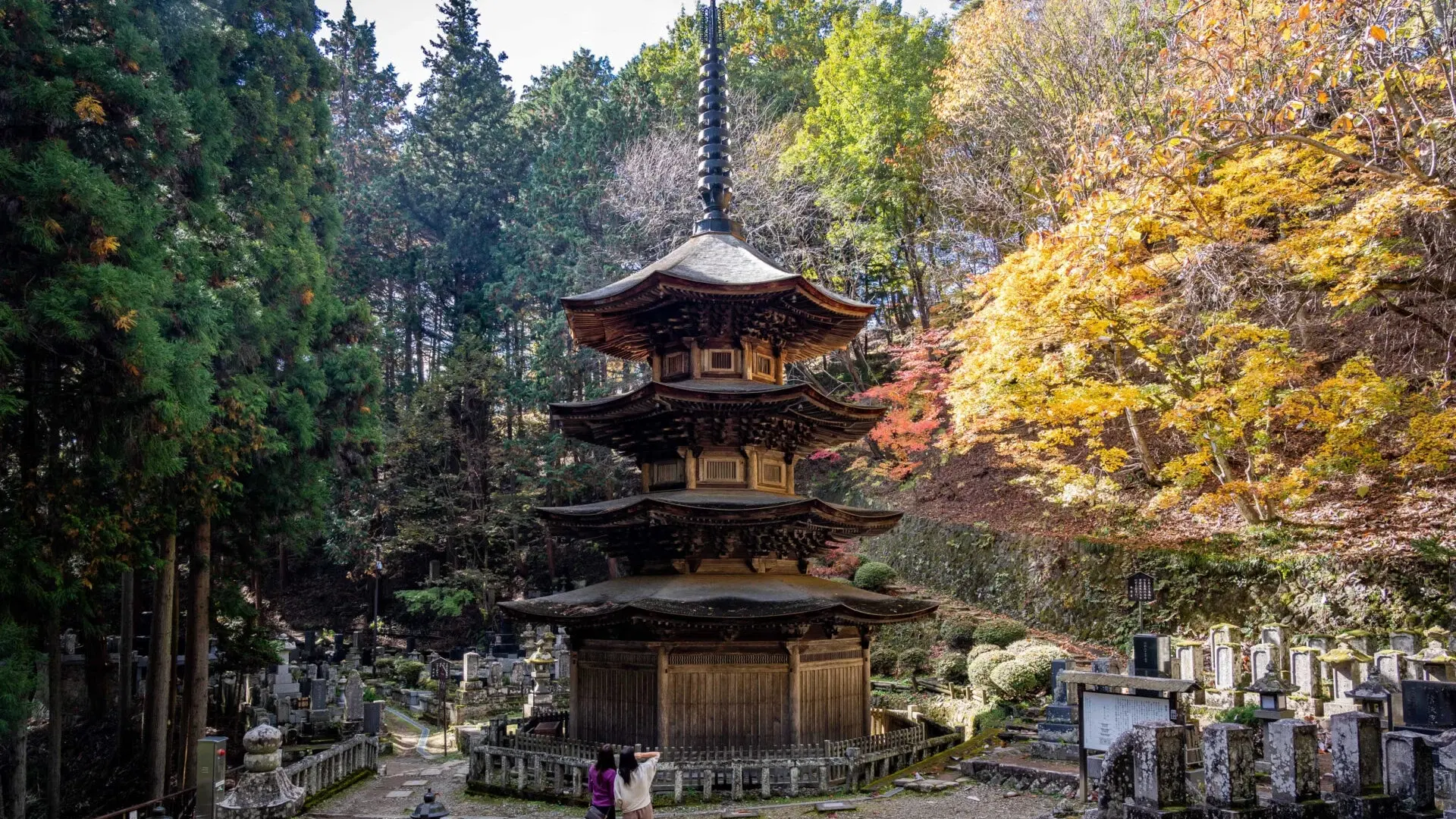
Anrakuji Temple, founded in the eighth century, houses a two-storied octagonal pagoda that is designated a National Treasure, the only structure of its kind in Japan. The pagoda's unusual form, an octagonal base supporting an octagonal upper story beneath a gently curving roof, reflects Chinese architectural influences that arrived in Japan during the Nara and early Heian periods and were preserved here while vanishing elsewhere. The building's modest scale, it stands barely ten meters tall, belies its architectural and historical significance, and the forest setting in which it stands, surrounded by ancient trees whose roots intertwine with the moss-covered stones of the temple grounds, creates an atmosphere of concentrated antiquity.
Kitamuki Kannon, a temple perched on a hillside overlooking the Ueda Basin, takes its name from its unusual northward orientation, facing toward the great temple of Zenkoji in Nagano City in a relationship of spiritual symmetry that the faithful of the Kamakura period established. The temple's veranda, projecting from the hillside above the village, provides a panoramic view of the basin and the mountains beyond that serves as both scenic lookout and meditation platform. The cherry blossoms that surround the temple in spring and the autumn foliage that flames across the hillside create seasonal frames for a view that has drawn pilgrims and travelers for eight centuries.
The three public bathhouses, Oyu, Daishi-yu, and Ishiyu, provide the most authentic onsen experience in the village. Each is a simple facility, a changing room and a single communal bath, maintained by the village cooperative and accessible for a nominal fee. The water temperatures are high, the bathing hours begin early in the morning, and the clientele is predominantly local, creating an experience of communal bathing that is intimate, unhurried, and free from the formality that characterizes the larger resort baths. Moving between the three bathhouses in an evening, comparing the subtle differences in water character and temperature, constitutes a micro-pilgrimage through the village's thermal geography.
Culinary Scene
Bessho Onsen's culinary character is shaped by the agriculture of the Ueda Basin and the mountain traditions of eastern Nagano. Shinshu soba, made from buckwheat grown in the surrounding highlands, is the essential dish, served in the village's soba restaurants with the seriousness and simplicity that the Nagano noodle tradition demands. The dipping sauce tends toward the dark, strongly flavored style of eastern Nagano, a contrast to the lighter preparations found in the western part of the prefecture, and the noodles themselves carry the robust, slightly coarse texture that hand-cutting and local grain produce.
The ryokan of Bessho serve kaiseki dinners built from the basin's seasonal produce: spring brings sansai mountain vegetables and bamboo shoots; summer offers river fish and the first of the stone fruits from the Ueda orchards; autumn brings matsutake mushrooms, chestnuts, and the apple varieties for which the region is famous; winter provides root vegetables, preserved pickles, and the warming preparations that cold weather demands. The meals are not elaborate by the standards of the coastal regions, but their honesty and their connection to the immediately surrounding landscape give them a groundedness that more ambitious menus sometimes lack.
Oyaki, the stuffed dumplings that are Nagano's most distinctive everyday food, are available from several shops in the village, their fillings rotating with the seasons through nozawana pickles, wild mushrooms, pumpkin, and red bean paste. The dumplings, grilled or steamed until their wheat flour shells achieve a chewy resilience, provide a portable, satisfying meal that bridges the gap between snack and sustenance.
Ryokans in Nagano
There are no ryokans in our guide listed in Bessho Onsen. See our selection across Nagano.
View ryokans in Nagano