Arashiyama
嵐山Arashiyama is the place where Kyoto meets the wild. Situated at the western edge of the city, where the Hozu River emerges from a gorge in the forested mountains, this district has served as the retreat of emperors, aristocrats, and artists for more than a thousand years, its combination of river, mountain, and bamboo creating a landscape of such concentrated beauty that it has become inseparable from the Japanese idea of nature refined by human attention. The Togetsukyo Bridge, spanning the river in a low, elegant arc that mirrors the curve of the mountains behind it, provides the iconic image of Arashiyama, but the district's true character reveals itself in the quieter reaches above and beyond the bridge: the bamboo grove whose towering culms create a green cathedral of light and silence, the moss garden of Gio-ji whose emerald carpet absorbs both sound and time, the villa of Okochi Sanso whose gardens compose the distant mountains into views of cinematic perfection.
The literary and artistic associations of Arashiyama are so dense that walking through the district is like moving through the pages of a thousand years of Japanese culture. The Heian aristocrats built their villas here to escape the heat and politics of the capital, and their poetry, filled with references to the river, the cherry blossoms, the autumn maples, and the monkeys on the mountainside, established the aesthetic vocabulary through which Arashiyama is still understood. Tenryu-ji, the great Rinzai Zen temple that dominates the central district, was built in the fourteenth century on the site of an imperial villa, and its garden, designed by the legendary Muso Soseki, borrows the mountains behind it as part of its composition, erasing the boundary between the made and the natural in a gesture that defines the Japanese garden tradition.
The seasonal transformations of Arashiyama are among the most dramatic in Kyoto. The cherry blossoms of spring, reflected in the river beneath the Togetsukyo Bridge, create compositions that have been painted, photographed, and described in literature for centuries without exhausting their capacity to astonish. The autumn foliage, when the maples on the mountainsides ignite in gradients of red, orange, and gold that descend from the peaks to the river's edge, produces a landscape of chromatic intensity that challenges the viewer's ability to absorb it. Even in winter, when the bare branches and occasional snow reveal the structural beauty of the mountains and the bamboo grove acquires the silence of a monastic cloister, Arashiyama offers an experience of natural beauty that justifies the journey.
Arashiyama is the place where Kyoto meets the wild.
Highlights
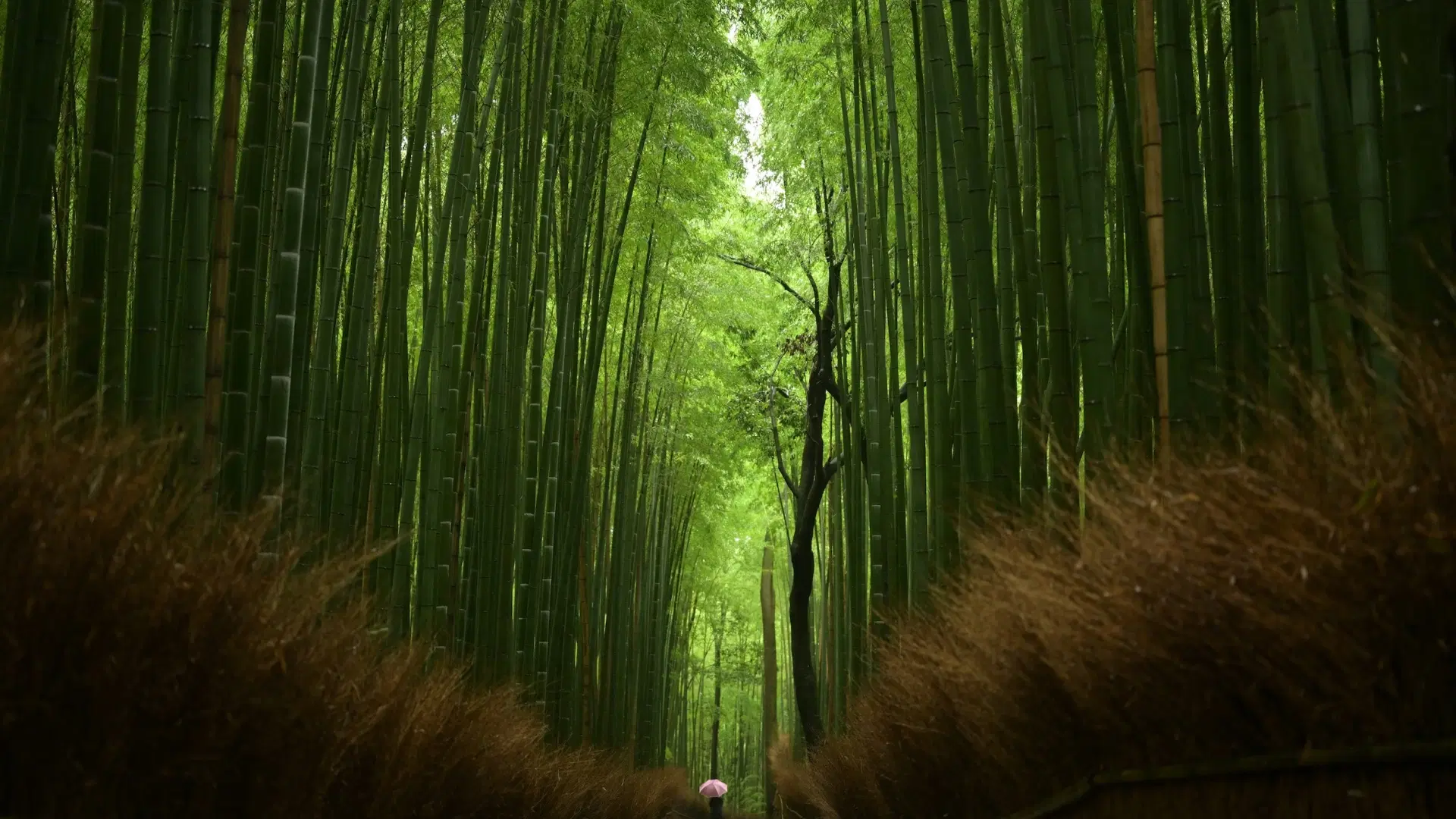
The Arashiyama Bamboo Grove is one of the most extraordinary natural environments in Japan, a corridor of towering moso bamboo whose culms rise to heights of twenty meters and more, their green surfaces filtering the sunlight into a luminous, shifting glow that transforms the path below into something from a world that operates by different physical laws. The sound of the grove is as remarkable as the sight: the creaking of the culms against each other in the wind, a sound that has been designated as one of the hundred soundscapes of Japan, produces a music that is at once organic and otherworldly. Walking the grove in the early morning, before the crowds arrive, when the light is still low and the bamboo's shadow patterns are longest, is an experience of sensory immersion that operates on the consciousness with a directness that temple gardens, for all their refinement, cannot match.
Tenryu-ji, ranked first among Kyoto's five great Zen temples, anchors the cultural landscape of Arashiyama with a compound of halls, gardens, and sub-temples that reward sustained exploration. The Sogenchi garden, a pond garden designed by Muso Soseki in the fourteenth century and designated as both a Special Place of Scenic Beauty and a Historic Site, uses the mountains behind the temple as shakkei, borrowed scenery, incorporating them into the garden's composition so seamlessly that the boundary between art and nature dissolves. The garden's rock arrangements, representing waterfalls and islands in the Buddhist cosmological landscape, achieve a balance between dynamism and stillness that centuries of viewing have not diminished.
Okochi Sanso, the villa and gardens of the silent film actor Okochi Denjiro, occupies a hilltop above the bamboo grove and commands views that stretch from Arashiyama's mountains to the distant skyline of Kyoto. The gardens, designed over thirty years by Okochi himself, are a masterwork of the stroll garden tradition, their paths winding through compositions of moss, maple, cherry, and pine that frame the views with a cinematic sensibility that reflects their creator's profession. The villa's tea room, where visitors are served matcha and wagashi while gazing across the garden to the mountains, provides one of the most perfectly composed moments of rest in a city that specializes in them.
Culinary Scene
Arashiyama's culinary tradition draws on the river, the mountain, and the temple kitchen, producing a table that ranges from the refined vegetarianism of shojin ryori to the robust pleasures of grilled river fish. The tofu cuisine of the district, shaped by the proximity to Tenryu-ji and the other Zen temples, reaches its highest expression in the yudofu restaurants that serve hot tofu in simple kombu-enriched water, the silken texture and subtle sweetness of the soy product the sole focus of preparations that celebrate the ingredient by doing almost nothing to it. The experience of eating yudofu in a tatami room overlooking a garden, dipping each trembling piece in ponzu or sesame sauce, is one of the most meditative dining experiences available in Kyoto.
The Hozu River provides ayu in summer and other freshwater fish in season, and the mountain slopes behind the district yield bamboo shoots in spring and matsutake mushrooms in autumn, both of which appear in the kaiseki courses of the local ryokans and restaurants. The bamboo shoot, taken from the same species that forms the famous grove and prepared within hours of harvest, possesses a sweetness and tenderness that commercially distributed bamboo shoot cannot approach, and the spring menus built around this ingredient, grilled, simmered in dashi, or prepared as tempura, demonstrate the Kyoto principle that the finest cuisine begins with the most precisely timed ingredients.
The traditional sweets of the Arashiyama district reflect the area's association with natural beauty and seasonal change. The cherry blossom mochi of spring, the maple leaf confections of autumn, and the matcha-flavored treats that accompany tea throughout the year are crafted by shops that have served the visitors and residents of this district for generations, their products carrying the specific flavors and forms that distinguish Arashiyama's confectionery tradition from the broader wagashi culture of central Kyoto.
Ryokans in Kyoto
There are no ryokans in our guide listed in Arashiyama. See our selection across Kyoto.
View ryokans in Kyoto