Amanohashidate
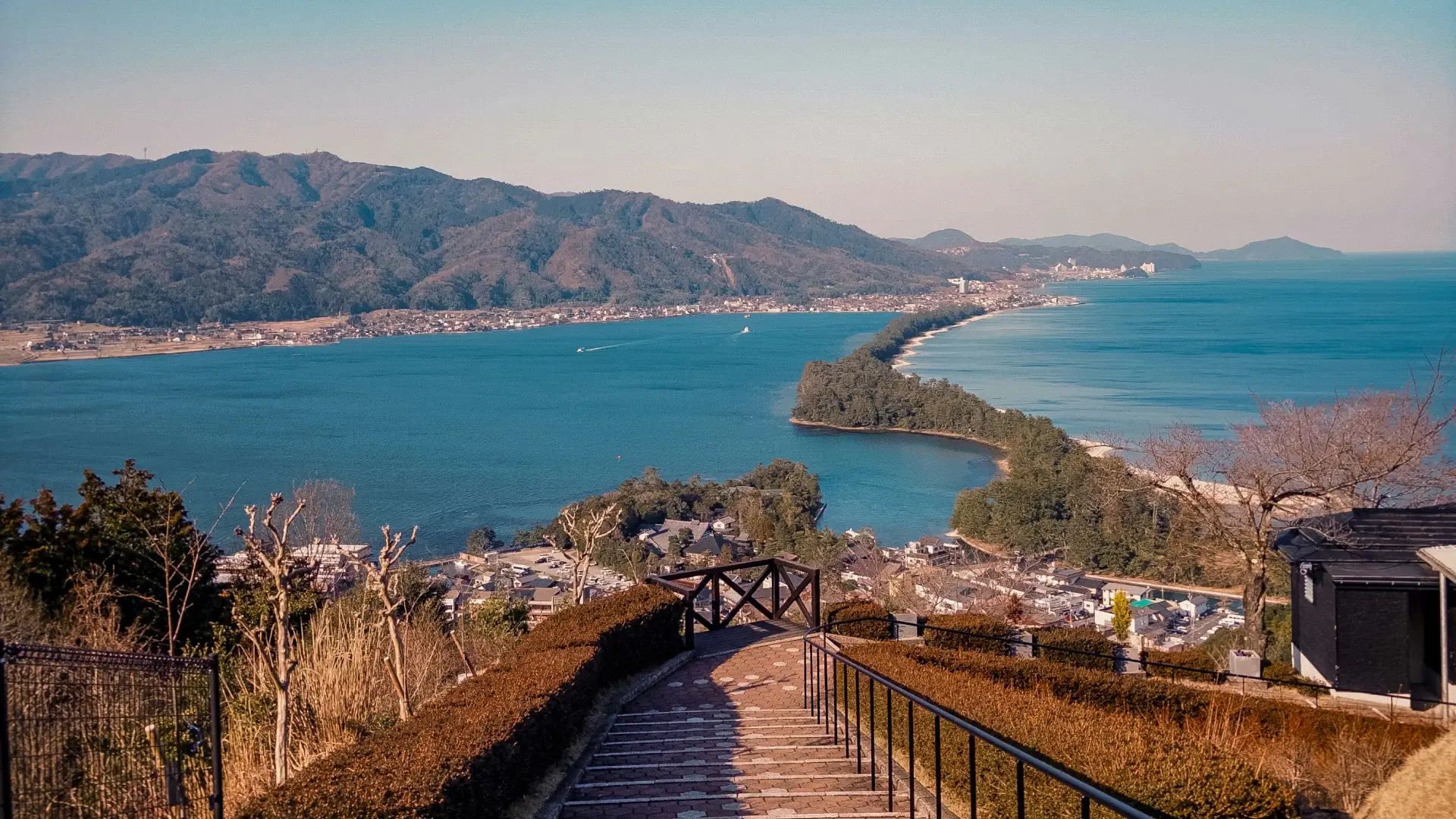
天橋立Amanohashidate is one of the three most celebrated scenic views in Japan, a natural sandbar that stretches for nearly four kilometers across Miyazu Bay on the Sea of Japan coast of Kyoto Prefecture, its pine-covered form creating a bridge between two shores that has been the subject of poetry, painting, and pilgrimage since the earliest centuries of Japanese literary culture. The name means "bridge of heaven," and the tradition of viewing the sandbar upside down, bending at the waist and looking between one's legs from the elevated viewpoints on either end, transforms the pine-covered spit into a celestial bridge ascending into the sky, the water below becoming the heavens and the heavens above becoming the sea in a perceptual inversion that the Japanese have found irresistible for a thousand years.
The sandbar itself is a geological phenomenon of delicate beauty, a narrow strip of white sand planted with more than five thousand pine trees whose twisted forms, shaped by the sea wind, create a corridor of green that floats between the blue of the bay and the blue of the sky. Walking or cycling along the sandbar, with the water visible through the pine trunks on both sides and the mountains rising at either end, produces a sensation of being suspended between elements, neither quite on land nor quite at sea, that captures the liminal quality that the name "bridge of heaven" implies.
The surrounding Tango Peninsula, one of the most beautiful and least visited coastal regions in the Kansai area, provides the context for Amanohashidate's singular beauty. The Sea of Japan coast here is dramatic and varied, its rocky headlands, hidden beaches, and fishing villages maintaining a relationship with the ocean that the Pacific coast, more urbanized and more accessible, has largely lost. The region's cuisine, built on the extraordinary crab, yellowtail, and oyster harvests of the winter sea, gives travelers from the south a compelling reason to cross the mountains and discover a Kyoto Prefecture that bears no resemblance to the temples and tea houses of the capital.
Highlights
The two elevated viewpoints at either end of the sandbar offer complementary perspectives on Amanohashidate's celebrated form. The Kasamatsu Park viewpoint on the northern side, reached by chairlift or cable car, provides the classic view from which the sandbar, seen through one's legs, appears to rise into the sky. The southern viewpoint at Amanohashidate View Land, accessible by chairlift or monorail, offers a broader panorama that places the sandbar in the context of Miyazu Bay and the mountains of the Tango Peninsula. Both viewpoints are beautiful, and visiting both, with the walk or cycle across the sandbar connecting them, provides a complete encounter with the landscape that justifies the journey.
Chion-ji, the temple at the southern base of the sandbar, is the starting point for the crossing and a cultural destination in its own right. The temple, dedicated to Monju Bosatsu, the bodhisattva of wisdom, is one of the three great Monju temples of Japan, and its connection to learning and intelligence has made it a pilgrimage destination for students and scholars for centuries. The temple's setting, with the sandbar stretching away from its grounds into the blue distance, provides a frame for the crossing that elevates a pleasant walk into something approaching pilgrimage.
The fishing villages of the Ine Bay area, accessible by bus or car from Amanohashidate, preserve one of the most distinctive coastal landscapes in Japan. The funaya, boat houses built directly over the water so that fishing boats can be stored beneath the living quarters, line the bay in a continuous row of more than two hundred structures, their weathered timber facades and tiled roofs creating a waterfront of quiet, functional beauty. The bay, protected and calm, reflects the funaya in its still surface, and the effect, particularly in the soft light of early morning or late afternoon, is of a settlement that exists as much in the water as above it.
Culinary Scene
The Sea of Japan coast delivers to Amanohashidate a winter harvest of extraordinary richness. The matsuba-gani, the male snow crab of the Tango coast, is one of the most prized crustaceans in Japanese cuisine, its long legs yielding sweet, delicate meat that is served as sashimi, grilled with salt, or steamed in preparations that honor the catch with minimal intervention. The crab season, from November through March, transforms the region's ryokans and restaurants into destinations for gastronomes who make the journey across the mountains specifically for the quality of the local catch. The kaiseki courses built around a single crab, its legs, body, and roe presented in a progression of preparations that explores the full range of the ingredient, represent some of the finest seasonal dining in the Kansai region.
Buri, the winter yellowtail that fattens in the cold Sea of Japan, arrives at the tables of Amanohashidate with an oily richness that sashimi and grilling alike do justice to. The oysters of Miyazu Bay, cultivated in the nutrient-rich waters where river and sea meet, achieve a plumpness and brininess that reflects their protected growing environment. In summer, the iwagaki rock oyster, harvested from the coastal shallows, provides a seasonal counterpart to the winter harvest, its creamy, mineral-rich flesh a reminder that the sea provides generously in all seasons.
The local sake of the Tango region, brewed with soft water from the mountain streams that feed into Miyazu Bay, accompanies these marine flavors with a clean, slightly sweet character that complements rather than competes with the delicacy of the seafood. The small breweries of the region, producing in quantities that rarely reach the Kyoto shops, offer a drinking experience of genuine locality, each cup tasting of the specific water and rice and climate that produced it.
Ryokans in Kyoto
There are no ryokans in our guide listed in Amanohashidate. See our selection across Kyoto.
View ryokans in Kyoto