Kawagoe
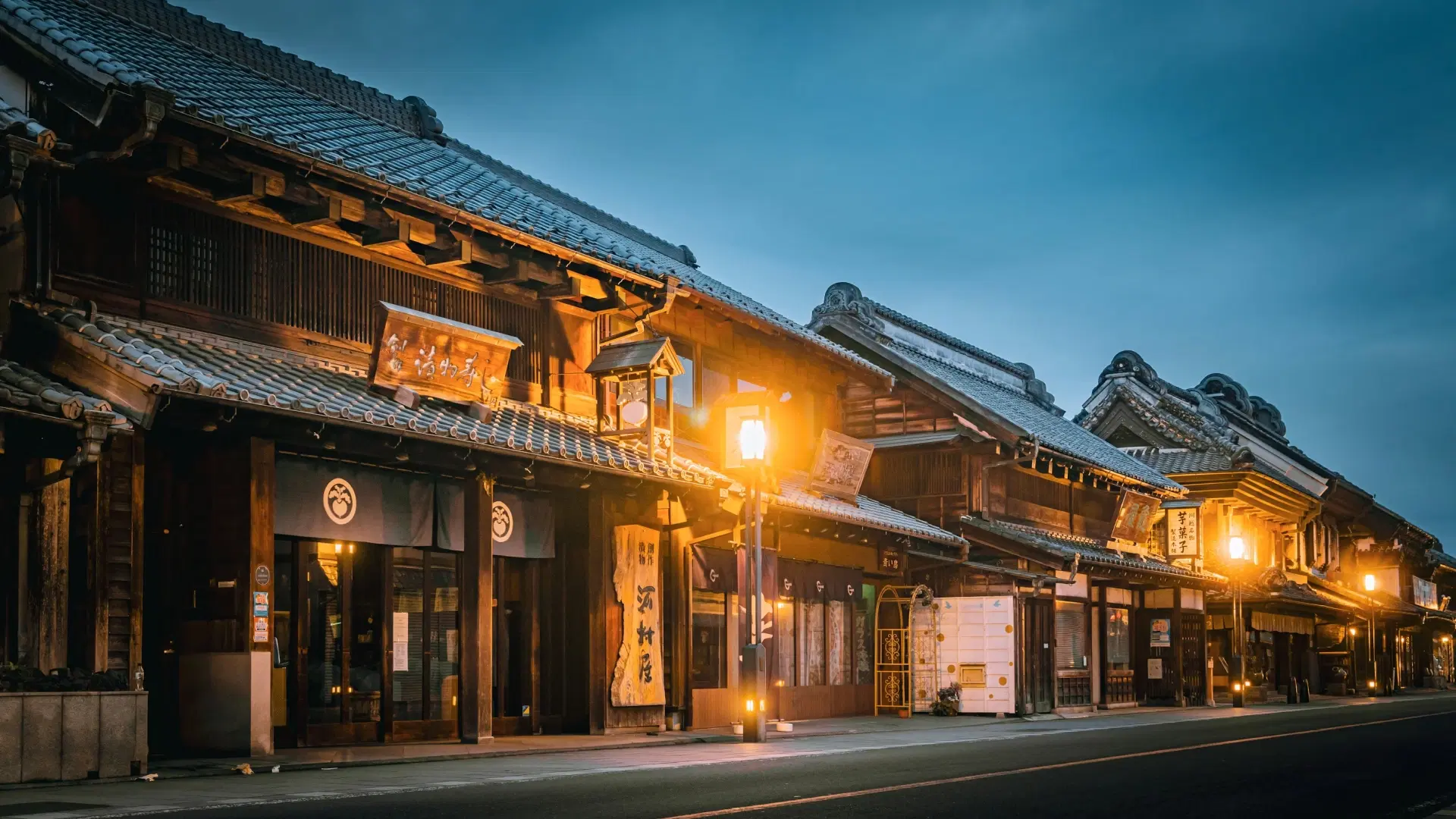
川越Kawagoe is the Kanto region's most convincing time capsule. Known as Koedo, Little Edo, this city thirty minutes north of Ikebukuro preserves a streetscape of kurazukuri merchant warehouses that once defined the commercial architecture of the Tokugawa capital. The great fire of 1893 destroyed much of Kawagoe, and the merchants who rebuilt chose the fire-resistant kurazukuri style, dark clay walls of extraordinary thickness that had proven their worth in Edo. Ironically, this response to disaster preserved an architectural form that Edo itself, through subsequent fires, earthquakes, and twentieth-century redevelopment, would almost entirely lose.
The result is a main avenue that feels like a physical memory of a vanished Tokyo. The two-story warehouses, their dark facades unbroken by modern signage, create a corridor of solemn commercial beauty. Above them, the Toki no Kane bell tower, rebuilt multiple times but structurally faithful to its seventeenth-century form, still rings four times daily, its sound carrying over the tiled rooftops with an authority that no digital recording can reproduce.
Beyond the warehouse district, Kawagoe reveals additional layers. Kashiya Yokocho, the candy alley, preserves a Taisho-era lane of confectioners selling handmade sweets from another age. Kita-in temple, with its remarkable collection of 540 stone rakan statues, each with a unique expression, and the only surviving structure from Edo Castle's interior, adds spiritual and historical depth to what might otherwise be a merely picturesque experience.
Kawagoe is the Kanto region's most convincing time capsule.
Highlights
The kurazukuri street is best experienced early in the morning, before the crowds arrive and when the low light emphasizes the texture of the clay walls. The Kurazukuri Museum, housed in an actual warehouse, allows visitors to explore the interior architecture and understand the construction techniques that made these buildings resistant to fire. The Toki no Kane tower, located on a side street off the main avenue, is Kawagoe's most photographed landmark, and the bells at 6:00, 12:00, 15:00, and 18:00 provide natural punctuation to a day's visit.
Kashiya Yokocho is a narrow lane where approximately twenty candy shops produce traditional confections: giant lollipops, senbei rice crackers, penny candies in glass jars, and sweet potato treats in every conceivable form. The atmosphere is nostalgic without being forced, and the proprietors, many second or third generation, take visible pride in their craft.
Kita-in's 540 rakan statues, carved in the early nineteenth century, offer an exercise in contemplation: tradition holds that if you search among them, you will find one whose expression matches your own. The temple also contains rooms transported from Edo Castle, including the chamber where the third shogun, Tokugawa Iemitsu, was born, the only surviving interior from the castle complex.
Culinary Scene
Sweet potato is Kawagoe's culinary identity, a heritage that dates to the Edo period when the city supplied satsumaimo to the capital via river barge. Today, sweet potato appears in every form: imo yokan, the smooth, jellied confection; imo chips, crisp and lightly salted; imo soft-serve ice cream; and imo beer, brewed with local sweet potatoes. The best imo confections are found along Kashiya Yokocho and the kurazukuri street, where shops have refined their recipes over generations.
Beyond sweet potato, Kawagoe's unagi restaurants serve grilled eel in the traditional Kanto style, kabayaki split along the back and steamed before grilling, a preparation that produces flesh of extraordinary softness. The city's proximity to the agricultural heartland of Saitama ensures excellent seasonal vegetables, and several restaurants along the warehouse district serve refined Japanese cuisine that draws on these local ingredients.
Ryokans in Saitama
There are no ryokans in our guide listed in Kawagoe. See our selection across Saitama.
View ryokans in Saitama