Akiu
秋保Akiu is the onsen retreat that belongs to Sendai. Tucked into the Natori River valley barely thirty minutes from the city center, this hot spring district has served as the bathing ground for the capital of Tohoku since at least the sixth century, when Emperor Kinmei is said to have cured a skin ailment by immersing himself in the local waters. The designation as one of Japan's three "Imperial Waters," alongside Arima in Hyogo and Dogo in Ehime, speaks to a pedigree that few onsen in the country can equal. Date Masamune, ever the connoisseur, maintained a bathing residence here, and the springs have supplied the region's lords and merchants with restorative soaking for fourteen centuries.
The setting amplifies the therapeutic effect. The Natori River, emerging from the mountains to the west, has carved a gorge through volcanic rock that the town's ryokan perch above, their windows opening onto cliffs fringed with Japanese maple, oak, and cedar. Akiu Great Falls, a 55-meter cascade designated as one of Japan's Top 100 Waterfalls, anchors the valley's western end with a spectacle of falling water that shifts character with the seasons: a thundering curtain of snowmelt in spring, a serene veil framed by green in summer, a dramatic centerpiece surrounded by blazing autumn color. The gorge, known as Rairai-kyo, translates roughly as "the place of magnetic beauty," a name that suggests the landscape's pull has been felt and acknowledged for centuries.
Unlike the more remote onsen settlements of the Tohoku interior, Akiu offers the particular luxury of proximity. Business travelers from Sendai arrive for a single night of restoration. Wedding parties celebrate in the grand halls of the larger ryokan. Yet the valley has resisted the over-commercialization that proximity to a major city sometimes invites. The scale remains intimate, the forest encroaches closely, and the sound of the river pervades even the most polished interiors.
Akiu is the onsen retreat that belongs to Sendai.
Highlights
Akiu Great Falls demands the first visit. The approach trail descends through forest to an observation platform where the full height of the cascade reveals itself, the water dropping in a single unbroken sheet over a basalt lip worn smooth by millennia of erosion. The pool at the base churns with a force that sends mist across the viewing area, a natural air conditioning in summer and a crystalline spectacle when the surrounding trees turn in October. A secondary path climbs to a viewpoint above the falls, offering a perspective that reveals the river's course through the forested valley beyond.
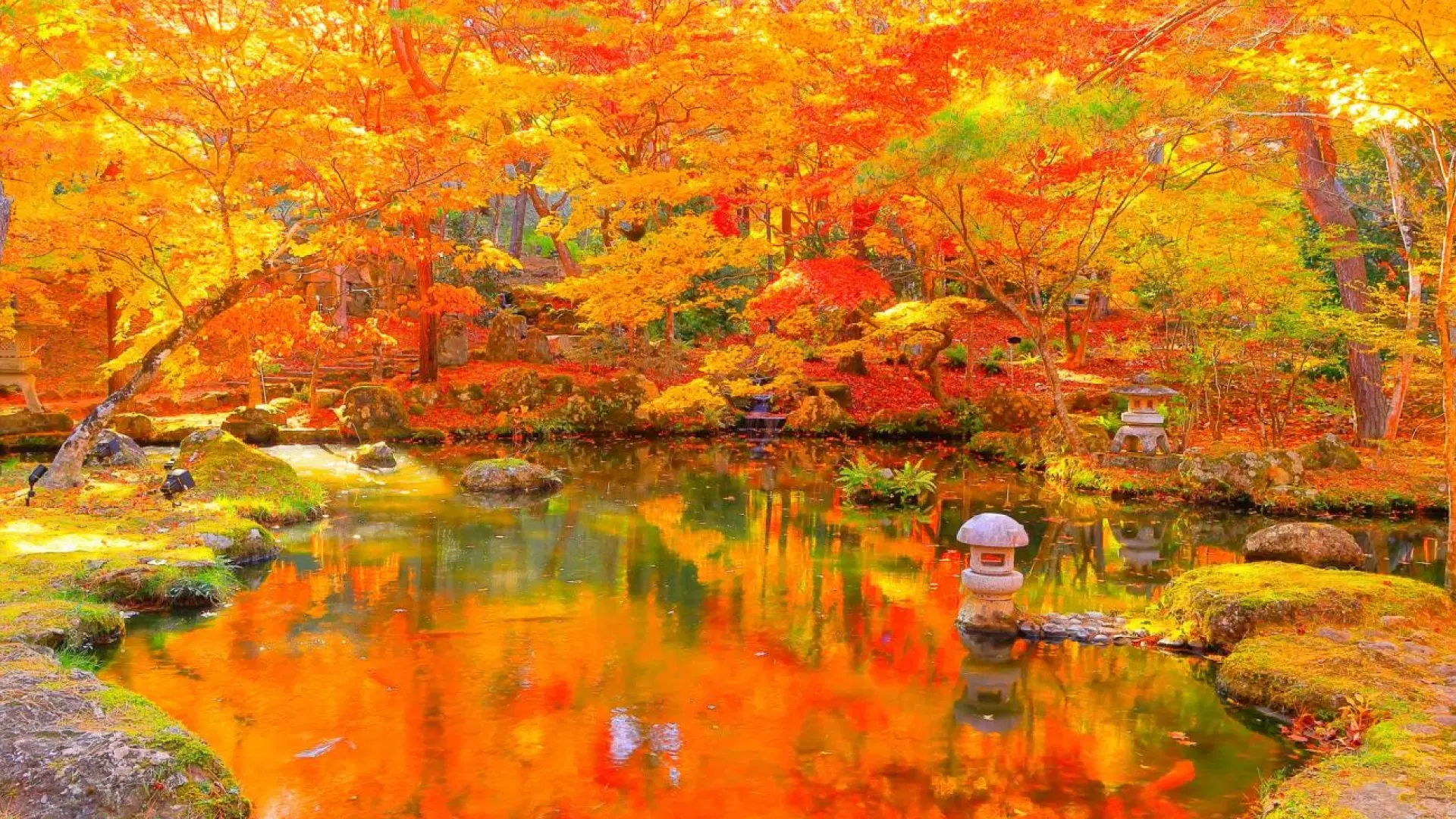
Rairai-kyo Gorge, accessible from the town center, provides a walking experience that compresses the beauty of the valley into a single trail. The river has sculpted the volcanic rock into potholes, channels, and smooth shelves over which the water flows in patterns that shift with rainfall and season. In autumn, the maples that overhang the gorge create a canopy of red and gold reflected in the dark water below, a scene that has been reproduced in countless photographs and paintings yet retains its capacity to astonish in person.
The Akiu Craft Village, Akiu Kogei no Sato, gathers traditional artisans into a single campus where visitors can observe and practice kokeshi carving, indigo dyeing, Sendai tansu furniture making, and other regional crafts. The village functions as a living workshop rather than a museum, its studios producing work for sale while offering demonstrations and hands-on experiences that connect visitors to the material culture of the Tohoku region. The adjacent Saito Hideo Museum of Art, a small but carefully curated collection, displays traditional and contemporary craft alongside the natural beauty visible through its windows.
Culinary Scene
Akiu's ryokan kitchens benefit from the dual harvest of mountain and coast. The proximity to both the Ou Mountains and the Sanriku fishing ports means that kaiseki dinners here can pair wild mountain vegetables and freshwater fish with ocean sashimi and shellfish in combinations unavailable to more isolated onsen towns. Spring menus feature sansai tempura alongside Sanriku uni. Autumn brings matsutake from the surrounding forests alongside Pacific saury grilled to crackling perfection. The Natori River itself yields ayu in summer, served salt-grilled with the bitter innards intact, a preparation that the Japanese regard as the purest expression of the fish.
The town's most distinctive local product is Akiu tofu, a firm, dense preparation made with the mineral-rich water of the valley. Served chilled with ginger and soy in summer or simmered in nabe in winter, the tofu's slightly sweet, concentrated flavor reflects the quality of the spring water from which it is made. Several ryokan incorporate this tofu into their kaiseki sequences, and a small producer in the town center sells it fresh daily. Local wineries have begun to establish a presence in the broader Sendai hills, producing vintages that pair unexpectedly well with the region's seafood-forward cuisine.
Ryokans in Miyagi
There are no ryokans in our guide listed in Akiu. See our selection across Miyagi.
View ryokans in Miyagi