Kurokawa Onsen Yunakuri
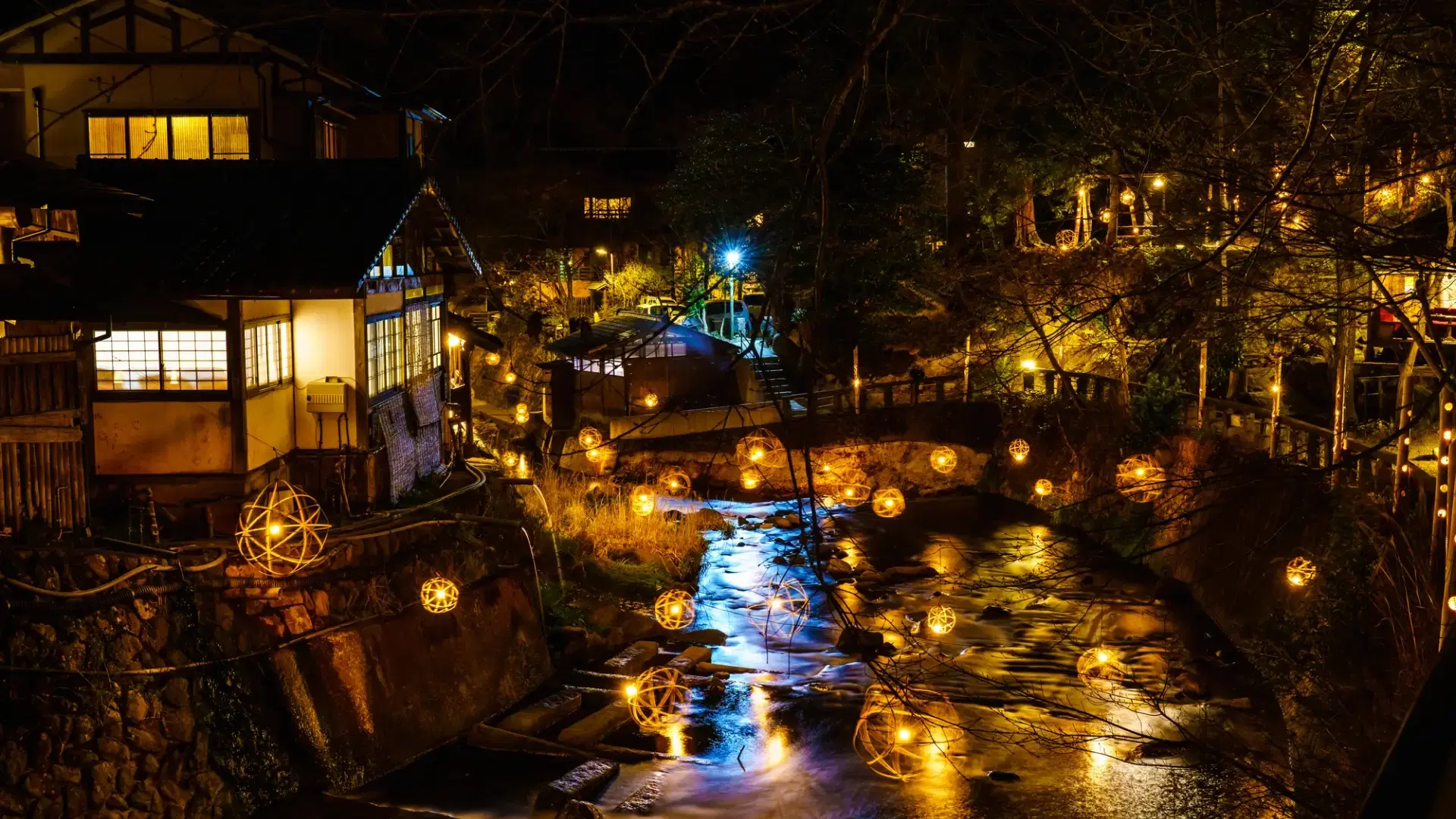
黒川温泉湯あかりThe Kurokawa Onsen Yunakuri is an illumination that understands its landscape. Where most Japanese winter light festivals deploy LED technology in displays that overwhelm the darkness with artificial brilliance, the Yunakuri uses handmade bamboo lanterns and the natural forms of the Tanohara River valley to create an illumination that enhances rather than competes with the onsen village's already extraordinary atmosphere. The lanterns, constructed from locally harvested bamboo and lit by candles whose warm, flickering glow is fundamentally different from the cold precision of electric light, are placed along the river and at key points throughout the village, transforming the winter evening into a landscape of warmth and intimacy that deepens the bathing experience into something approaching the transcendent.
The Yunakuri is the material expression of the philosophy that has made Kurokawa one of Japan's most admired onsen destinations: the conviction that beauty is achieved not by addition but by harmony, not by imposing spectacle upon a landscape but by revealing the beauty already present within it. The bamboo lanterns do not illuminate the village so much as they make visible the relationships between water, stone, wood, and darkness that define Kurokawa's character in every season. The river, whose sound is the constant accompaniment to village life, becomes visible in the candlelight as a ribbon of reflected flame. The ryokan facades, dark wood and stone that disappear into the night without illumination, emerge from the shadows in the lanterns' amber glow with a warmth that seems to emanate from the buildings themselves.
The installation is conceived as a single work, a landscape-scale composition in which each lantern is placed with attention to its relationship with every other, with the river, with the bridges, and with the natural features of the valley. The effect is cumulative: individual lanterns are modest, but their collective presence transforms the village into an environment whose beauty is both simple and overwhelming, the kind of beauty that Japanese aesthetics describes with the term yugen, the profound sense of the universe's beauty that lies beyond what can be directly expressed.
The Kurokawa Onsen Yunakuri is an illumination that understands its landscape.
History & Significance
The Yunakuri was conceived in 2012 as a winter event that would extend Kurokawa's appeal into the cooler months, when the shorter days and lower temperatures traditionally reduced visitor numbers. The initiative emerged from the same cooperative spirit that had transformed the village's physical environment in the preceding decades: just as the ryokan owners had collectively agreed to replace concrete with wood and neon with nature, they now agreed to create a winter illumination that would embody the village's aesthetic values rather than contradicting them.
The choice of bamboo lanterns was deliberate and philosophically grounded. Bamboo grows abundantly in the forests surrounding Kurokawa, and its use connects the illumination to the landscape from which it emerges. The handmade construction of each lantern, undertaken by community members and volunteers, gives the installation a human presence that mass-produced lighting cannot achieve. And the use of candles rather than electric light, a decision that requires daily maintenance and limits the illumination to the hours of darkness, ensures that the Yunakuri remains an event of finite, precious duration rather than a permanent fixture that would inevitably become invisible through familiarity.
The Yunakuri's success has been both commercial and cultural. The winter months, once the village's quietest period, have become among its most popular, and the illumination has been widely cited as a model for sustainable, landscape-sensitive tourism promotion. The annual repetition of the installation, with subtle variations in placement and design, has given the village a winter identity as distinctive as its autumn foliage or its summer greenery.
What to Expect
The illumination is installed along the Tanohara River and at selected points throughout the village, creating a walking route that connects the major viewing areas in a circuit of approximately thirty to forty-five minutes. The lanterns take two primary forms: individual cylindrical lanterns placed on the river's banks and at intervals along the walking paths, and clusters of small spherical lanterns suspended above the river itself, their reflections in the water creating the effect of floating pools of light. The combination of the two forms, the vertical cylinders standing like sentinels and the suspended spheres hovering above the water, creates a spatial composition of considerable beauty.
The experience is best absorbed at a slow pace, pausing at each viewing point to allow the eyes to adjust to the candlelight and the subtle variations of warmth and shadow to register fully. The sound of the river, always present, provides the acoustic element that the visual installation does not provide, and the combination of moving water, flickering light, and the cold mountain air creates a multisensory experience that is uniquely Kurokawa. The bridges that cross the river at several points along the route provide the most concentrated viewing positions, the lanterns visible in both directions and the reflections doubling the display in the dark water below.
The integration of the illumination with the bathing experience is essential to the full Yunakuri encounter. Many visitors follow a pattern of bathing in one of the village's rotenburo, walking the illuminated riverside path in their yukata, and returning to a second bath, the warmth of the water alternating with the cold night air in a rhythm that is simultaneously physical and aesthetic. The ryokans' evening kaiseki, served by candlelight in rooms that look out onto the illuminated village, completes the experience with a culinary dimension that matches the visual.