Amakusa
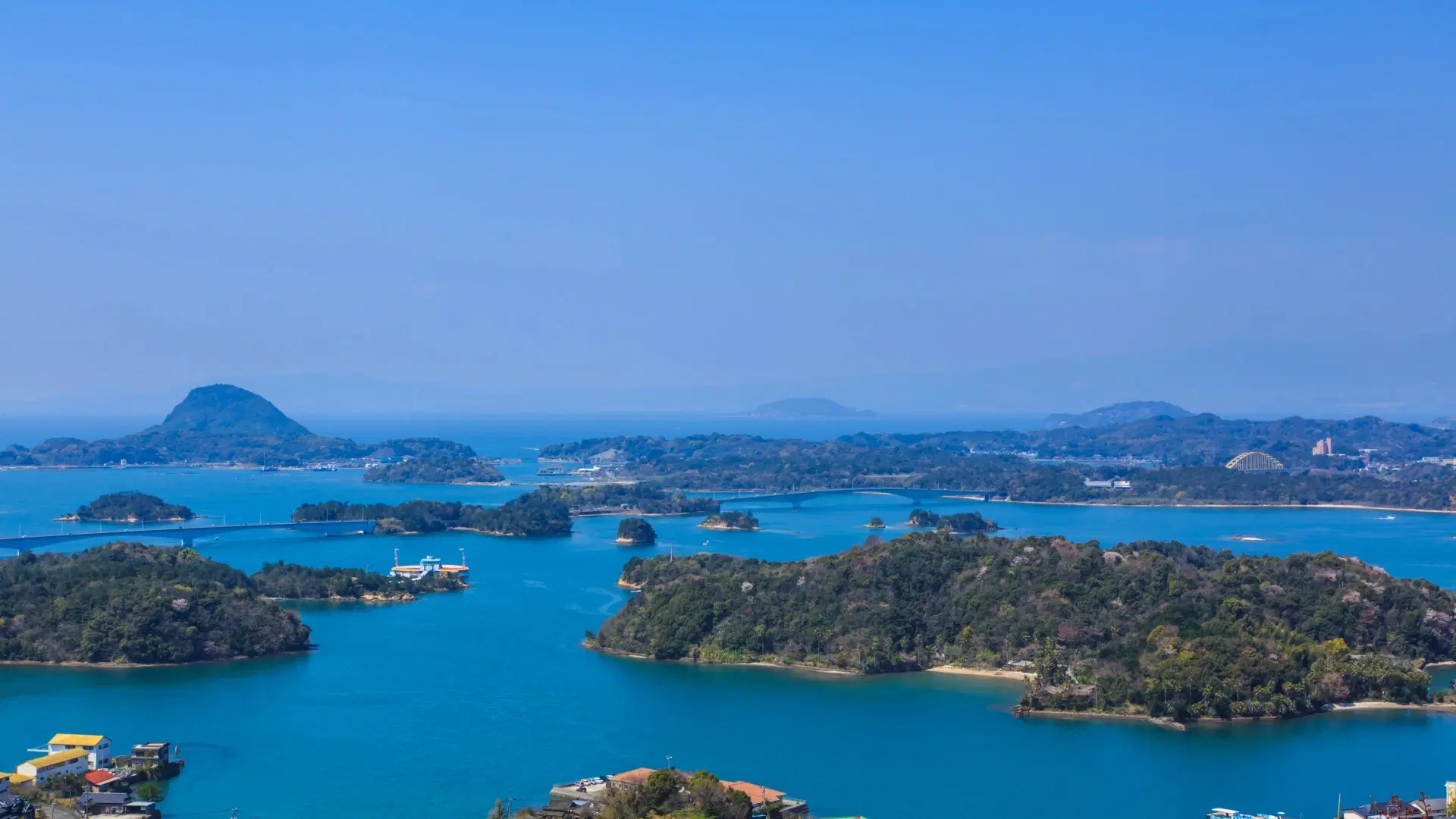
天草Amakusa is an archipelago of over 120 islands that stretches from the western coast of Kumamoto into the waters where the Ariake Sea, the Yatsushiro Sea, and the East China Sea converge. The landscape is one of forested hills, terraced slopes, and a coastline so convoluted that every turn of the road reveals a new inlet, a new island, a new composition of sea, land, and sky. The five bridges that connect the main islands to the Kumamoto mainland, collectively known as the Amakusa Gokyo, traverse passages of open water with a sweeping architectural grace that announces the visitor's passage from the terrestrial world to the maritime, from the familiar patterns of mainland life to the distinct rhythms of island existence.
Amakusa's history is dominated by two narratives that intertwine across four centuries. The first is the story of Christianity in Japan, which took root here with particular depth following the arrival of Portuguese missionaries in the sixteenth century. The second is the story of the Shimabara-Amakusa Rebellion of 1637-1638, the desperate Christian uprising against Tokugawa persecution that ended with the slaughter of approximately 37,000 rebels and civilians at Hara Castle and the near-total suppression of the faith. The Hidden Christians of Amakusa, like their counterparts on the Goto Islands and in the Nagasaki region, maintained their beliefs in secret for over two hundred years, and the churches, museums, and memorial sites that dot the islands today bear witness to a faith whose persistence under persecution remains one of the most remarkable chapters in Japanese religious history.
Beyond its historical gravity, Amakusa is a place of sensory abundance. The waters surrounding the islands support dolphin populations that can be observed year-round, the fishing industry produces some of the finest seafood in Kyushu, and the sunsets over the East China Sea, watched from the western shores as the sun descends toward the horizon of open water, achieve a drama of color and light that justifies the journey even for visitors whose interest in history is limited.
Amakusa is an archipelago of over 120 islands that stretches from the western coast of Kumamoto into the waters where the Ariake Sea, the Yatsushiro Sea, and the East China Sea converge.
Highlights
The Sakitsu Church, a Gothic-style structure built in 1934 on the site of earlier churches and included in the UNESCO World Heritage inscription of Hidden Christian Sites, stands at the water's edge of Sakitsu village in a position that seems to declare the community's faith to the sea that sustained it through centuries of persecution. The church's interior, with its tatami-matted floor, wooden pews, and the stained glass that filters the coastal light into colored patterns on the matting, demonstrates the synthesis of Christian worship and Japanese domestic practice that characterized the Hidden Christian communities. The village itself, with its narrow streets, fishing boats, and the domestic architecture of a community that has changed little in decades, provides the human context that gives the church its full meaning.
The Amakusa Rosario Museum and the Amakusa Christian Museum, located in different parts of the islands, document the history of Christianity in the region with collections that include liturgical objects hidden by the Christian communities during the centuries of prohibition, the fumie images on which suspected Christians were forced to tread as proof of apostasy, and the personal artifacts of believers whose faith was maintained in secret at the cost of their safety and often their lives.
The dolphin-watching excursions from Itsu-wa, on the southeastern coast, provide an encounter with the resident pod of approximately two hundred bottlenose dolphins that inhabit the waters between Amakusa and the Shimabara Peninsula. The dolphins, accustomed to the presence of boats, approach with a curiosity and playfulness that make the encounter feel like a meeting between species rather than a one-sided observation, and the sight of dolphins leaping against the backdrop of the volcanic peaks of Unzen, visible across the water, creates a composition that encompasses the region's natural beauty in a single moment.
The western coast of Shimoshima, the largest of the Amakusa islands, provides sunset viewing of extraordinary quality. The unobstructed western horizon, facing the East China Sea with no intervening landmass between Amakusa and the coast of China, allows the sun to descend into the water in a display of color that deepens from gold through orange to crimson before the brief green flash that rewards those who watch until the final moment.
Culinary Scene
Amakusa's cuisine is defined by the extraordinary quality and variety of its seafood. The islands' position at the convergence of three bodies of water creates a marine environment of unusual productivity, and the fishing fleets that work these waters bring back catches of remarkable diversity. The kuruma prawn of Amakusa, a species whose sweet, firm flesh has made it one of the most prized shrimp varieties in Japan, is the islands' most celebrated marine product, served as sashimi, tempura, or grilled with a simplicity that allows the prawn's natural flavor to express itself without competition.
The uni, sea urchin, harvested from the rocky shores of the outer islands, is available from spring through summer and achieves a sweetness and creaminess that reflect the clean, nutrient-rich waters in which it feeds. Served fresh on the half shell or over rice as uni-don, the sea urchin provides one of the purest expressions of the ocean's flavor available in western Japan. The tai, sea bream, of the surrounding waters appears in sashimi, grilled preparations, and the tai-meshi, a rice dish cooked with the whole fish whose broth permeates every grain.
The coastal villages maintain food traditions that reflect generations of maritime life. The dried fish, salt-preserved vegetables, and fermented preparations that sustained fishing communities through lean seasons continue to be produced, and their concentrated, complex flavors provide depth to the island cuisine that fresh ingredients alone cannot achieve. The local shochu, distilled from sweet potatoes grown in the volcanic soil of the island interiors, provides the natural accompaniment to the seafood, its earthy warmth complementing the brine and sweetness of the marine ingredients.