Kurokawa Onsen
黒川温泉Kurokawa Onsen is the onsen village that the rest of Japan dreams about. Tucked into a narrow, forested valley in the mountains north of Aso, this small collection of roughly thirty ryokans has achieved something that larger, more commercially ambitious hot spring resorts have spent decades and fortunes attempting without success: a sense of place so complete, so integrated, so free of the visual and experiential clutter that afflicts most tourist destinations, that the boundary between the village and the landscape dissolves entirely. Walking through Kurokawa feels like moving through a garden that happens to contain buildings, a forest that has opened to accommodate baths, a landscape that has rearranged itself to welcome the human visitor without sacrificing any of its natural character.
This achievement is not accidental. The village's transformation from a declining, aesthetically incoherent hot spring settlement to one of the most admired onsen destinations in Japan is the result of a collective decision, made by the ryokan owners in the 1980s and 1990s, to reject the conventional model of competitive expansion in favor of a cooperative vision that treated the village as a single entity. Concrete walls were replaced with stone and wood. Neon signs were removed. Trees were planted along the river and between the buildings. Each ryokan agreed to open at least one of its baths to non-guests through the village's innovative rotenburo tegata, a wooden bathing pass that allows visitors to experience three different outdoor baths for a single fee. The result is a village where the competition between establishments has been sublimated into a collective standard of excellence, each ryokan contributing to an overall atmosphere that benefits all.
The valley's natural setting completes the vision. The Tanohara River runs through the center of the village in a rocky, tree-shaded course whose sound provides the constant accompaniment to every activity. The forested hills rise steeply on both sides, their tree cover dense enough to create a canopy that filters the light into the soft, dappled patterns that give Kurokawa its characteristic visual quality. The rotenburo, the outdoor baths that are the village's signature experience, are set into the hillsides and along the riverbanks, their stone and wood construction disappearing into the forest setting so seamlessly that the act of bathing feels like an immersion in the landscape itself.
Kurokawa Onsen is the onsen village that the rest of Japan dreams about.
Highlights
The rotenburo tegata, the wooden bathing pass that provides access to three outdoor baths at different ryokans, is the key to experiencing Kurokawa's distinctive village-wide approach. The pass, shaped like a small wooden disk and stamped at each bath visited, encourages visitors to walk between ryokans, experiencing the variety of bathing environments that the village's thirty-odd properties offer. The baths range from intimate stone tubs surrounded by bamboo and garden plantings to expansive pools overlooking the river, from cave-like enclosures carved into the hillside to open platforms that face the forest canopy. The water quality varies between properties, as different springs produce water of different mineral character, and the most dedicated visitors spend an entire day moving between baths, comparing the water, the settings, and the subtle differences of atmosphere that each ryokan creates.
The riverside walking path that connects the village's upper and lower sections provides the transition between baths and the opportunity to appreciate the village's architectural coherence. The path follows the Tanohara River past ryokans whose exteriors of dark wood, stone, and thatch blend with the forested banks, and the small bridges that cross the stream at intervals provide framing views of the village that emphasize its integration with the natural setting. In autumn, when the maples along the river turn crimson and gold against the dark green of the conifers, the walk achieves a beauty that approaches the ideal.
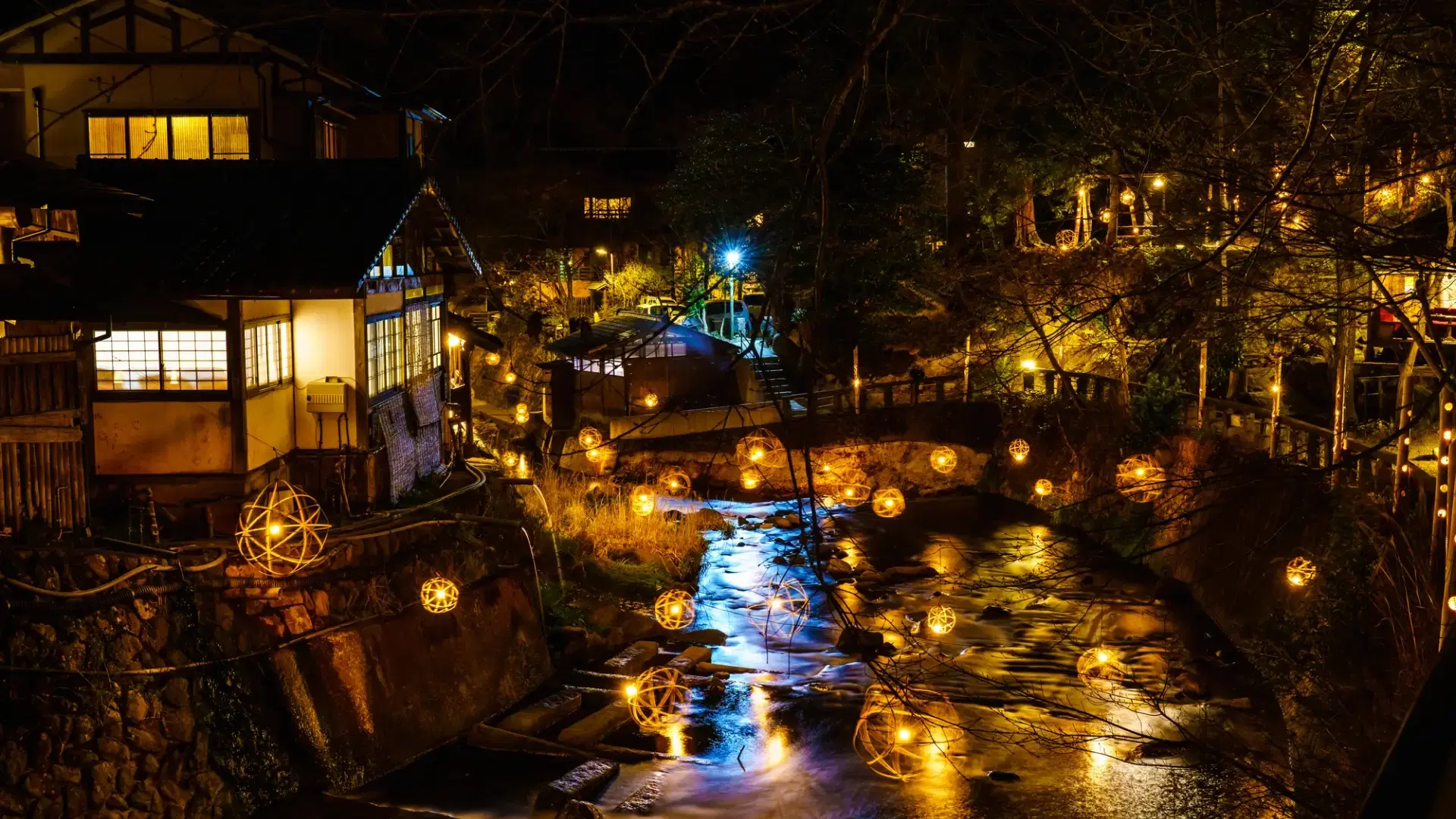
The Yunakuri illumination, held during the winter months from December through March, transforms the village's evening atmosphere with the warm glow of bamboo lanterns placed along the river and throughout the village. The lanterns, handmade from local bamboo and containing candles whose light flickers in the evening air, cast a soft, amber illumination that gives the dark winter village a fairy-tale quality that complements the warmth of the baths with a visual warmth of equally comforting character.
Culinary Scene
Kurokawa's ryokans serve kaiseki that draws on the mountain and river ingredients of the surrounding highlands. The emphasis is on wild and foraged ingredients, on the vegetables, mushrooms, river fish, and game that the forested landscape provides in quantities that vary with the season but whose quality is consistently excellent. Mountain trout, grilled over charcoal with nothing more than salt, its flesh firm and clean from the cold river water, is one of Kurokawa's most characteristic preparations, its simplicity reflecting the village's aesthetic philosophy.
Saga and Kumamoto wagyu appear at the finer ryokan tables, their richness providing the counterpoint to the lighter mountain preparations. The mushrooms of the surrounding forests, including maitake, shiitake, and the seasonal matsutake whose arrival in autumn is awaited with particular anticipation, bring deep umami flavors to soups, rice dishes, and grilled preparations. The sansai, the mountain vegetables that emerge in spring, provide a concentrated burst of wild flavor that no cultivated vegetable can replicate.
The village's small cafes and sweet shops offer refreshments between baths that include soft-serve made with local milk, manju filled with seasonal pastes, and the kurikinton chestnut confections that celebrate the autumn harvest of the mountain chestnuts. The drinking water of the village, drawn from the same mountain sources that feed the hot springs, is itself a pleasure, its purity and mineral softness providing the ideal palate cleanser between the rich flavors of the meal and the mineral intensity of the bath.
Ryokans in Kumamoto
There are no ryokans in our guide listed in Kurokawa Onsen. See our selection across Kumamoto.
View ryokans in Kumamoto