Hiraizumi
平泉Hiraizumi is the site of a vanished civilization. In the twelfth century, this small town in the Kitakami River valley was the seat of the Fujiwara clan of the north, whose four generations of rule created a capital that rivaled Kyoto in cultural ambition and, by some accounts, surpassed it in population. The Fujiwara envisioned their domain as a Pure Land on earth, a Buddhist paradise made material through architecture, gardens, and gold. Konjikido, the Golden Hall of Chusonji temple, completed in 1124 and sheathed entirely in gold leaf, mother-of-pearl inlay, and lacquerwork, remains the most luminous evidence of that aspiration, and it earned Hiraizumi its designation as a UNESCO World Heritage Site in 2011.
The destruction of the Fujiwara by Minamoto no Yoritomo in 1189 ended the dream, and the centuries that followed reduced the capital to a provincial village. When Matsuo Basho arrived in 1689 during his journey to the north, he found rice paddies where palaces had stood. His haiku composed here, "Natsukusa ya / tsuwamono-domo ga / yume no ato" (Summer grasses, all that remains of warriors' dreams), captures the melancholy of Hiraizumi's transformation with a precision that five centuries of commentary have not improved upon.
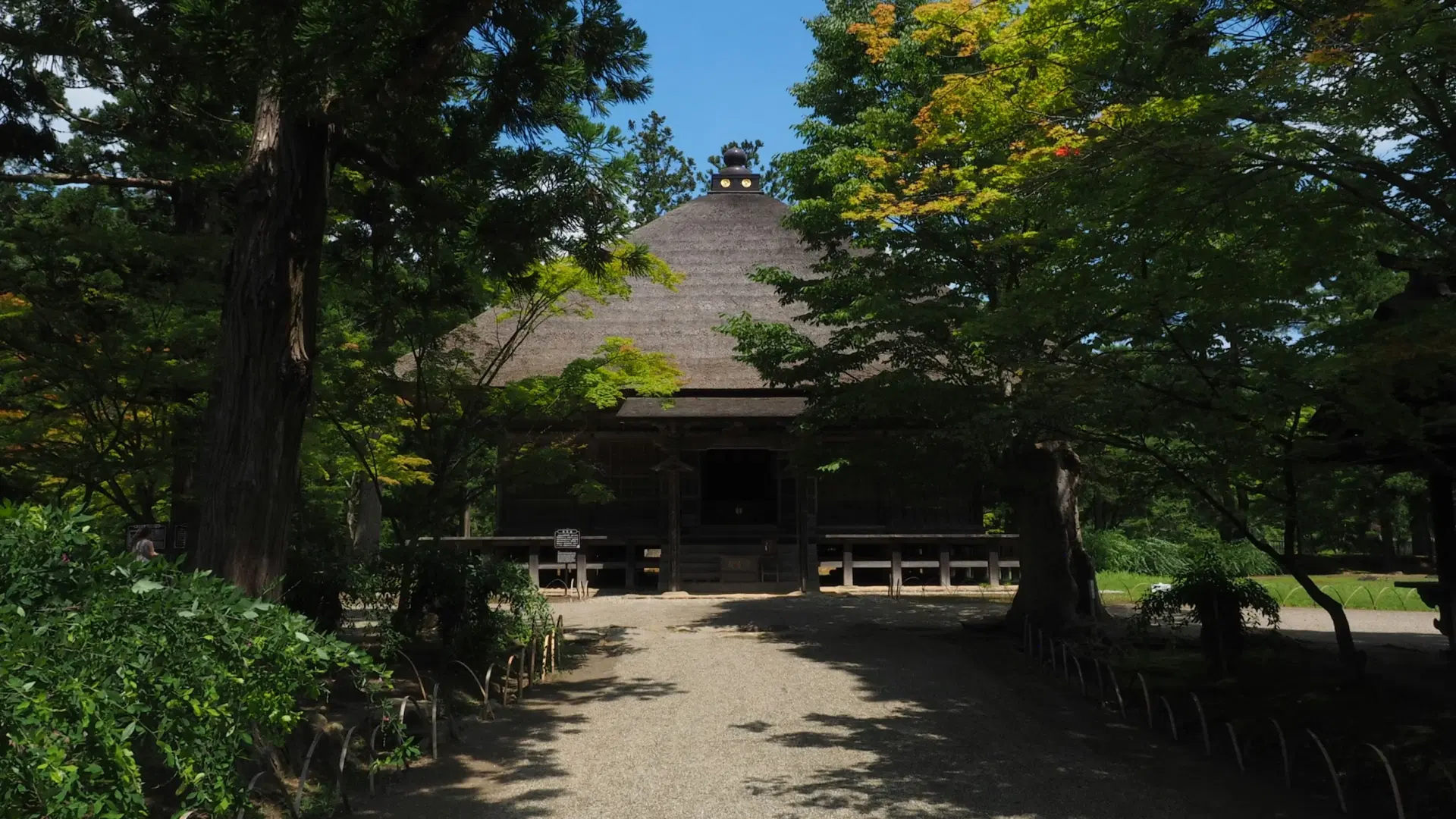
Yet what survives is extraordinary. Chusonji and Motsuji, the two great temple complexes, preserve enough of the Fujiwara vision to convey its scale and refinement. Motsuji's Pure Land garden, with its central pond designed to evoke the paradise described in Amida Buddhist scripture, is considered the finest surviving example of Heian-era garden design in Japan. To walk these grounds is to encounter a twelfth-century aesthetic sensibility that predates the wabi-sabi austerity of later Japanese culture, one that embraced opulence as a path to enlightenment.
Hiraizumi is the site of a vanished civilization.
Highlights
Chusonji sits atop a hill approached through a corridor of ancient cedars, their canopy filtering the light into the green half-darkness that the Japanese call komorebi. The temple complex encompasses over a dozen halls, but Konjikido commands the pilgrimage. Enclosed within a protective glass case since the 1960s, the Golden Hall glows with an intensity that photographs cannot convey: every surface covered in gold leaf, the altar columns inlaid with mother-of-pearl in patterns of lotus and hosoge, the interior housing the mummified remains of three Fujiwara lords. It is a reliquary, a work of art, and a theological argument rendered in precious materials, asserting that the Pure Land can be made visible on earth.
Motsuji, a ten-minute walk south, offers a contrasting beauty. Where Chusonji dazzles with ornament, Motsuji achieves its effect through spatial composition. The Oizumi-ga-Ike pond, surrounded by carefully placed rocks, white sand beaches, and the foundations of buildings long since vanished, creates a landscape of deliberate emptiness that feels more modern than medieval. The iris garden, blooming in late June and early July, fills the grounds with 30,000 plants in over 300 varieties, a spectacle that the Fujiwara lords themselves would recognize.
The Takadachi Gikeido, a small hall perched on a cliff above the Kitakami River, marks the spot where Minamoto no Yoshitsune, the tragic hero of the Genpei War, met his end. It was standing here that Basho composed his famous haiku. The view from this promontory, encompassing the river, the rice fields, and the mountains beyond, remains essentially unchanged since the twelfth century, a continuity that deepens the emotional weight of the site.
Culinary Scene
Hiraizumi's cuisine reflects the agricultural wealth of the Kitakami River valley. Iwate's rice, grown in paddies that have occupied these flatlands since the Fujiwara era, provides the foundation for simple, satisfying meals served at restaurants near the temple complexes. Mochi, pounded rice cakes prepared in a staggering variety of styles, constitutes a regional obsession in southern Iwate; the Ichinoseki mochi cuisine, centered in the neighboring city, offers formal multicourse meals in which every dish features mochi prepared differently, from sweet red bean to savory walnut, sesame, shrimp, and edamame preparations.
Local restaurants near Chusonji serve set meals featuring mountain vegetables, grilled river fish, and Maesawa wagyu beef from the nearby pastures. The quiet pace of Hiraizumi encourages lingering over lunch, and several establishments occupy traditional buildings with views of the surrounding landscape that connect the meal to the contemplative atmosphere of the temples.