Mito Plum Festival
水戸梅まつりThe Mito Plum Festival unfolds across Kairakuen, one of Japan's three great landscape gardens, where more than three thousand plum trees of over one hundred varieties release their blossoms in a staggered sequence that stretches across six weeks of late winter and early spring. The garden, conceived not as a private retreat but as a place of shared pleasure for all classes, becomes during this period a living encyclopedia of the plum's botanical range, its colors moving from the waxy white of early-blooming varieties through shell pink to the deep crimson of late cultivars, each tree bearing flowers whose individual perfection is amplified by the collective spectacle surrounding it.
Unlike cherry blossoms, whose beauty depends on evanescence and massed profusion, plum blossoms reward close observation. Their petals are rounder, their branches more angular and sculptural, their fragrance stronger and more complex. The Mito Plum Festival invites this intimacy, encouraging visitors to move slowly through the garden's winding paths, pausing at individual trees whose names and lineages are marked on small plaques, reading the landscape not as a single canvas but as a gallery of distinct botanical portraits.
The festival's cultural programming reinforces this contemplative quality. Outdoor tea ceremonies are held in the garden's pavilions, candlelit evening illuminations reveal the blossoms against the darkness of bare branches, and local artisans demonstrate traditional crafts in temporary stalls along the garden's perimeter. The atmosphere is one of refined appreciation rather than carnival exuberance, appropriate to a flower whose cultural associations in Japan center on perseverance, scholarly virtue, and the quiet courage of blooming before winter has fully released its grip.
The Mito Plum Festival unfolds across Kairakuen, one of Japan's three great landscape gardens, where more than three thousand plum trees of over one hundred varieties release their blossoms in a staggered sequence that stretches across six weeks of late winter and early spring.
History & Significance
Kairakuen was established in 1842 by Tokugawa Nariaki, the ninth lord of the Mito domain, who conceived the garden as a place where samurai and commoners alike could gather for rest and cultivation. The name itself, meaning "a garden to enjoy with the people," was radical for its era, expressing a vision of shared public amenity that anticipated modern park culture by more than a century. Nariaki's choice of plum trees as the garden's signature planting was deliberate: the plum's association with Confucian virtue and resilience aligned with the scholarly values he promoted through the Kodokan, the domain school he founded nearby.
The plum festival tradition evolved gradually from informal spring viewings into the organized event established in 1896, making it one of Japan's oldest continuously held flower festivals. Through the upheavals of the twentieth century, including the firebombing of Mito in 1945 that devastated the surrounding city, Kairakuen survived largely intact, its plum groves providing continuity with a cultural tradition that the destruction around them had interrupted. The postwar restoration of the garden and the expansion of the festival reflected a community's determination to preserve not merely a landscape but the values of public beauty and shared enjoyment that Nariaki had embedded in its design.
What to Expect
The garden's topography guides the viewing experience naturally. The main plum grove occupies the southern slope, where the trees are arranged by variety to create a progression of bloom times that ensures color throughout the festival period. Early visitors in mid-February find the first white and pale pink varieties opening in the crisp winter air, their fragrance sharpened by the cold. By early March, the garden reaches full expression, with hundreds of varieties in simultaneous bloom creating a mosaic of color against the dark, gnarled branches that plum trees develop with age.
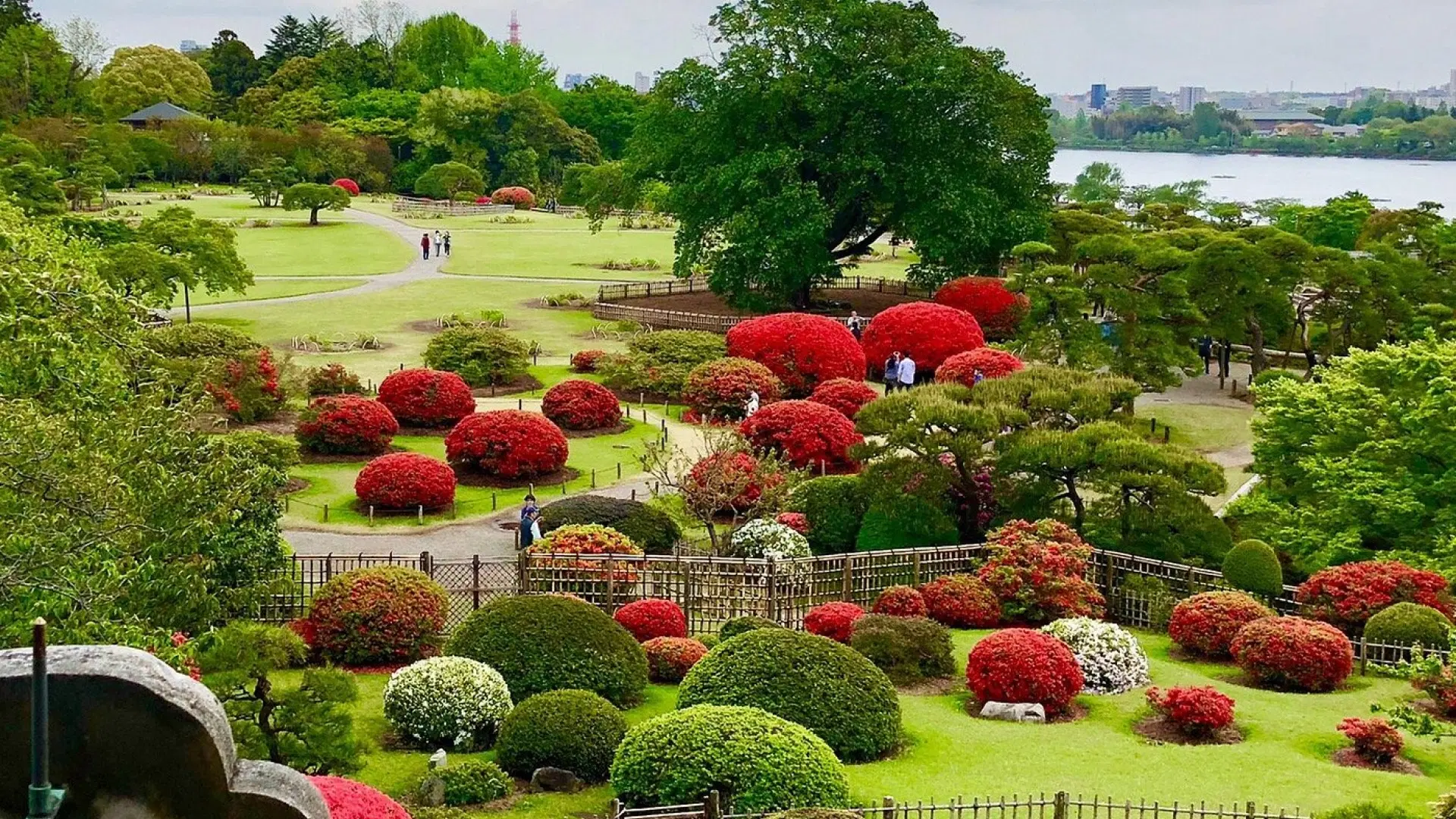
The Kobuntei, Nariaki's original three-story wooden pavilion, provides an elevated vantage point over the garden and across Senba Lake to the city beyond. From this perspective, the plum grove reads as a pointillist landscape, the individual trees merging into waves of color that shift in intensity with the light. Evening illuminations, held on select weekends, transform the garden into a different experience entirely, the blossoms glowing against the darkness with a theatrical beauty that reveals forms invisible in daylight.
The festival's food culture centers on umeboshi and plum-derived products. Local vendors offer plum wine, plum vinegar, and plum-flavored confections that connect the visual experience to the fruit's culinary legacy. Mito natto, the city's other famous product, appears alongside in preparations that range from traditional to inventive, the pungent fermented soybeans providing a savory counterpoint to the plum's sweetness.