Hitachi Seaside Park Nemophila Harmony
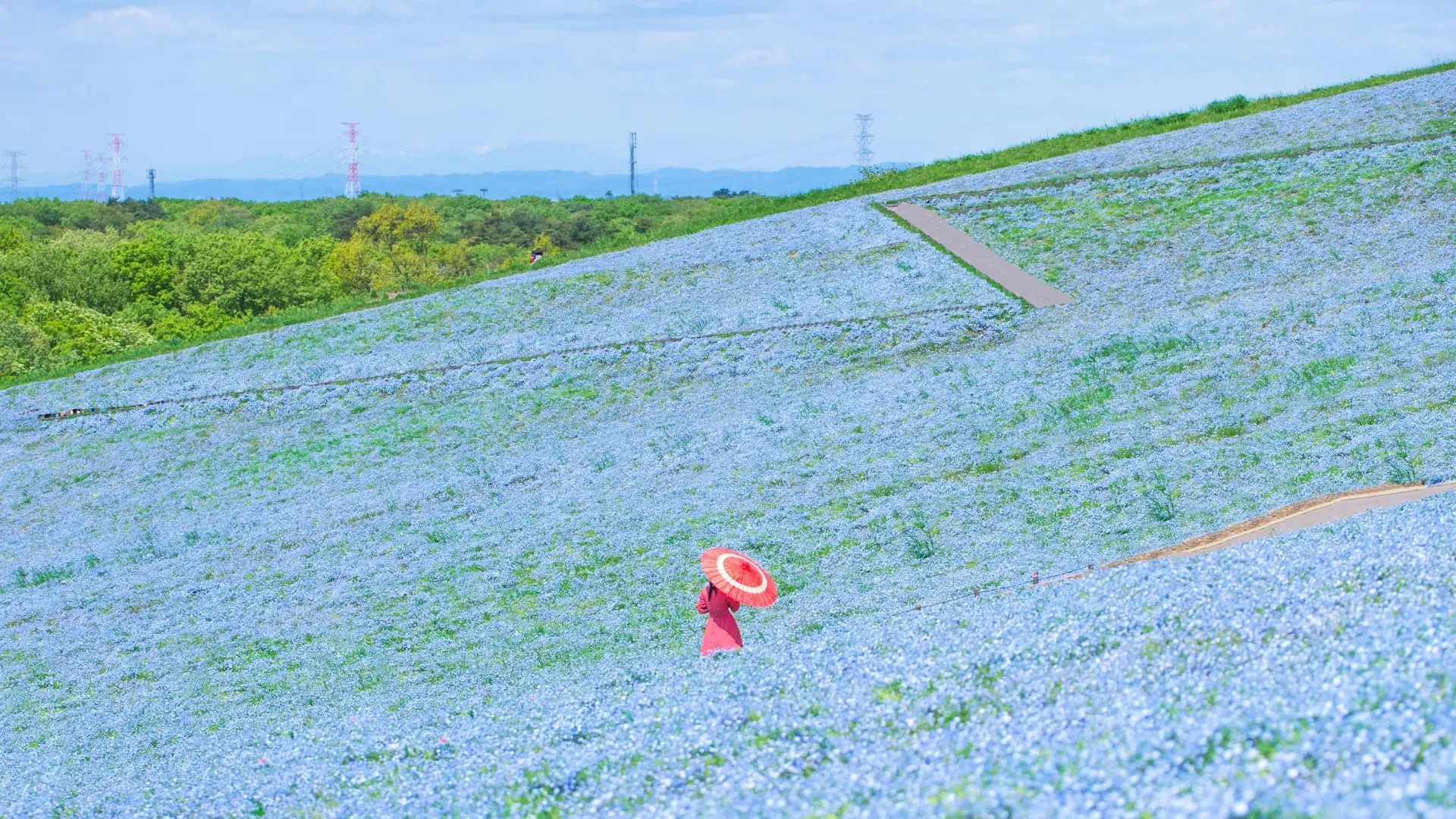
ひたち海浜公園ネモフィラハーモニーFor approximately three weeks each spring, Miharashi Hill at Hitachi Seaside Park becomes a place where earth and sky appear to merge. Four and a half million nemophila, tiny five-petaled flowers of a blue so pale it seems translucent, blanket the gentle hill in a continuous carpet that rises to meet the horizon, their color indistinguishable from the April sky above. The effect is not of a garden planted with flowers but of a landscape dissolved into pure color, a blue so pervasive and so soft that the usual boundaries between ground, air, and ocean lose their definition.
The nemophila, commonly known as baby blue eyes, are native to North America but have found in this coastal Ibaraki hillside an environment that amplifies their modest individual beauty into something approaching the sublime. Each flower is barely two centimeters across, its petals veined with lines slightly darker than their translucent blue ground, its center a small white eye. Individually they are charming but unremarkable. Massed in millions across a hillside that curves gently toward the Pacific, they produce a visual experience that overwhelms the eye's ability to distinguish individual forms and surrenders to the field of color itself.
The park's location on the coast adds a dimension that inland gardens cannot replicate. The Pacific Ocean is visible beyond the hill's crest, its deeper blue providing a chromatic anchor that makes the nemophila's paler tone read as a watercolor wash between the green of the surrounding landscape and the saturated blue of the sea. On clear days, the gradation from green grass to pale blue flowers to deep blue ocean to lighter blue sky creates a spectrum of blue that seems to contain every possible shade of the color.
For approximately three weeks each spring, Miharashi Hill at Hitachi Seaside Park becomes a place where earth and sky appear to merge.
History & Significance
Hitachi Seaside Park occupies a site with a complicated history. The 350-hectare coastal area served as a Japanese military airfield during World War II and was subsequently requisitioned by United States forces as a bombing and gunnery range. The land was returned to Japan in 1973, but the decades of military use had left a landscape that required extensive remediation before any public purpose could be realized. The park opened in stages beginning in 1991, its design conceived as a transformation of damaged land into a public landscape of beauty and ecological diversity.
The nemophila plantings on Miharashi Hill began in the park's early years and have expanded steadily as the spectacle's reputation grew. What started as a modest floral display became, through word of mouth and the amplifying power of photography, one of Japan's most recognizable spring landscapes. The irony is rich and deliberate: a hillside once used to practice destruction is now one of the country's most visited sites of natural beauty, its annual transformation into a field of blue functioning as a quiet testament to the possibility of renewal.
What to Expect
The approach to Miharashi Hill is designed to build anticipation. Visitors walk through the park's lower gardens, passing displays of daffodils and tulips, before the hill reveals itself as a rising curve of blue that seems to grow more intense as the path ascends. The climb is gentle, the paths wide and well-maintained, winding through the nemophila in curves that place the viewer at constantly changing angles to the light. The flowers are at their most luminous in morning light, when the eastern sun passes through the translucent petals and seems to illuminate them from within.
The summit of Miharashi Hill provides a panoramic view that places the nemophila field in its coastal context. The Pacific stretches to the east, the park's forests and gardens extend to the south and west, and the blue carpet of flowers falls away in every direction from the hilltop, an immersive experience of color that visitors often describe as dreamlike. The combination of open sky, ocean wind, and the subtle fragrance of millions of flowers creates a sensory environment that is simultaneously exhilarating and calming.
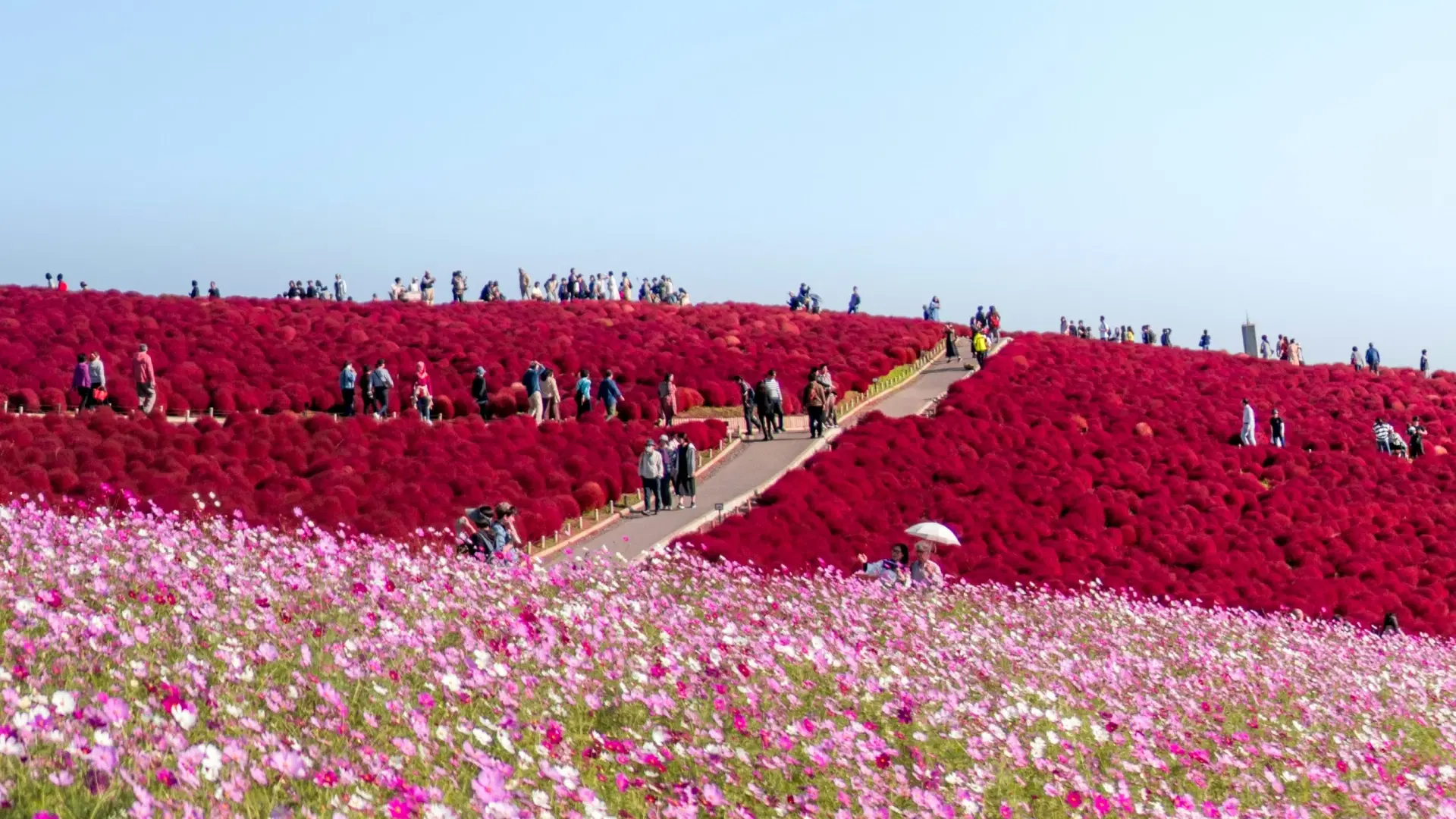
Beyond the nemophila, the park offers extensive walking and cycling trails through varied landscapes including a seaside promenade, a pleasure garden, and forested areas planted with native species. The timing of the nemophila bloom overlaps with the park's tulip displays, and the contrast between the nemophila's misty blue and the tulips' bold primary colors provides a satisfying visual dialogue between restraint and exuberance.