Gero Onsen
下呂温泉Gero Onsen holds a place in Japanese bathing culture that few hot spring towns can claim. Named by the Confucian scholar Hayashi Razan in the early seventeenth century as one of Japan's three finest hot springs alongside Arima and Kusatsu, Gero has sustained that reputation for four hundred years through the simple, irreducible quality of its water. The alkaline simple spring, emerging at 84 degrees Celsius with a pH of 9.18, produces a bathing experience of extraordinary smoothness, the water coating the skin with a silken quality that has earned it the description bijin no yu, the water of beauty. This is not marketing language; it is a description of a physical sensation that becomes apparent within moments of entering the bath.
The town itself follows the Hida River through a narrow valley in the mountains of southern Gifu, its ryokans and hotels arranged along both banks and connected by bridges that offer views of the forested slopes above and the river's rocky course below. Unlike the great onsen resorts of the northeast, Gero retains a modest scale and an unhurried atmosphere, its streets walkable in an afternoon, its pleasures centered on the bath rather than on entertainment or spectacle. The free foot baths scattered throughout town, the rotenburo beside the river where bathers soak in full view of passing traffic, and the yu-meguri system that allows guests of participating ryokans to visit each other's baths all contribute to a culture in which bathing is not a private luxury but a communal practice woven into the fabric of daily life.
Gero's setting in the Hida highlands gives it a seasonal character that the coastal onsen towns cannot match. The river changes color with the seasons, grey-green in summer, reflecting crimson in autumn, bordered by snow in winter. The mountains above the town provide hiking in the warmer months and a backdrop of white in the colder ones. And the proximity to Takayama, less than an hour by rail, positions Gero as a natural complement to the cultural richness of the Hida region, offering the physical restoration that follows days of temple visits and mountain walks.
Gero Onsen holds a place in Japanese bathing culture that few hot spring towns can claim.
Highlights
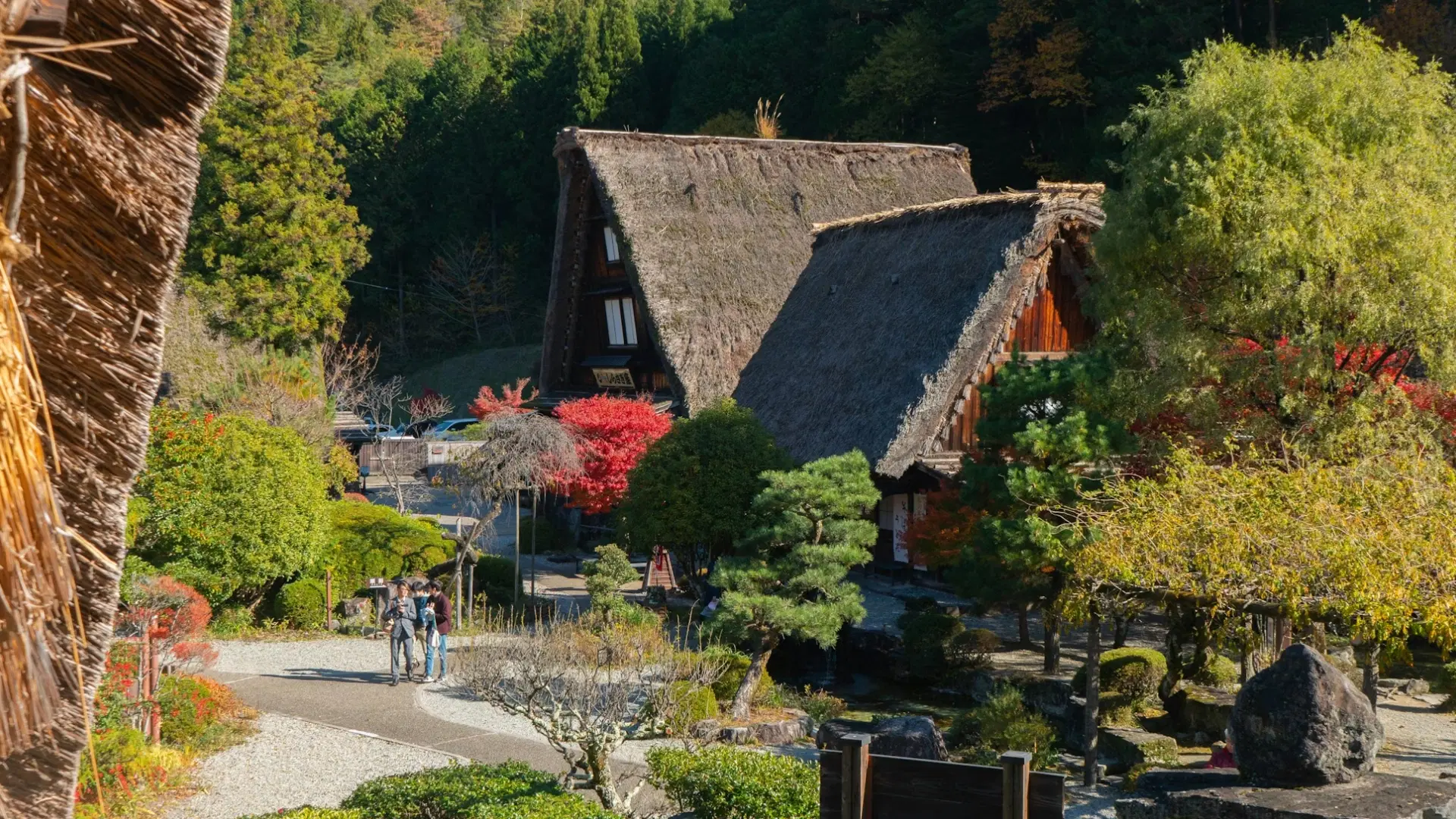
The onsen experience itself is Gero's primary attraction, and the town has organized itself to offer that experience in multiple forms. The Gero Onsen Gassho Village, a small collection of relocated gassho-zukuri farmhouses near the town center, houses a museum of local history and craft workshops, but its outdoor bath, set among the thatched buildings with views across the valley, provides the most atmospheric soak in town. The Funsenchi, a large open-air bath beside the Hida River in the town center, is the most democratic: free, mixed-gender (swimwear permitted), and surrounded by the sounds and sights of the river and the forested slopes. Bathing here, with the water flowing past and the mountains above, connects the modern visitor to the centuries of bathers who have sought the same restorative warmth in the same setting.
The yu-meguri tegata, a wooden pass that allows holders to visit the baths of three participating ryokans, transforms the bathing experience from a single event into a journey through the town's architectural and aesthetic range. Each ryokan's bath is different in design, from sleek contemporary stone to rustic timber and rock, and the walk between them provides an opportunity to explore the town's streets, bridges, and riverside paths. The system encourages the unhurried, ambulatory engagement with hot spring bathing that the Japanese term toji, bathing as therapy, implies.
Beyond the baths, the Gero Onsen Temple district, reached by a gentle uphill walk from the main street, offers a cluster of small temples and shrines set among cedars, their quiet grounds providing a contemplative counterpoint to the sociable atmosphere of the bathing district. The Onsenji Temple, associated with the legend of a white heron that revealed the location of the hot spring, anchors this area and provides views over the town and valley that contextualize Gero's relationship to the landscape that sustains it.
Culinary Scene
Gero shares the culinary traditions of the Hida highlands, with Hida beef occupying the center of the table. The ryokans of the town serve Hida beef in kaiseki courses that range from delicate shabu-shabu to robust hoba miso preparations, the magnolia leaf grilled over charcoal lending its subtle smokiness to the rich, marbled meat. The morning markets, smaller and more intimate than Takayama's, sell local produce including the tomatoes and mushrooms that thrive in the mountain climate, alongside handmade tofu and the pickles that accompany every Hida meal.
The ryokan kaiseki in Gero tends toward a style that emphasizes the seasonal harvest of the surrounding mountains. River fish, sansai in spring, mushrooms in autumn, and the preserved foods of winter appear in courses that document the turning of the year through flavor and texture. The simplicity of these preparations, a grilled iwana with nothing but salt, a clear soup of mountain vegetables, a small dish of pickled red turnip, reflects the character of the town itself: unpretentious, attentive to quality, and grounded in the conviction that the best cooking begins with the best ingredients rather than the most elaborate technique.
Ryokans in Gifu
There are no ryokans in our guide listed in Gero Onsen. See our selection across Gifu.
View ryokans in Gifu