Okayama
岡山Okayama is a city that lives in the company of one of Japan's supreme gardens, and the presence of Korakuen, that masterwork of Edo-period landscape design, pervades the city's identity like a quiet gravitational force. The garden occupies an island in the Asahi River directly below Okayama Castle, and this pairing of cultivated nature and feudal power, linked by a bridge across the water, defines the spatial and cultural logic of the city center. Okayama is not a place of spectacle but of proportion. Its pleasures are measured, refined, and deeply considered, qualities that reflect the Ikeda clan lords who shaped the domain for three centuries and whose aesthetic sensibilities survive in the careful geometry of Korakuen's lawns, groves, and waterways.
The city enjoys the mildest climate on Honshu's main island. Known as the "Land of Sunshine," Okayama receives less rainfall than nearly any other city in the country, and this meteorological generosity produces a landscape of agricultural abundance that directly enriches the table. The Okayama Plain, watered by the Asahi, Yoshii, and Takahashi rivers, supports rice paddies, orchards, and vineyards that have earned the prefecture its reputation as the "Fruit Kingdom" of Japan. White peaches and Muscat grapes cultivated here are among the most prized fruit in a nation that treats exceptional produce with the reverence others reserve for wine.
Beyond its garden and its climate, Okayama functions as a transportation crossroads whose position at the southern edge of the Chugoku mountains, facing the Seto Inland Sea, connects the San'yo coast to the Shikoku island via the Seto Ohashi Bridge. This geographic centrality has made the city a natural starting point for journeys into the art islands of the Inland Sea, the historic canal quarter of Kurashiki, and the ceramic traditions of Bizen, all within an hour of the city center.
Okayama is a city that lives in the company of one of Japan's supreme gardens, and the presence of Korakuen, that masterwork of Edo-period landscape design, pervades the city's identity like a quiet gravitational force.
Highlights
Korakuen is routinely named among Japan's three finest gardens, alongside Kenrokuen in Kanazawa and Kairakuen in Mito, and among the three it may be the most immediately beautiful. Completed in 1700 by Ikeda Tsunamasa, the second lord of the Okayama domain, the garden covers roughly fourteen hectares and is designed in the kaiyushiki style, a strolling garden whose views are experienced sequentially as the visitor follows paths that wind between lawns, ponds, groves, tea fields, and streams. The central lawn, an expanse of meticulously maintained grass bordered by stands of cherry, plum, and maple, provides a sense of openness unusual in Japanese garden design, and the "borrowed scenery" of Okayama Castle, its black silhouette rising above the treetops on the opposite bank, anchors the composition in the feudal history from which the garden emerged.
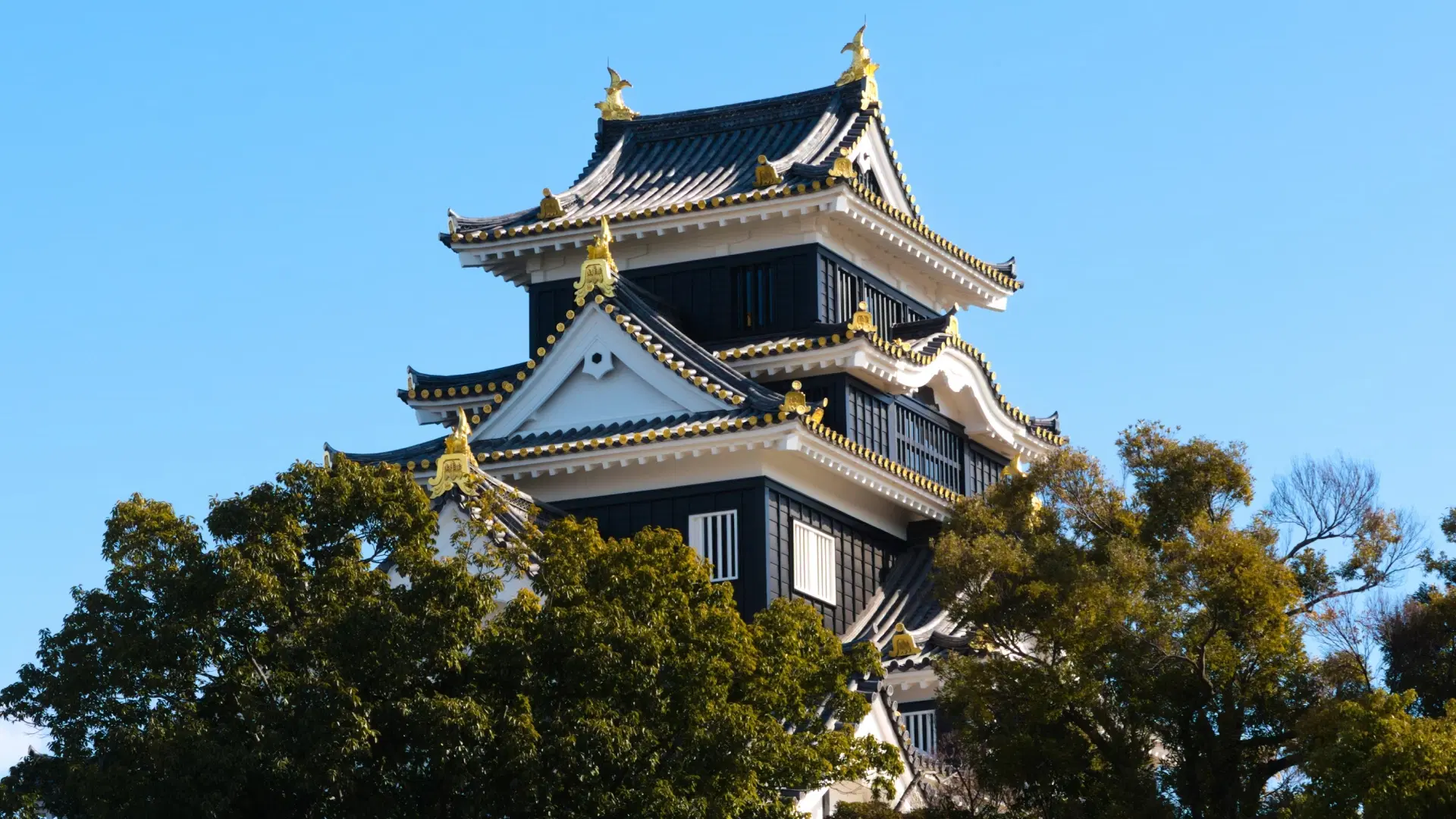
Okayama Castle, known as "Crow Castle" for its black exterior walls, was rebuilt in 1966 following its destruction in the Second World War, and while the reconstruction lacks the material authenticity of surviving originals, its position above the river and its relationship to Korakuen preserve the visual logic of the original Edo-period ensemble. The castle interior houses a museum documenting the Ikeda clan's rule and the development of the domain, and the upper floors provide panoramic views over the garden and the city that clarify the spatial relationship between lord, garden, and governed territory.
The Okayama Prefectural Museum of Art, set in a grove near Korakuen, houses a distinguished collection of Japanese painting and ceramics, with particular strength in the Bizen ware for which the prefecture is celebrated. The Yumeji Art Museum, dedicated to the Taisho-era artist Takehisa Yumeji, whose lyrical paintings of women defined an era's visual sensibility, occupies a graceful building in the garden district and provides a counterpoint to the more austere pleasures of Korakuen and the castle.
Culinary Scene
Okayama's culinary identity begins with fruit. The white peaches of summer, their flesh so delicate that they are individually wrapped and handled with the care of porcelain, represent the pinnacle of Japanese fruit cultivation, their sweetness pure and floral, their texture dissolving on the tongue like a perfumed cloud. The Muscat of Alexandria and Shine Muscat grapes, cultivated in the greenhouses and vineyards north of the city, achieve a sweetness and aromatic complexity that justify their presentation in the wooden gift boxes that have made Okayama fruit a luxury commodity throughout the country. Visiting a fruit parlor in the city center, where these specimens are served in parfaits, tarts, and as unadorned slices accompanied by nothing more than a fork, is one of Okayama's essential culinary experiences.
Barazushi, Okayama's signature festive dish, is a scattered sushi that layers vinegared rice with a colorful mosaic of seasonal toppings: shrimp, lotus root, shiitake, shredded egg, pickled ginger, and the vegetables of the moment, composed with a visual exuberance that reflects the dish's origins as a celebration food prepared for seasonal festivals and family gatherings. Demi-katsudon, a tonkatsu served over rice with a rich demiglace sauce rather than the conventional egg-and-dashi preparation, is Okayama's contribution to Western-influenced yoshoku cuisine, its satisfying depth a testament to the city's quiet culinary inventiveness.
The proximity of the Seto Inland Sea provides Okayama's kitchens with a marine larder that includes sea bream, octopus, conger eel, and the small shrimp that appear in tempura and kakiage throughout the region. Mamakari, a type of sardine so delicious that, according to local legend, one would borrow rice from a neighbor just to eat more of it, is Okayama's most distinctive seafood offering, typically served vinegar-cured as a small, bright accompaniment to sake.
Ryokans in Okayama
There are no ryokans in our guide listed in Okayama. See our selection across Okayama.
View ryokans in Okayama