Kurashiki
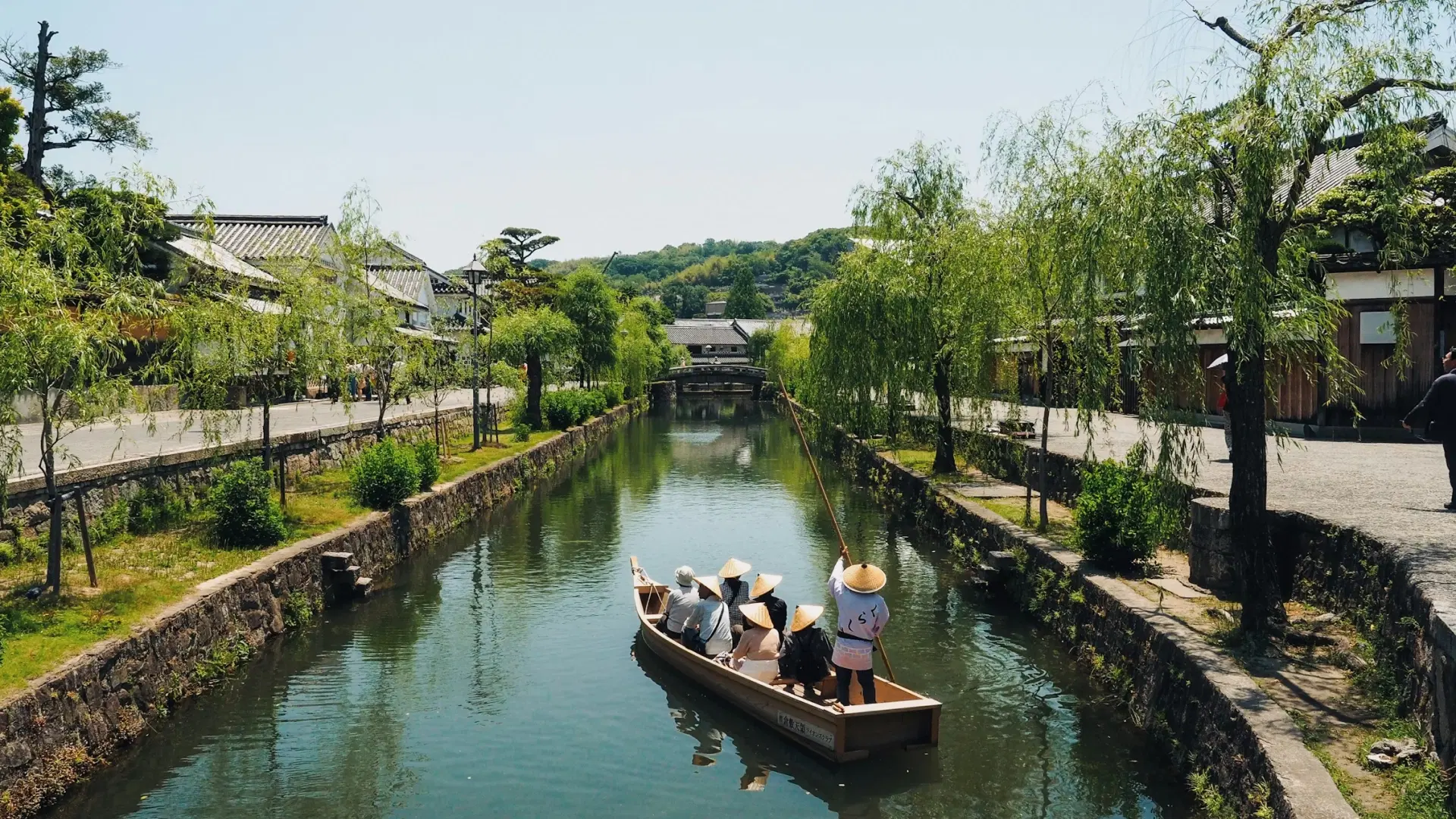
倉敷Kurashiki is a town that remembers wealth. The white-walled warehouses and willow-lined canal that constitute its historic Bikan quarter are the surviving evidence of a commercial prosperity that began in the Edo period, when this town on the Takahashi River plain served as a rice distribution center under direct shogunal control, and continued into the modern era through the textile industry that made Kurashiki a center of Japanese cotton manufacturing. The warehouses, built to store rice and later cotton, line a narrow canal whose still waters reflect their white plaster walls, black tile roofs, and the weeping willows that shade the towpath, creating one of the most photographed streetscapes in western Japan.
What distinguishes Kurashiki from other preserved towns is the quality of the cultural institutions that have been installed within its historic fabric. The Ohara Museum of Art, founded in 1930 by the industrialist Ohara Magosaburo and housed in a neoclassical building at the canal's edge, was the first museum of Western art in Japan and remains one of the finest, its collection spanning El Greco, Monet, Matisse, and Pollock alongside Japanese and Asian works. The presence of a world-class art museum within a townscape of Edo-period warehouses creates a juxtaposition of Western and Japanese, modern and traditional, that is Kurashiki's defining cultural characteristic.
The town's textile heritage continues through the Kurashiki Denim brand, which has leveraged the region's century-old expertise in cotton weaving and indigo dyeing to establish the Kojima and Kurashiki area as one of the world's premier centers of artisanal denim production. The intersection of historical craft, contemporary design, and industrial heritage gives Kurashiki a creative vitality that prevents its museum-quality beauty from becoming merely preserved.
Kurashiki is a town that remembers wealth.
Highlights
The Bikan Historical Quarter is compact enough to explore in a half day but rich enough to reward a much longer stay. The central canal, approximately six hundred meters in length, is bordered by the finest concentration of white-walled kura warehouses, their namako-kabe tile patterns and black wooden lattice windows preserved with an attention to detail that extends to the stone bridges, the iron lanterns, and the graceful curve of the willows whose branches trail in the water. Boat rides along the canal, poled by boatmen in traditional dress, provide a perspective that cannot be achieved from the towpath, the low vantage point emphasizing the height of the warehouses and the depth of their reflections.
The Ohara Museum of Art anchors the quarter's cultural offerings. The main gallery's collection of European painting, acquired by Ohara with the guidance of the painter Kojima Torajiro in the years before and after the First World War, is of a quality that would be remarkable in any setting but is extraordinary in a town of this size. The museum's annexes, housed in renovated warehouses and the former Ohara family residence, extend the collection into Japanese contemporary art, folk art, and East Asian antiquities, and the Craft Art Gallery, devoted to the work of mingei movement artists including Hamada Shoji, Bernard Leach, and Kawai Kanjiro, provides a philosophical bridge between the European modernism of the main gallery and the vernacular craft traditions of the region.
The Ivy Square complex, a converted cotton spinning mill built in 1889, preserves the industrial architecture of Kurashiki's textile era while housing hotels, shops, restaurants, and cultural facilities within its red-brick walls. The courtyard, draped in the ivy that gives the complex its name, is one of the most pleasant outdoor spaces in the Bikan quarter, and the Kurabo Memorial Hall within documents the history of the cotton industry that sustained the town through its modern transformation.
Culinary Scene
Kurashiki's culinary character blends the agricultural abundance of the Okayama Plain with the creative energy of a town that has long understood the relationship between craft and commerce. The town's fruit parlors and cafes, many housed within renovated warehouses, serve Okayama's celebrated white peaches and Muscat grapes in preparations that range from simple fresh servings to elaborate parfaits and tarts. The marriage of historic architecture and contemporary patisserie creates dining environments whose visual beauty matches the quality of what they serve.
The Seto Inland Sea provides Kurashiki's kitchens with the same seafood that enriches the broader Okayama culinary tradition: sea bream, octopus, mantis shrimp, and the seasonal small fish that appear in nimono and tempura throughout the region. Bukkake udon, thick wheat noodles served with a concentrated broth poured directly over the top rather than used as a dipping sauce, is a Kurashiki contribution to the Sanuki udon tradition of nearby Shikoku, and the city's udon shops serve versions whose simplicity belies the skill required to achieve the proper balance of noodle texture, broth concentration, and topping arrangement.
Kurashiki's denim district in the neighboring Kojima area has spawned a secondary culinary culture of denim-themed cafes serving indigo-colored drinks and blue-tinted confections, a playful expression of the town's creative spirit that, at its best, transcends novelty to become genuinely enjoyable.