Beppu Hatto Onsen Festival
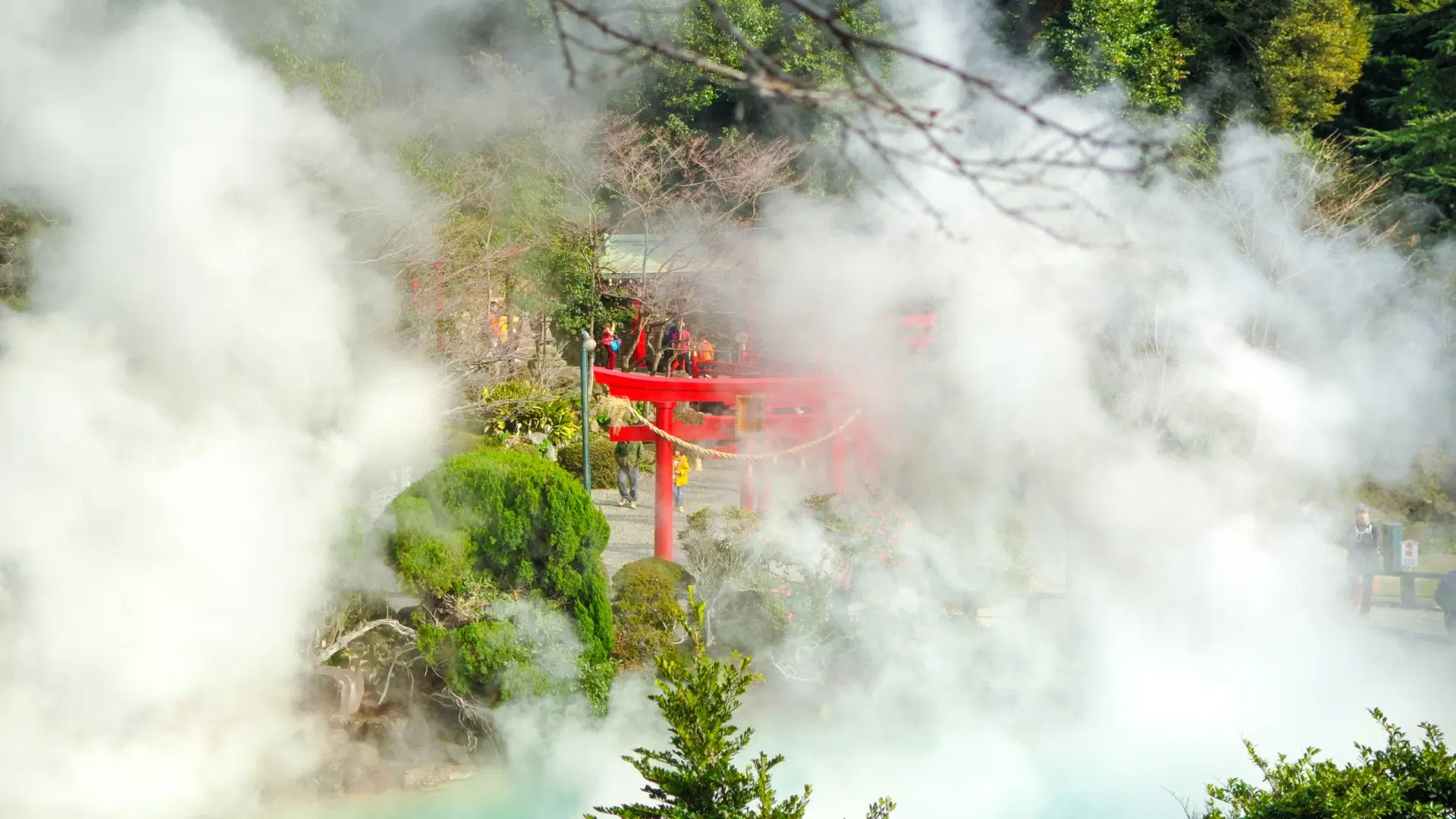
別府八湯温泉まつりThe Beppu Hatto Onsen Festival is a city giving thanks to the force that created it. For three days each April, Beppu celebrates its eight onsen districts with a festival that combines Shinto purification rites, communal bathing events, and street processions in an expression of gratitude to the volcanic springs that have sustained the city for over a thousand years. The festival transforms the already steam-filled streets of Beppu into corridors of ceremony and festivity, the ordinary act of bathing elevated to civic ritual.
The festival's emotional center is the Ogiyama Fire Festival, held on the slopes of Mount Ogiyama above the city, where an enormous bonfire is lit to honor the spirit of the hot springs. The flames, visible from across the city, cast a warm glow over the steam rising from the eight districts below, creating a tableau in which fire and water, the elemental forces of Beppu's geology, are celebrated simultaneously. Throughout the city, individual bathhouses open their doors for free or discounted bathing, inviting residents and visitors alike to participate in the communal immersion that is Beppu's most fundamental cultural act.
What distinguishes this festival from other hot spring celebrations across Japan is the specificity of Beppu's relationship with its waters. The eight districts, each with distinct mineral compositions and bathing traditions, stage their own local events that reflect their individual characters: Kannawa's steam-cooking demonstrations, Myoban's yunohana crystal harvesting displays, Hamawaki's seaside processions. The festival is not a single event but a constellation of celebrations, each anchored in the particular geology and community of its district.
The Beppu Hatto Onsen Festival is a city giving thanks to the force that created it.
History & Significance
The Beppu Hatto Onsen Festival traces its origins to the Meiji period, when civic leaders formalized older traditions of spring worship into an organized annual celebration. The historical roots, however, reach much deeper. The springs of Beppu have been venerated since at least the eighth century, when the Bungo no Kuni Fudoki, an ancient provincial gazetteer, recorded the therapeutic properties of the region's thermal waters. The medieval period saw the establishment of temples and shrines at major spring sites, their priests conducting purification ceremonies that acknowledged the springs as sacred manifestations of the earth's creative energy.
The modern festival took its current form in the postwar era, when Beppu was rebuilding both its physical infrastructure and its identity as a bathing destination. The decision to celebrate all eight districts simultaneously, rather than favoring any single neighborhood, reflected a democratic impulse that has shaped the festival's character: each district contributes its own events and ceremonies, creating a decentralized celebration that mirrors the distributed geography of the springs themselves. The Ogiyama Fire Festival was revived as the unifying ceremonial element, its hilltop location providing a symbolic vantage from which the entire city and its eight steaming neighborhoods could be witnessed as a single, interconnected geothermal organism.
What to Expect
The festival opens with a Shinto ceremony at the Onsen Shrine, where priests perform rituals of purification and gratitude directed at the spirits of the hot springs. The proceedings carry a solemnity that contrasts with the festive atmosphere of the street events that follow, a reminder that Beppu's relationship with its waters has a spiritual dimension that precedes and underlies its touristic identity. Visitors who attend this opening ceremony witness a form of nature worship that illuminates the deeper cultural significance of Japanese bathing.
The Ogiyama Fire Festival, held on the mountainside above the city on the festival's climactic evening, is an experience of visceral power. The bonfire, built from timber and straw, is lit after dark, its flames shooting skyward against the backdrop of the night sky while the city's steam plumes glow below. Taiko drummers perform on the hillside, their rhythms reverberating across the amphitheater of the bay. The descent from the mountain through streets filled with festival-goers, food stalls, and the ever-present steam creates a sensory immersion in Beppu's unique atmosphere.
Throughout the three days, the individual onsen districts host bathing events that range from the ceremonial to the carnivalesque. Free bathing at participating public baths allows visitors to experience the mineral variations between districts, moving from the sulfur springs of Myoban to the sodium chloride waters of Hamawaki in a comparative journey through Beppu's geothermal diversity. The Yukemuri Marathon, a foot race through the city's steam-filled streets, adds an athletic dimension that is both comic and genuinely demanding.