Beppu
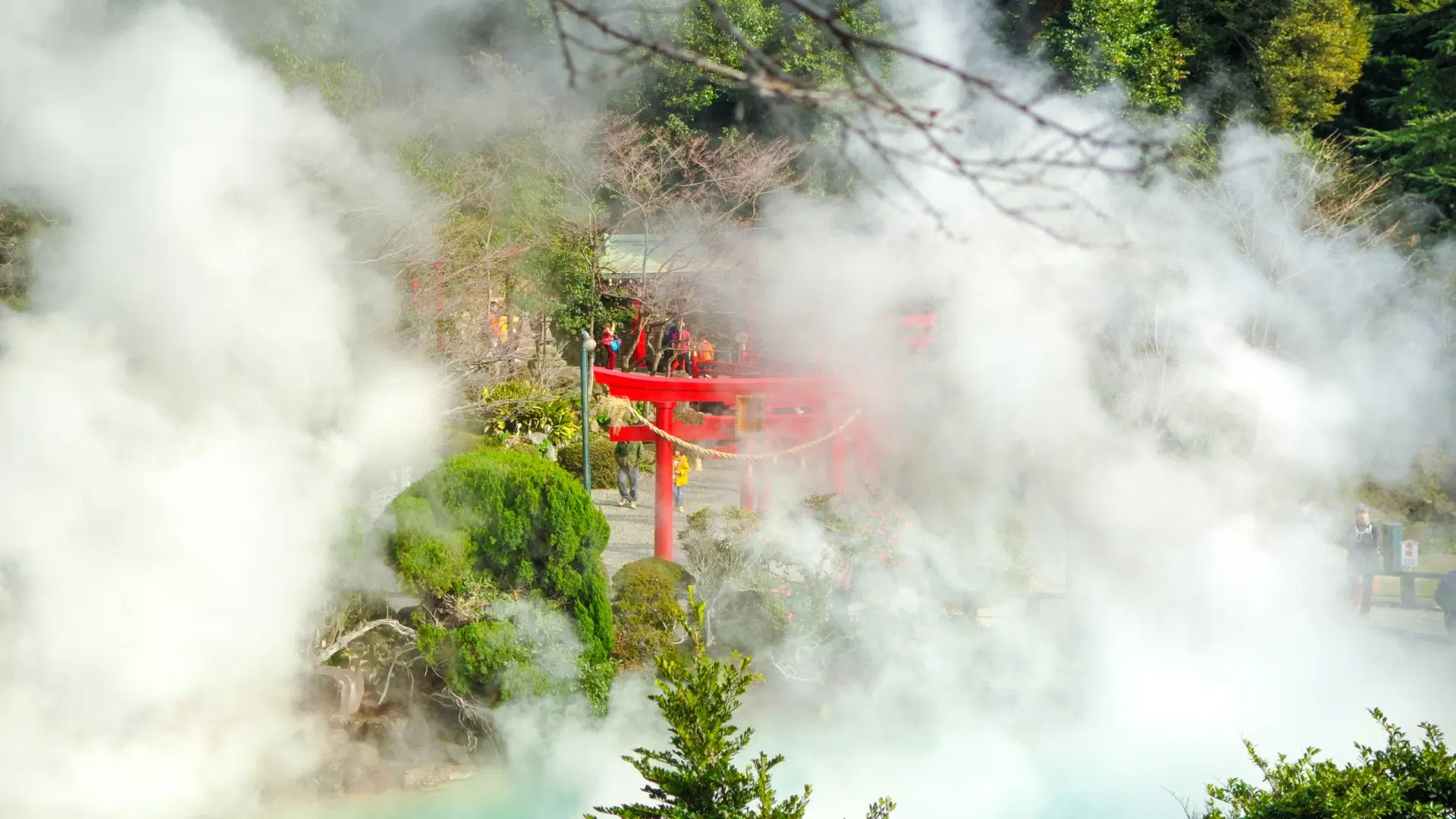
別府Beppu is a city built on steam. More hot spring water rises here than in any other city on earth save Yellowstone, the volcanic plumbing beneath Beppu Bay pushing nearly 130,000 kiloliters of thermal water to the surface each day through over two thousand named vents and springs. The city does not hide this geological inheritance but displays it with a frankness that can startle: steam rises from storm drains and parking lots, from cracks in residential sidewalks and from pipes jutting out of hillside restaurants. The air carries a faint sulfurous warmth even on cold mornings, and the clouds that hang above certain neighborhoods are not weather but geology, the visible breath of the earth itself.
The city occupies a natural amphitheater facing Beppu Bay, its neighborhoods climbing the slopes of the volcanic mountains that form a crescent behind the coastline. Each of the eight onsen districts, collectively known as Beppu Hatto, possesses distinct characteristics shaped by the particular mineral composition and temperature of its springs. Kannawa, the most atmospheric of the eight, is a neighborhood where steam defines the streetscape, rising from vents in the pavement, billowing from the latticed wooden covers of communal baths, and drifting between the traditional ryokan that line the narrow lanes. Myoban, higher on the slopes, is known for its milky blue sulfur springs and the thatched-roof huts where yunohana bath crystals have been harvested using techniques unchanged since the Edo period.
Yet Beppu is not a museum of geothermal curiosity. It is a living city of 115,000 people whose daily rhythms are shaped by the springs in ways both practical and philosophical. Locals cook food in the steam vents of Kannawa, softening eggs and steaming vegetables in the natural heat. The public bathhouses, numbering over a hundred and priced for neighborhood use rather than tourist commerce, remain the communal gathering places they have been for centuries, their wooden changing rooms echoing with conversation in the broad vowels of the Oita dialect.
Highlights
The Jigoku Meguri, or "Hell Tour," is Beppu's most celebrated attraction, a circuit of seven spectacular hot springs whose extreme temperatures, vivid colors, and violent geological activity place them beyond the category of bathing and into the realm of natural spectacle. Umi Jigoku, the Sea Hell, holds a pool of cobalt-blue water heated to 98 degrees Celsius, its color the result of iron sulfate dissolved in the thermal fluid. Chi-no-Ike Jigoku, the Blood Pond Hell, takes its name from the deep red of its iron-oxide-laden waters, a color so saturated it appears artificial until one comprehends the scale. Tatsumaki Jigoku, the Spout Hell, is a geyser that erupts at regular intervals, sending a column of boiling water skyward with a force that speaks to the pressure contained beneath the thin crust of ground.
Beyond the spectacle of the hells, Beppu's bathing culture reveals itself in the public and communal baths scattered through every neighborhood. Takegawara Onsen, operating since 1879, offers sand baths where visitors are buried in naturally heated volcanic sand, the weight and warmth producing a full-body thermal immersion unlike any conventional soak. The building itself, with its imposing wooden facade and cavernous interior, is an architectural monument to the city's bathing heritage. Hyotan Onsen in Kannawa provides a comprehensive introduction to multiple bathing styles within a single facility, its outdoor and indoor pools, steam baths, waterfall showers, and sand baths offering a curriculum in the art of thermal immersion.
The Kannawa district rewards exploration on foot. The steam-lined streets, the small shrines tucked between bathhouses, the cooking vents where visitors can prepare their own jigoku-mushi (hell-steamed) meals using the natural geothermal heat: these experiences compose a portrait of a neighborhood where volcanic energy is not spectacle but infrastructure, woven into the fabric of everyday life with a matter-of-factness that makes the extraordinary feel entirely natural.
Culinary Scene
Beppu's most distinctive culinary tradition is jigoku-mushi, or hell-steaming, a cooking method that uses the natural geothermal steam vents of Kannawa to prepare food without fuel, flame, or electricity. At the Jigoku Mushi Kobo workshop near the center of Kannawa, visitors place baskets of vegetables, eggs, seafood, and meat over stone-lined steam vents and wait as the pressurized, mineral-infused steam cooks the ingredients to a tenderness and flavor that conventional steaming cannot replicate. The minerals in the steam subtly season the food, lending a faint earthiness to eggs and a particular sweetness to root vegetables that devotees consider irreproducible by any other method.
The city's seafood draws from Beppu Bay and the broader Bungo Channel, where the convergence of currents creates fishing grounds of exceptional richness. Seki-aji and seki-saba, the horse mackerel and mackerel caught in the swift tidal currents of the Hoyo Strait, are prized throughout Japan for their firm flesh and clean flavor, the result of a lifetime spent swimming against strong currents. These fish are served as sashimi in Beppu's harbourside restaurants with a simplicity that acknowledges the ingredient needs no elaboration. Toriten, Oita's signature chicken tempura, is Beppu's most beloved casual dish, the chicken pieces marinated in a soy and ginger mixture before being battered and fried, producing a crunch and savoriness that explains why every restaurant in the city offers its own version.
The onsen tamago, eggs slow-cooked in the mineral springs until the white achieves a silky, custard-like consistency while the yolk remains creamy, are Beppu's simplest and perhaps most perfect edible expression of the city's geothermal identity. Eaten warm, sprinkled with a little salt, they taste of the earth itself.