Yufuin
由布院Yufuin occupies a basin at the foot of the twin-peaked Mount Yufu, a setting so perfectly composed it seems arranged by a landscape painter rather than geology. The town sits at an elevation of roughly 450 meters, high enough that the air carries a crispness absent from the coastal lowlands, and the basin's enclosed geography creates a microclimate famous for morning mist. On autumn and winter mornings, fog fills the valley floor like water in a bowl, the rooftops and treetops of the town emerging from the white surface as the sun warms the air, a phenomenon so reliably beautiful that it has become Yufuin's visual signature.
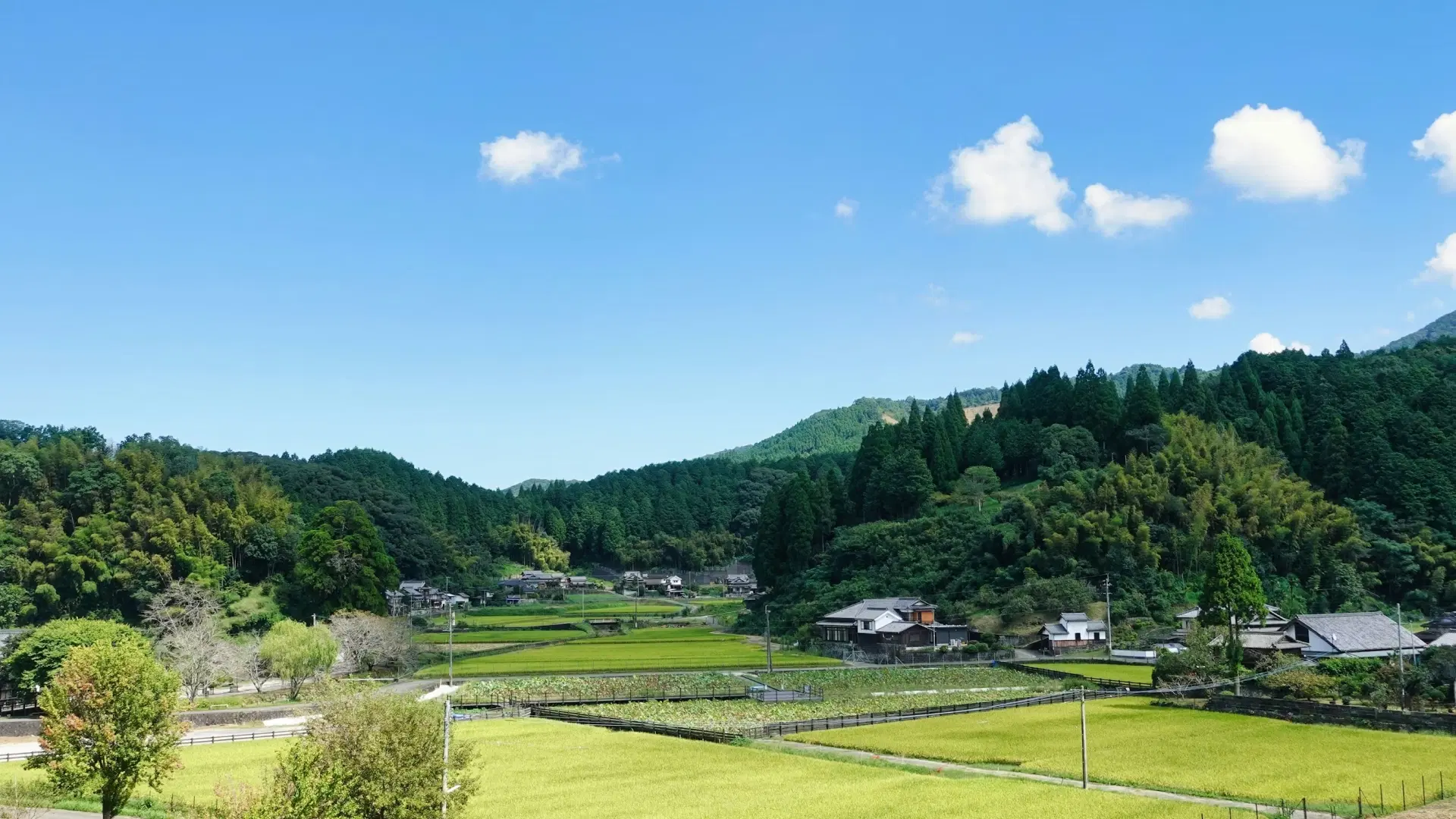
Unlike Beppu, its boisterous neighbor thirty minutes to the east, Yufuin developed its identity through a conscious act of refusal. In the 1970s, when Japan's onsen towns were succumbing to the economic logic of mass tourism, building concrete resort hotels and neon-lit entertainment districts, Yufuin's civic leaders chose a different path. They studied European spa towns, particularly those in Germany's Black Forest, and resolved to preserve Yufuin's rural character: its rice paddies, its thatched-roof farmhouses, its scale. The result is a town that feels curated without feeling artificial, its main street lined with galleries, cafes, and artisan workshops that serve a sophisticated clientele without surrendering the pastoral atmosphere that drew visitors in the first place.
The hot springs of Yufuin, though less voluminous than Beppu's, possess a gentle, slightly alkaline character that makes them exceptionally pleasant for bathing. Many of the town's finest ryokan maintain private outdoor baths that look across rice fields to Mount Yufu, composing a scene where the elements of the Japanese aesthetic ideal converge: mineral water, mountain, cultivated land, and the sound of nothing but birdsong and the distant clatter of a shishi-odoshi water feature.
Yufuin occupies a basin at the foot of the twin-peaked Mount Yufu, a setting so perfectly composed it seems arranged by a landscape painter rather than geology.
Highlights
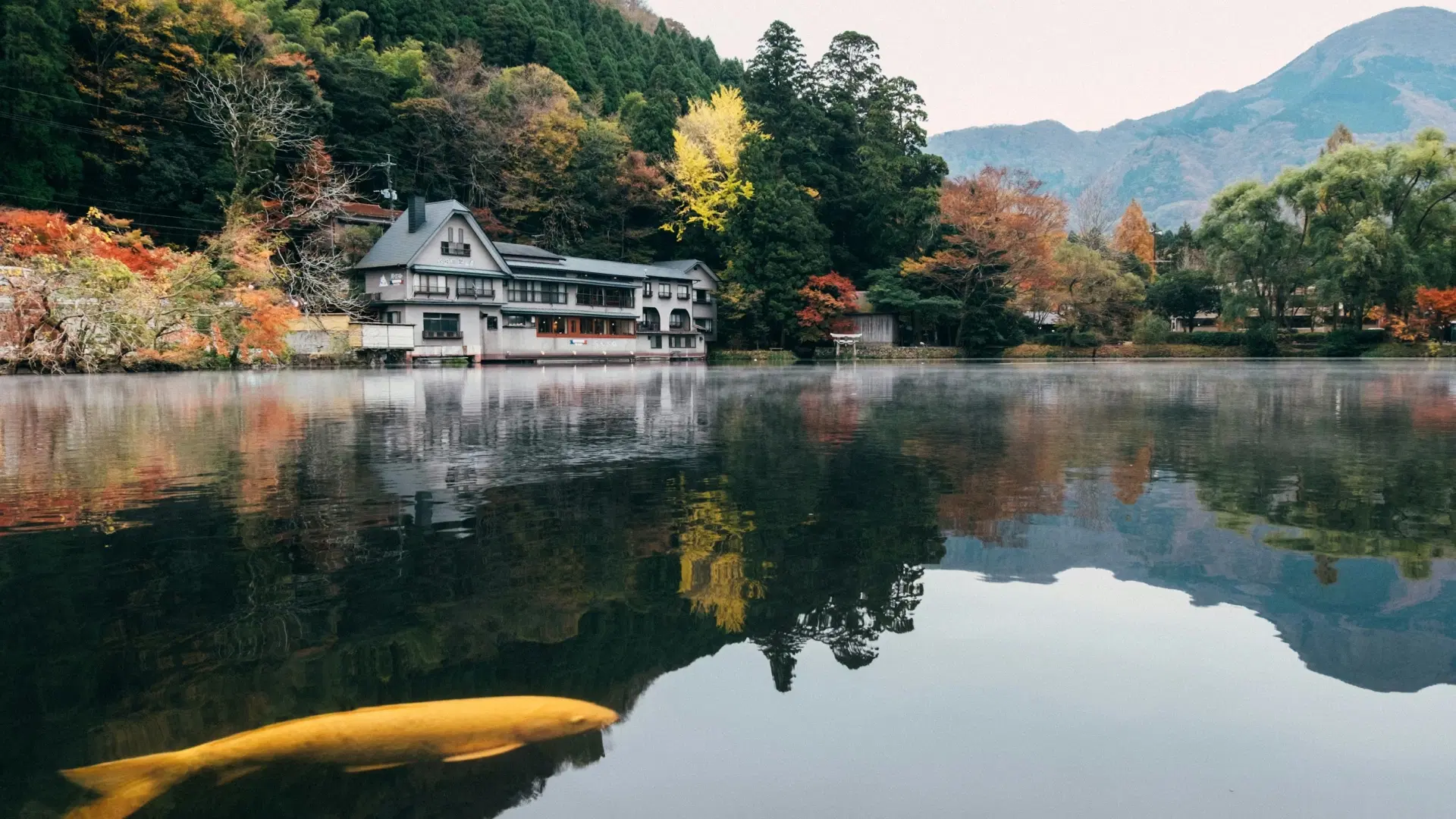
Lake Kinrin, at the eastern edge of the town center, is a small thermal lake fed by hot springs that keep portions of its surface warm enough to generate steam on cool mornings. The lake is ringed by trees whose foliage transforms with the seasons, the autumn maples and ginko reflected in water whose surface is broken only by the occasional rise of a carp. The Tenso Shrine on the lake's southern shore, approached through a torii gate flanked by towering cedars, provides a stillness that the busier main street cannot offer. Early morning, before the day-trippers arrive, is the essential hour at Kinrin, the mist lifting from the water in slow, dissolving veils.
Yunotsubo Kaido, the pedestrian street connecting JR Yufuin Station to Lake Kinrin, is the town's commercial spine, its roughly one-kilometer length lined with shops and galleries that reflect the town's commitment to craft over commerce. Glasswork studios, ceramics galleries, and small museums occupy converted farmhouses and purpose-built structures designed to harmonize with the surrounding architecture. The Yufuin Floral Village, though occasionally dismissed as theme-park quaintness, provides a fairy-tale aesthetic that children find enchanting and adults can appreciate as a commitment to whimsy in a landscape of restraint.
Mount Yufu itself offers a challenging but accessible hike. The trail from the western trailhead ascends through grassland and forest to the twin peaks at 1,584 meters, where clear-day views extend across the Kuju mountain range and, on exceptional days, as far as the Tsukushi Plain of northern Kyushu. The descent rewards with an onsen soak that carries the particular satisfaction of thermal immersion earned by physical effort.
Culinary Scene
Yufuin's culinary character reflects its positioning as a town where rural tradition and contemporary sophistication coexist without tension. The local cuisine draws on Oita's bounty of chicken, citrus, and freshwater fish, prepared in kitchens that range from farmhouse simplicity to ryokan refinement. Bungo-gyu, the premium beef raised in Oita's highland pastures, appears on many Yufuin menus as steak, shabu-shabu, or grilled over charcoal, the marbling and flavor reflecting the cattle's diet of clean mountain grass and the mineral-rich water of the volcanic plateau.
The town's cafe culture is unusually developed for a rural Japanese destination. Small, architect-designed coffee houses occupy sites along the main street and the quieter back lanes, serving single-origin brews alongside cakes and pastries that use local dairy and Oita's celebrated kabosu citrus. Several of these cafes offer terrace seating with views across rice paddies to Mount Yufu, compositions of steam, mountain, and cultivated field visible through the frame of a coffee cup. Yufuin roll cake, a sponge roll filled with cream made from local milk, has become the town's most popular edible souvenir, its simplicity and quality reflecting the same principles that govern the town's broader aesthetic.
Kabosu, the small, round citrus fruit native to Oita Prefecture, appears throughout Yufuin's cuisine as a seasoning, garnish, and flavoring. Its tartness, brighter and more aromatic than lemon, transforms grilled fish, tempura dipping sauce, and even cocktails with a flavor that has no precise equivalent in Western citrus traditions. Restaurants in Yufuin squeeze kabosu over virtually everything, a practice that initially seems excessive until the palate adjusts and begins to crave its particular lift.