Yamashiro Onsen
山代温泉Yamashiro Onsen is a town that has been healing travelers for thirteen centuries, its thermal waters first discovered, according to tradition, by the itinerant monk Gyoki in 725 AD when he observed a crow bathing its injured wing in a hot spring bubbling from the earth. Whether the legend is literally true matters less than what it communicates: that the relationship between this place and the act of bathing is old enough to belong to myth rather than history. The town that grew around those springs became one of the principal stops on the pilgrimage and trade routes crossing the Kaga region, a place where merchants, monks, artists, and aristocrats paused to restore themselves in waters whose mineral warmth seemed to dissolve not merely physical ailment but the accumulated fatigue of the road itself.
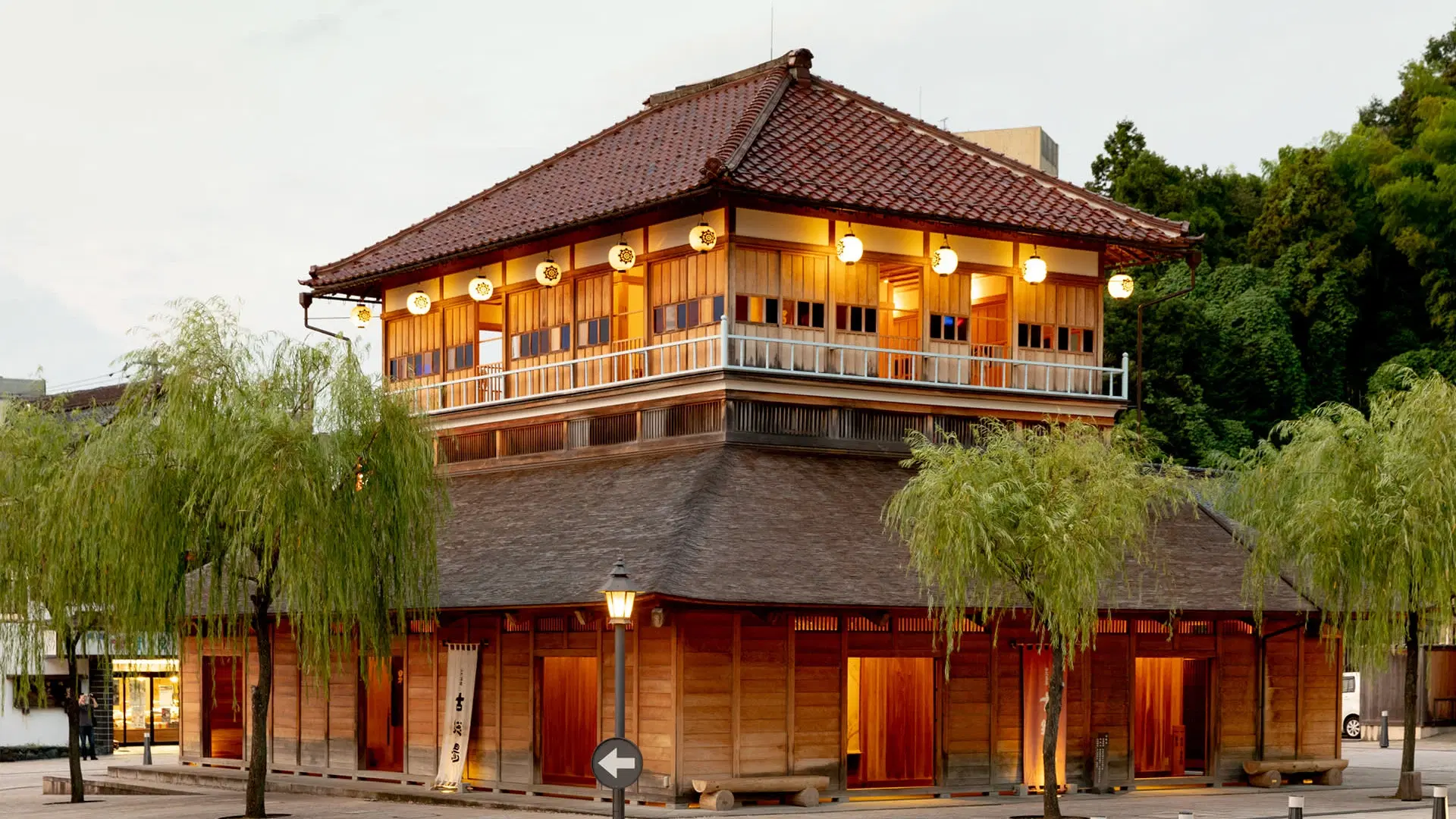
The town's spatial organization reflects a concept unique to the onsen communities of this region: the yu no machi, or hot spring village, arranged around a central communal bathhouse called the soyu. Yamashiro's soyu tradition dates back centuries, and the recent reconstruction of the Ko-soyu bathhouse, faithfully recreating the Meiji-era building that once stood on the site using traditional materials and techniques, has restored the architectural heart of the town. The building's stained glass windows, ornate tilework, and wooden changing rooms evoke an era when the public bath was not merely a functional space but a civic monument, a place where the community gathered and where the social hierarchies that governed daily life were temporarily suspended by the democracy of shared water.
Yamashiro's cultural significance extends beyond its waters. The town was a favorite retreat of Rosanjin Kitaoji, the twentieth-century polymath whose achievements in ceramics, calligraphy, painting, lacquerwork, and cuisine made him one of modern Japan's most formidable artistic figures. Rosanjin lived and worked in Yamashiro during a formative period, and the Rosanjin-an house where he stayed has been preserved as a museum that reveals the intersections between onsen culture, artistic practice, and the Kutani ceramic tradition that flourishes in the surrounding area. His presence sanctified the town as a place where creative work and thermal bathing exist in natural symbiosis, the relaxation of the body enabling the liberation of the artistic mind.
Yamashiro Onsen is a town that has been healing travelers for thirteen centuries, its thermal waters first discovered, according to tradition, by the itinerant monk Gyoki in 725 AD when he observed a crow bathing its injured wing in a hot spring bubbling from the earth.
Highlights
The Ko-soyu bathhouse stands at the center of Yamashiro's identity, its reconstruction a declaration that communal bathing remains the spiritual core of the town rather than a relic to be admired from behind glass. The building's exterior reproduces the Meiji-era original with faithful precision, its ornamental woodwork and tiled roof distinguished from the surrounding modern structures by a craftsmanship that insists on continuity with the past. Inside, the bathing halls are intimate in scale, their walls decorated with Kutani ceramic tiles in the bold, colorful style known as Kutani gosai, the five-color palette of green, yellow, purple, navy, and red that has defined the region's ceramic art since the seventeenth century. Bathing here is both a physical and an aesthetic experience, the warm mineral water and the vivid ceramics engaging different senses toward the same end of restoration.
The Rosanjin-an, a modest wooden house set among trees at the edge of the town, preserves the rooms where Kitaoji Rosanjin lived during his sojourn in Yamashiro in 1915. The house is small, its tatami rooms and garden views scaled to the proportions of domestic life rather than public grandeur, and this intimacy is precisely its power. Rosanjin's calligraphy, his ceramic experiments, his observations on the relationship between food, pottery, and the seasons were conceived in these rooms, and visiting the house offers a rare encounter with the material conditions of artistic creation. The adjacent irori hearth room, where Rosanjin is said to have cooked and debated with local potters, retains the blackened ceiling beams that testify to decades of charcoal fires.
The surrounding Kutani ceramic workshops and galleries extend the town's artistic heritage into the present. Several studios welcome visitors to observe the process of Kutani production, from the shaping of the clay through the application of the distinctive overglaze enamels that give Kutani ware its saturated, jewel-like color. The Kutani Pottery Village, a short drive from the town center, gathers kilns, galleries, and hands-on workshops in a setting that contextualizes the pottery within the landscape and geology that produce its raw materials.
Culinary Scene
Yamashiro's culinary culture is shaped by the kaiseki traditions of its finest ryokan, where multi-course dinners composed from the seasonal bounty of both the Japan Sea coast and the Kaga plain are served in private rooms overlooking gardens designed to frame the passage of the seasons. The winter table is dominated by kano crab, served as sashimi, grilled over charcoal, steamed in its shell, and simmered in nabe hot pot, the progression of preparations revealing different facets of the crab's sweetness and texture. Kaga vegetables, a collection of fifteen heirloom varieties preserved and cultivated within the region since the Edo period, appear throughout the year in preparations that honor their individual characters: the lotus root of Kaga renkon, dense and starchy, is grated and formed into dumplings; the slender Kaga thick cucumbers are pickled in rice bran; the gold-skinned Gorojima kintoki sweet potatoes are roasted until their flesh caramelizes.
The town's proximity to the Kutani ceramic tradition elevates the dining experience beyond flavor into the realm of visual art. In the best ryokan, each course arrives on vessels selected not merely for function but for harmony with the food they carry, the deep greens and purples of Kutani ware intensifying the colors of the ingredients arranged upon them. A slice of winter yellowtail on a celadon plate, a mound of grated daikon on a russet dish, a clear soup in a lacquered bowl whose black interior reveals the amber broth like a window into still water: these compositions demonstrate the Japanese principle that cooking is incomplete without consideration of the vessel, that the plate is not a stage but a collaborator in the experience of flavor.
Ryokans in Ishikawa
There are no ryokans in our guide listed in Yamashiro Onsen. See our selection across Ishikawa.
View ryokans in Ishikawa