Yamanaka Onsen
山中温泉Yamanaka Onsen is the place that moved Matsuo Basho to declare its waters one of the three finest hot springs in Japan, a judgment rendered during his journey through the deep north in 1689 and recorded in the prose that would become Oku no Hosomichi. Basho stayed in Yamanaka for nine days, an unusually long pause in a journey characterized by restless movement, and the length of his sojourn testifies to the restorative power he found in both the thermal waters and the gorge landscape that surrounds the town. He wrote that the waters of Yamanaka made it unnecessary to pick chrysanthemums for their life-prolonging properties, a classical allusion that elevated the spring from a physical amenity to a literary and spiritual phenomenon. The town has never forgotten this benediction, and Basho's presence haunts its pathways and gardens and bathhouses like a benevolent ghost whose approval still confers legitimacy.
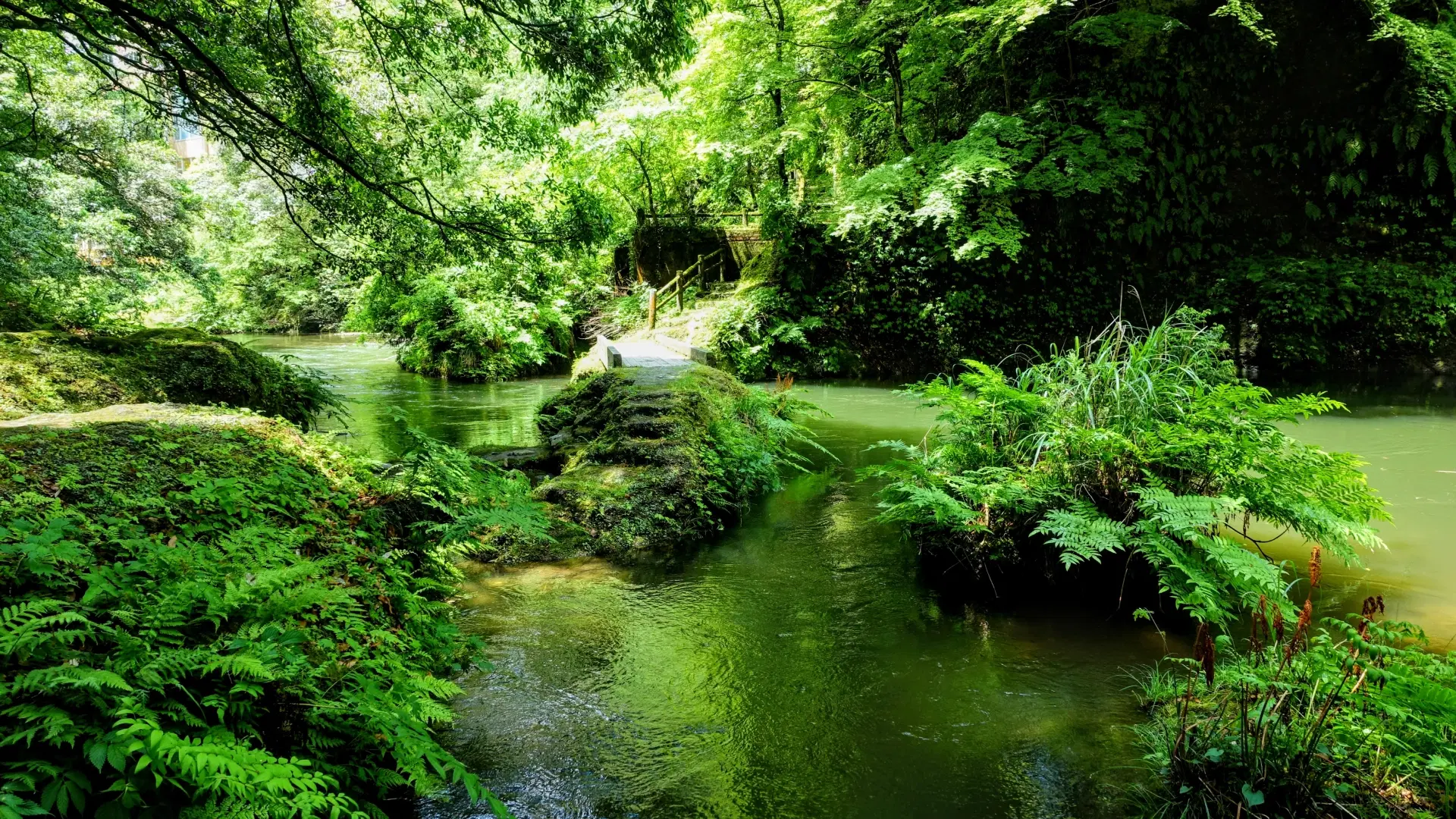
The town occupies a narrow valley carved by the Daishoji River, its buildings climbing the slopes above the Kakusenkei gorge, a corridor of volcanic rock, ancient cedar, and flowing water that constitutes one of the most beautiful riparian landscapes in the Hokuriku region. The gorge walk, tracing the riverbank for approximately 1.3 kilometers through a canopy of broadleaf forest, passes moss-covered boulders, small waterfalls, and the Ayatorihashi bridge, a sinuous S-curved span designed by the flower artist Ikebana Sogetsu school master Hiroshi Teshigahara, whose crimson lacquer form arcs above the gorge like a calligraphic stroke written across the landscape. The integration of contemporary art into an ancient natural setting is characteristic of Yamanaka's sensibility, a town that reveres its past without being imprisoned by it.
Yamanaka is also the center of a woodturning tradition that has produced lacquerware of extraordinary refinement for over four centuries. The yamanaka-nuri technique, which shapes bowls, cups, and vessels on a lathe from local zelkova, cherry, and horse chestnut wood before applying layers of urushi lacquer, results in objects whose lightness, warmth, and tactile beauty distinguish them from the lacquerware of other regions. The craft persists as a living industry rather than a heritage curiosity, its artisans adapting traditional techniques to contemporary design while maintaining the material integrity and hand-finishing that define the tradition.
Yamanaka Onsen is the place that moved Matsuo Basho to declare its waters one of the three finest hot springs in Japan, a judgment rendered during his journey through the deep north in 1689 and recorded in the prose that would become Oku no Hosomichi.
Highlights
The Kakusenkei gorge is Yamanaka's natural masterpiece, a walk that unfolds as a sequence of composed views where water, rock, forest canopy, and filtered light create an experience closer to moving through a garden than traversing wild terrain. The path follows the Daishoji River through a landscape sculpted by volcanic geology and centuries of careful human stewardship, the cedar and maple canopy managed to allow shafts of light that illuminate the moss-covered boulders and the dark pools where the river gathers before tumbling over low falls. In autumn, the maples transform the gorge into a corridor of crimson and amber, the color intensified by reflection in the river below. In summer, the deep green canopy and the sound of rushing water create a coolness that feels curative, a natural air conditioning that drew travelers here long before the thermal waters were discovered.
The Ayatorihashi bridge, completed in 1990, is a work of sculptural architecture that has become Yamanaka's contemporary emblem. Its S-curved form, spanning the gorge in a graceful arc of purple-crimson, was designed to echo the flowing line of ikebana arrangement, the bridge itself functioning as a flower arrangement in which the materials are steel and lacquer rather than branch and blossom. Crossing it provides elevated views of the gorge and river that reframe the landscape from a new angle, the curvature of the path slowing the walker's pace and directing attention downward to the water below.
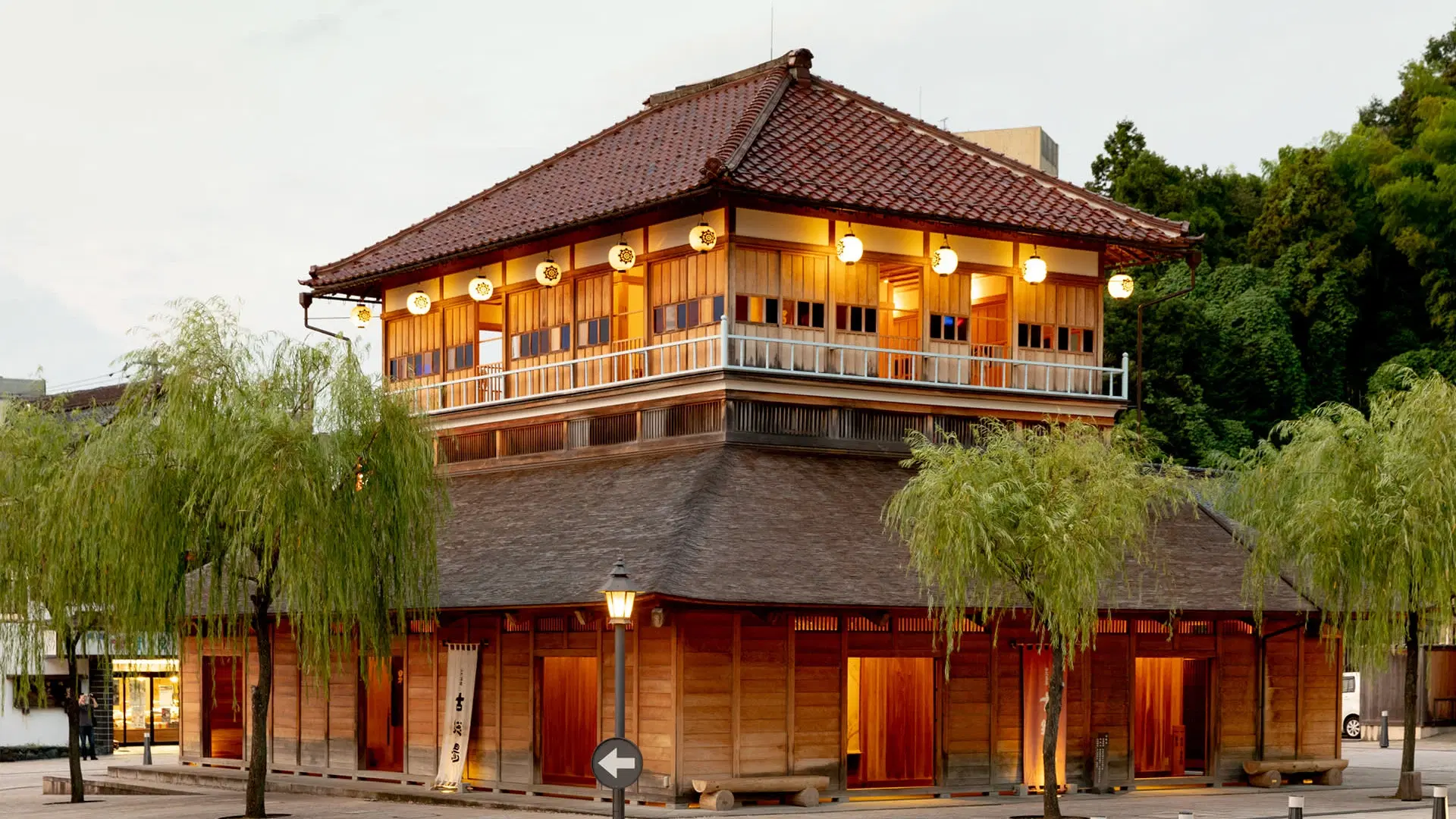
The soyu communal bathhouse, recently rebuilt in a design that references the town's architectural heritage while incorporating contemporary materials and spatial concepts, serves as Yamanaka's social center. Two bathing halls alternate between male and female use on a daily schedule: one rendered in the traditional style with wooden beams and stone, the other in a modern aesthetic of glass and tile. The alternation ensures that repeat visitors experience both sensibilities, the traditional hall evoking the bathhouse culture of Basho's era while the contemporary hall asserts that the onsen tradition is not frozen in the past but continues to evolve.
Culinary Scene
Yamanaka's dining culture reaches its fullest expression within the ryokan, where kaiseki meals composed with the discipline of poetic form translate the region's seasonal ingredients into multi-course narratives. The autumn and winter menus are particularly distinguished, incorporating matsutake mushrooms gathered from the surrounding forests, kano crab from the nearby coast, wild boar from the mountain valleys, and river fish including ayu sweetfish grilled over charcoal with a simplicity that honors the delicacy of the flesh. The presentation of these meals on yamanaka-nuri lacquerware and local ceramics creates a unity between food and vessel that embodies the Japanese concept of moritsuke, the art of arrangement that considers the plate as integral to the dish as any ingredient.
The town's confectionery tradition, sustained by the tea culture that has flourished in the Kaga region since the Maeda lords promoted the practice as a pillar of cultural refinement, produces wagashi of seasonal beauty. The sweets are designed to be experienced alongside matcha, their sweetness calibrated to complement the tea's bitterness, their forms shaped to evoke the natural world at a particular moment in the calendar: cherry petals in spring, flowing water in summer, chrysanthemums in autumn, snow-laden branches in winter. Several small shops along the town's main street produce these confections daily, their display cases functioning as miniature seasonal galleries that change with the passage of weeks.
Ryokans in Ishikawa
There are no ryokans in our guide listed in Yamanaka Onsen. See our selection across Ishikawa.
View ryokans in Ishikawa