Tojinbo
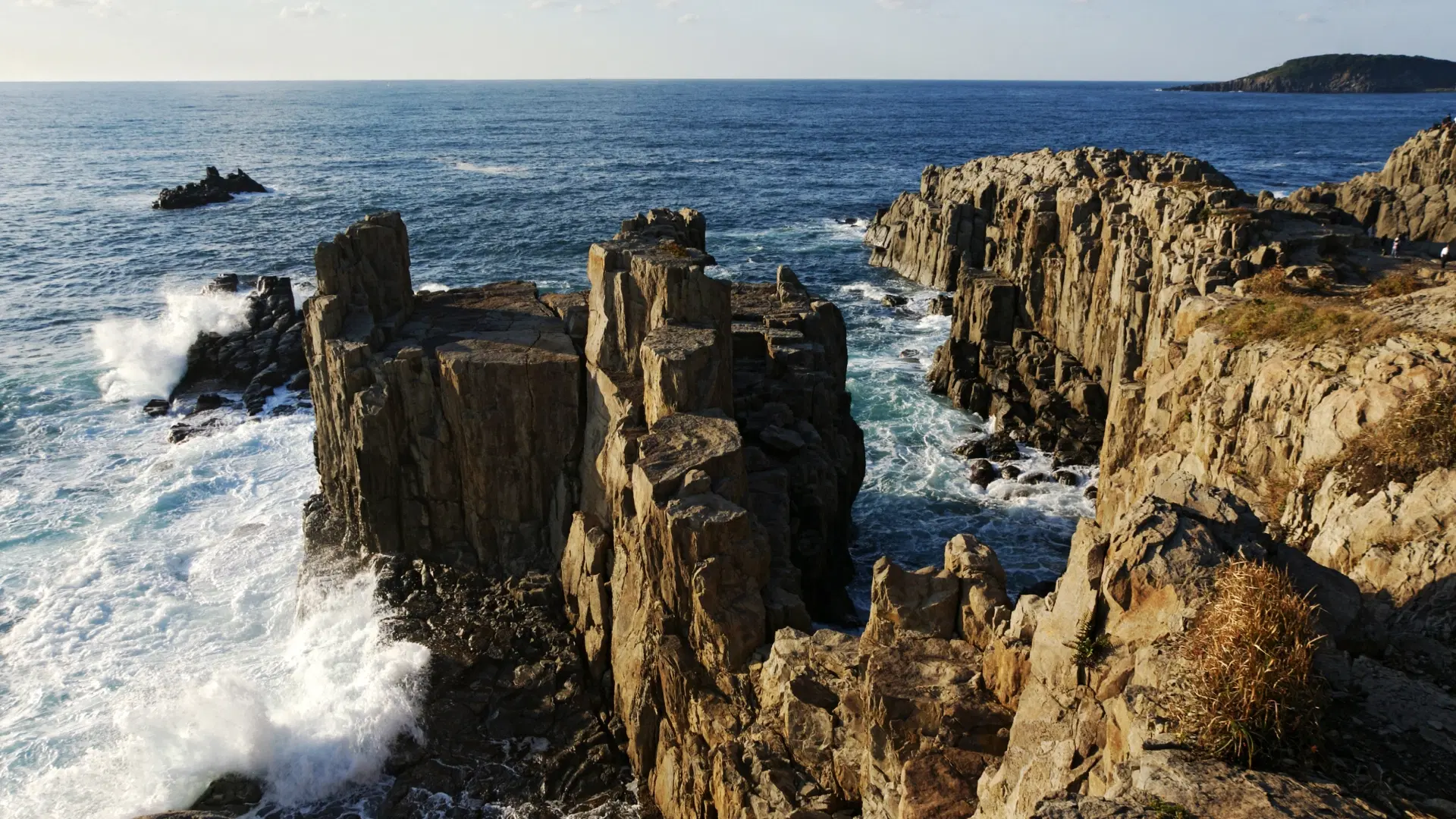
東尋坊Tojinbo is a geological drama written in columnar basalt, a kilometer-long stretch of sea cliffs on the Echizen coast where hexagonal rock pillars rise twenty-five meters above the churning Sea of Japan in formations so geometrically precise they appear engineered rather than natural. The cliffs are one of only three locations in the world where columnar jointing in andesite has produced structures of this scale and regularity, the others being the Strait of Dover and the coast of Korea. The rock was formed by volcanic activity approximately thirteen million years ago, its slow cooling producing the distinctive polygonal cross-sections that give each column the appearance of a crystalline organ pipe standing against the ocean.
The name Tojinbo derives from a legend of the Heian period, in which a monk of that name, despised by his fellow priests for his violence and dissolution, was lured to the cliff edge and thrown into the sea during a drinking party. For forty-nine days afterward, according to the story, the ocean raged with his vengeful spirit, and even now the turbulent waters at the base of the cliffs are attributed to his unresolved fury. Whether one reads this as supernatural folklore or as the narrative instinct of a coastal community seeking to explain the perpetual violence of waves against rock, the legend endows Tojinbo with a charged, liminal quality that mere geological interest cannot provide.
The cliffs are most powerful when the winter storms roll in from the Sea of Japan, driving waves against the basalt columns with a force that sends spray thirty meters into the air and produces a sound that is less crash than detonation. But even on calm summer days, when the water at the base of the cliffs is turquoise and transparent, the scale and verticality of the formations command a respect that borders on reverence. Walking along the unfenced cliff edge, where the rock drops away to the ocean without guardrail or warning, one feels the proximity of the elemental in a way that Japan's more cultivated landscapes deliberately soften.
Tojinbo is a geological drama written in columnar basalt, a kilometer-long stretch of sea cliffs on the Echizen coast where hexagonal rock pillars rise twenty-five meters above the churning Sea of Japan in formations so geometrically precise they appear engineered rather than natural.
Highlights
The cliff walk along Tojinbo's main promontory offers unmediated encounters with geological time. The basalt columns, their hexagonal surfaces weathered to shades of gray and rust, rise from the waterline in clusters that form natural platforms, corridors, and precipices. The path follows the cliff edge without significant barriers, allowing visitors to approach the drop and look down into the churning water below, where the ocean has carved caves and channels into the base of the formation. This lack of overprotection, unusual in contemporary Japan, preserves the raw power of the experience, though it demands alertness and respect for the terrain.
Oshima Island, connected to the mainland by a pedestrian bridge, extends the cliff landscape into a quieter setting. The island's circumference path passes through a grove of wind-stunted pines and along rock formations that continue the columnar basalt patterns of the main cliffs but at a more intimate scale. A small Shinto shrine occupies the island's highest point, its torii gate framing a view of the open sea that, on clear days, extends to the distant shapes of the Noto Peninsula. The island is less visited than the main cliffs, and walking its perimeter in the late afternoon, when the western sun illuminates the rock faces and the fishing boats return to port, provides a contemplative counterpoint to the drama of the promontory.
The Tojinbo Tower, a modest observation platform near the visitor area, provides an elevated perspective that reveals the full extent of the cliff system and its relationship to the surrounding coastline. From this height, the geological structure becomes legible as a continuous formation rather than a series of individual pillars, the columnar jointing extending both along the coast and back from the cliff edge into the land. On clear winter days, the view encompasses the snow-capped peaks of Mount Hakusan to the southeast and the gray expanse of the Sea of Japan to the northwest, placing Tojinbo at the junction of mountain and ocean that defines Fukui's geography.
Culinary Scene
The fishing villages flanking Tojinbo supply a marine pantry that shapes the dining experience along this stretch of coast. The area's restaurants specialize in the seafood of the Echizen coast, with particular emphasis on the seasonal catches that define the culinary calendar: squid and turban shells in summer, yellowtail and sea bream in autumn, and the crowning glory of echizen-gani snow crab from November through March. The crab is served in the full range of preparations, from delicate sashimi that reveals the raw flesh's sweetness to charcoal-grilled legs whose caramelized edges concentrate the flavor, to kani-meshi, crab mixed with seasoned rice and steamed in a ceramic pot.
Several restaurants overlooking the cliffs combine the seafood experience with panoramic views of the Sea of Japan, creating a dining context where the source of the meal is visible from the table. Kaisendon, bowls of rice topped with assorted raw seafood, and ika-yaki, grilled whole squid brushed with soy, represent the more casual end of the spectrum, while the fuller set meals at the better establishments compose multi-course narratives from the day's catch. The proximity to Awara Onsen, fifteen minutes by bus, allows visitors to combine a morning at the cliffs with a seafood lunch before retreating to the thermal waters for the afternoon.
Ryokans in Fukui
There are no ryokans in our guide listed in Tojinbo. See our selection across Fukui.
View ryokans in Fukui