Awara Onsen
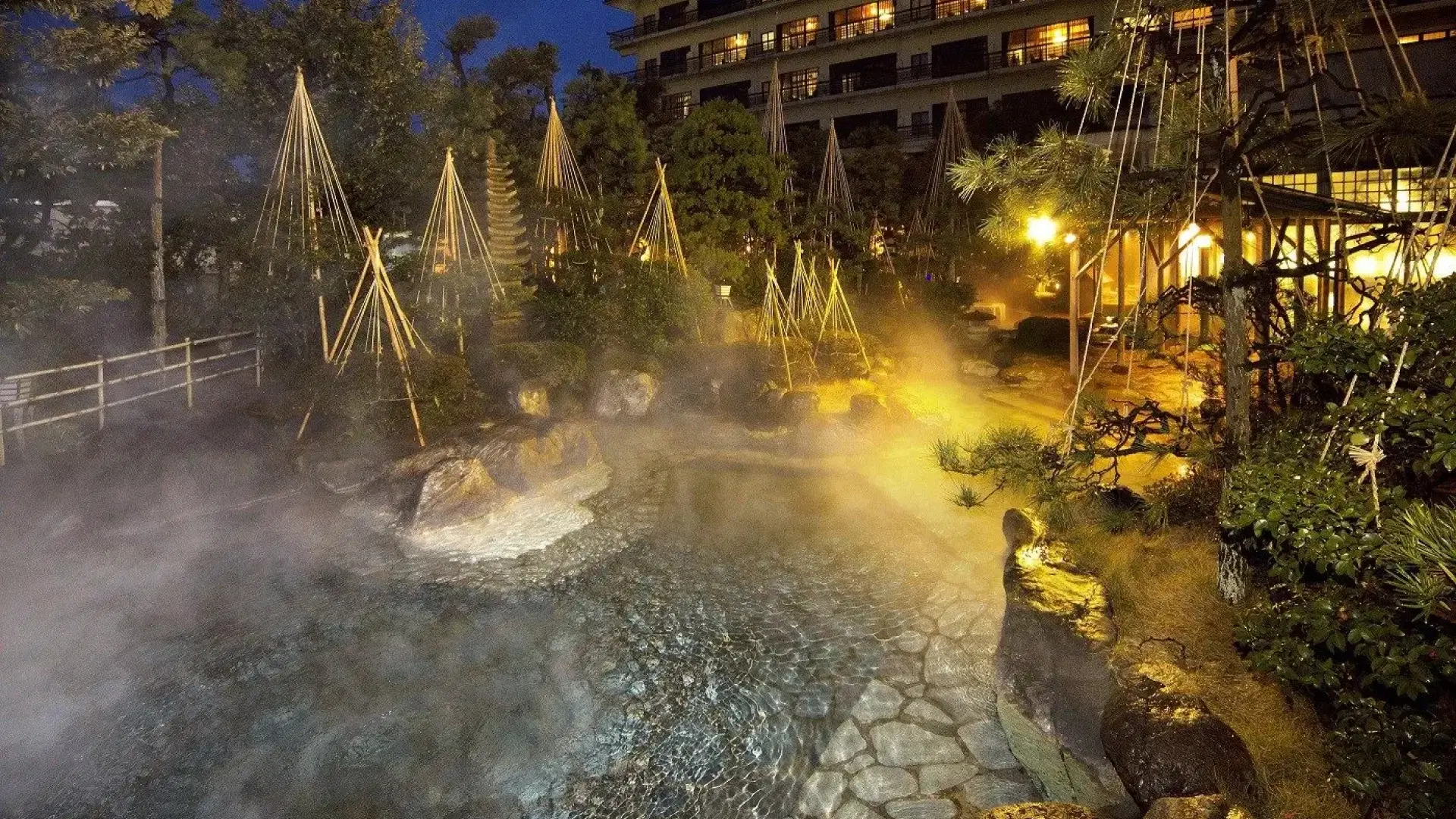
あわら温泉Awara Onsen emerged from the rice paddies of the Fukui coastal plain in 1883, when a farmer drilling for irrigation water struck a thermal spring instead, and the town that grew around this accidental discovery has spent the intervening century and a half cultivating a hot spring culture that balances refinement with agricultural honesty. Unlike the mountain onsen villages that derive their character from remoteness and vertical landscape, Awara sits in flat, open country near the Sea of Japan coast, its ryokan and bathhouses surrounded by the very rice fields and vegetable plots that supply their kitchens. This proximity to the source of sustenance gives Awara a groundedness that more dramatic settings sometimes lack.
The town earned the epithet "the parlor of the Kansai" during the early twentieth century, when wealthy merchants and industrialists from Osaka and Kyoto discovered that its thermal waters, combined with the exceptional seafood of the Echizen coast and the quiet countryside setting, provided a retreat of uncommon quality within relatively easy reach. That reputation attracted writers and artists, among them the novelist Izumi Kyoka, whose visits deepened the town's literary associations and established Awara as a place where creative sensibility and thermal relaxation existed in mutual reinforcement.
Today, Awara's ryokan range from intimate, family-operated establishments to larger properties with extensive garden grounds, but the best of them share a commitment to the kaiseki tradition that treats dinner as the evening's central event. The thermal water, a sodium chloride spring whose warmth penetrates deeply into muscle and joint, is distributed to each ryokan from multiple source wells, and the variations in mineral composition between wells give different properties subtly different bathing characters. Walking through Awara in the evening, when the ryokan lanterns illuminate the quiet streets and the steam from outdoor baths rises into the cool air, one encounters a hot spring town that has preserved its atmosphere without retreating into nostalgia.
Highlights
The Awara Yutaka public footbath, located at the center of the town near the main bus stop, offers a casual introduction to the thermal waters and serves as the social heart of the community. The open-air facility, designed with wooden benches surrounding a steaming pool, invites travelers to remove their shoes and soak their feet while observing the rhythm of the town. Locals gather here in the early evening, and conversations between strangers form easily over the shared experience of warm water, a dynamic that captures something essential about onsen culture's capacity to dissolve the barriers of formality.
The Kanazu district, adjacent to Awara, houses the Yoshizaki Gobo temple ruins, a fifteenth-century fortified temple of the Jodo Shinshu sect that played a pivotal role in the Ikko-ikki peasant uprisings that shaped the political history of the Hokuriku region. The archaeological site and accompanying museum provide context for understanding the fierce independence that has characterized Fukui's communities for centuries, a quality that persists in the self-reliance and directness of the people one encounters in Awara today.
The surrounding countryside rewards exploration by bicycle, the flat terrain and narrow farm roads passing through rice paddies, lotus ponds, and small villages where farmhouses of traditional construction still stand beside their working fields. In early summer, when the rice paddies have been flooded and the young shoots emerge in brilliant green rows, the landscape achieves a geometric beauty that rivals any designed garden. The agricultural calendar is not separate from the onsen experience but integral to it, the seasonal ingredients that appear at dinner having traveled, in many cases, only a few kilometers from field to kitchen.
Culinary Scene
Awara's culinary reputation rests on the convergence of two extraordinary pantries: the Sea of Japan, whose cold, nutrient-rich waters produce some of the finest seafood in the country, and the Echizen agricultural plain, whose rice, vegetables, and soba buckwheat supply the inland counterpoint. The winter months bring echizen-gani, the male snow crab caught off the Fukui coast that ranks among Japan's most prized crustaceans, its sweet, dense leg meat and rich coral served in preparations that range from raw sashimi to grilled over charcoal to steamed in the shell. The crab season, from November through March, transforms Awara's ryokan dining rooms into temples of crustacean worship, multi-course dinners building through six or seven crab preparations to reveal every dimension of the ingredient.
Beyond crab season, the kitchen calendar proceeds through a succession of seasonal peaks: spring brings mountain vegetables and bamboo shoots; summer offers abalone, turban shells, and the first of the year's squid; autumn introduces matsutake mushrooms and the fattening yellowtail that migrates south along the coast. Echizen oroshi soba, the region's signature noodle dish, appears year-round as a palate cleanser between courses or as a simple lunch in the town's soba shops. The rice of the Echizen plain, particularly the Koshihikari variety that thrives in Fukui's climate, provides the foundation for every meal, its subtle sweetness and firm texture setting a standard that explains why Fukui consistently ranks among Japan's finest rice-producing prefectures.
Ryokans in Fukui
There are no ryokans in our guide listed in Awara Onsen. See our selection across Fukui.
View ryokans in Fukui