Yokote Kamakura Festival
横手かまくらThe Yokote Kamakura Festival transforms one of Akita's snowiest cities into a landscape of softly glowing chambers carved from the material that defines winter in the Tohoku region. Each February, when the snow has accumulated to its deepest, the residents of Yokote construct hundreds of kamakura, domed snow houses approximately two meters tall and equally wide, along the banks of the Yokote River, on the grounds of Yokote Castle, and throughout the residential neighborhoods of the city. Inside each kamakura sits a small altar to Suijin, the Shinto deity of water, and children tend the shrine by offering amazake and mochi to visitors who kneel at the entrance and receive the warmth of both the drink and the greeting.
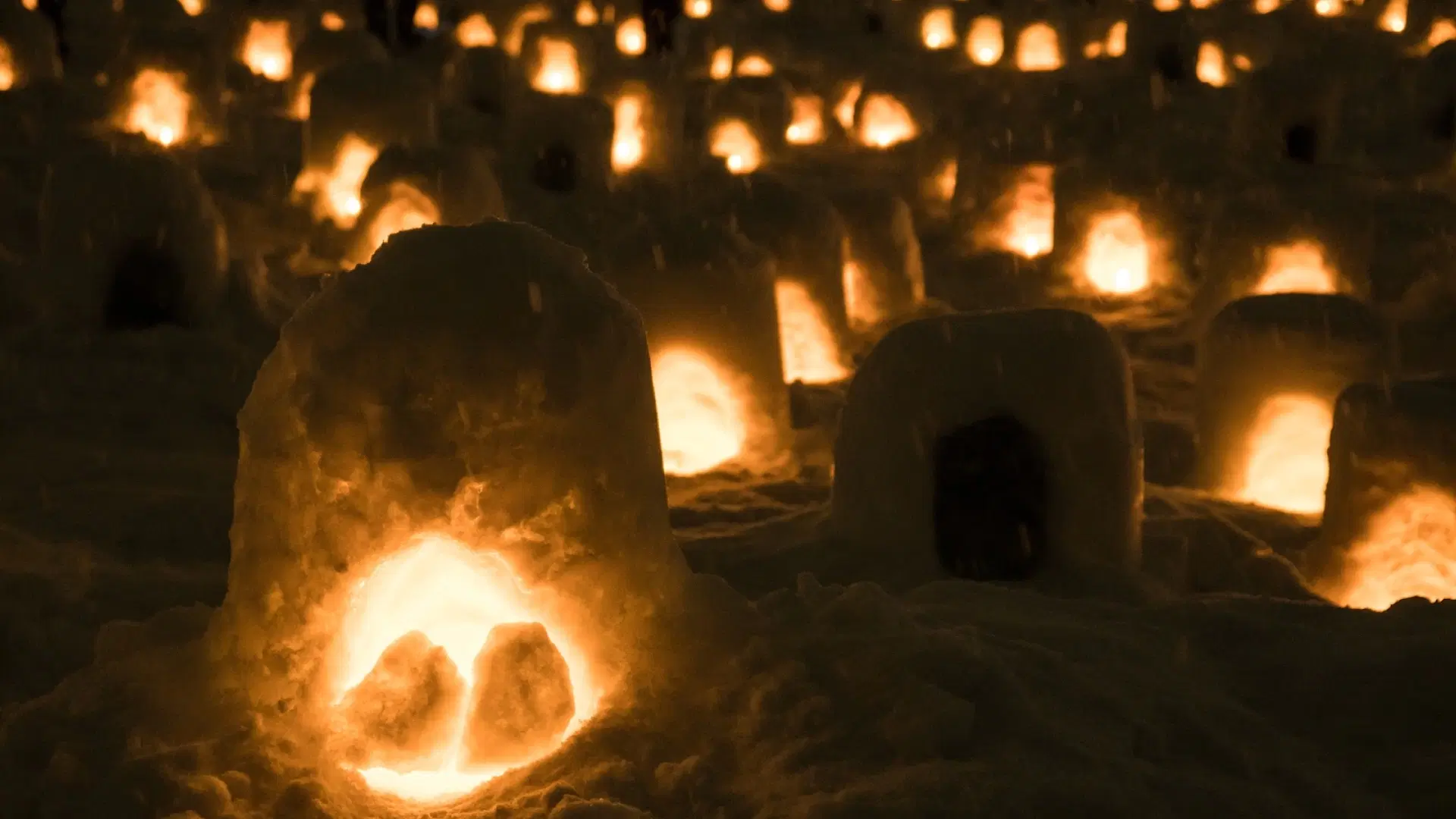
The visual effect is extraordinary. As evening falls and the candles within the kamakura are lit, the snow walls begin to glow with a warm amber light that transforms the city into something that resembles a constellation brought to earth. The larger kamakura, spacious enough for several people to sit inside, create intimate rooms where the cold of the outside world is held at bay by the insulating properties of the snow itself. The experience of sitting inside one, the candlelight flickering against the curved walls, the muffled silence of the snow, the sweetness of the amazake, engages the senses in a manner that is at once ancient and immediate.
The festival is not a performance staged for tourists but a community practice in which residents of all ages participate, building the kamakura in the days preceding the event and maintaining them through the festival nights. This quality of lived tradition, rather than presented spectacle, gives the Yokote Kamakura its particular emotional resonance.
The Yokote Kamakura Festival transforms one of Akita's snowiest cities into a landscape of softly glowing chambers carved from the material that defines winter in the Tohoku region.
History & Significance
The origins of the Kamakura Festival reach back at least four hundred years, though the precise genesis remains a subject of local debate. One tradition holds that the practice began as a New Year observance in which snow shelters were constructed for the worship of Suijin, whose blessing was essential for the rice cultivation that sustained the region. Another traces the custom to children's play, the construction of snow houses being a natural response to the environment's abundance of raw material. The truth likely encompasses both: a practical engagement with deep snow that acquired spiritual significance over generations of repetition.
The festival's scale and organization expanded during the Meiji and Taisho periods, when what had been a scattered neighborhood practice was consolidated into a citywide event. The postwar decades brought further growth, national attention, and the infrastructure of tourism, but the festival's essential character, its rootedness in the community's relationship with snow and with the water deity who governs the cycle of seasons, has remained constant. The Yokote Kamakura is now recognized as an Important Intangible Folk Cultural Property, a designation that protects its practice and acknowledges its significance within Japan's festival tradition.
What to Expect
The main festival evenings of February 15th and 16th see approximately one hundred large kamakura and countless smaller miniature versions constructed throughout the city. The primary viewing areas are along the Yokote River, at Yokote Castle grounds, and in the Futaba-cho neighborhood, where the kamakura are built in close formation and the cumulative glow is most impressive. Children inside the larger kamakura invite passersby to enter, sit on straw mats, and share amazake and grilled mochi, a gesture of hospitality that connects the modern visitor to a centuries-old practice of communal warmth.
The miniature kamakura, often just thirty centimeters tall, are arranged by the hundreds along the riverbank and on hillsides, each containing a single candle. When lit simultaneously at dusk, they create a field of tiny lights that stretches along the water's edge, their reflections doubling in the dark surface of the river. This secondary spectacle is, for many visitors, even more moving than the larger kamakura, its scale and collective effort suggesting a community acting in concert against the darkness and cold.
The temperature during the festival typically drops well below freezing, and the beauty of the experience is inseparable from the physical challenge of enduring it. Proper winter clothing, including insulated boots, thermal layers, and hand warmers, is not optional but essential. The cold itself becomes part of the memory, the relief of entering a kamakura's relative warmth heightened by the chill that preceded it.