Kakunodate
角館Kakunodate is a town that carries its past not as a burden but as a posture. Laid out in 1620 by the Ashina clan along the banks of the Hinokinai River, this former castle town was designed with a deliberate geometry that persists to this day: a wide central avenue lined with samurai residences to the north, a merchant quarter to the south, and a hierarchy of walls, gates, and gardens that made social order visible in the landscape itself. When the Satake clan assumed control later that century, they preserved and refined the town's structure rather than remaking it, and the result is one of the most intact samurai districts in all of Japan.
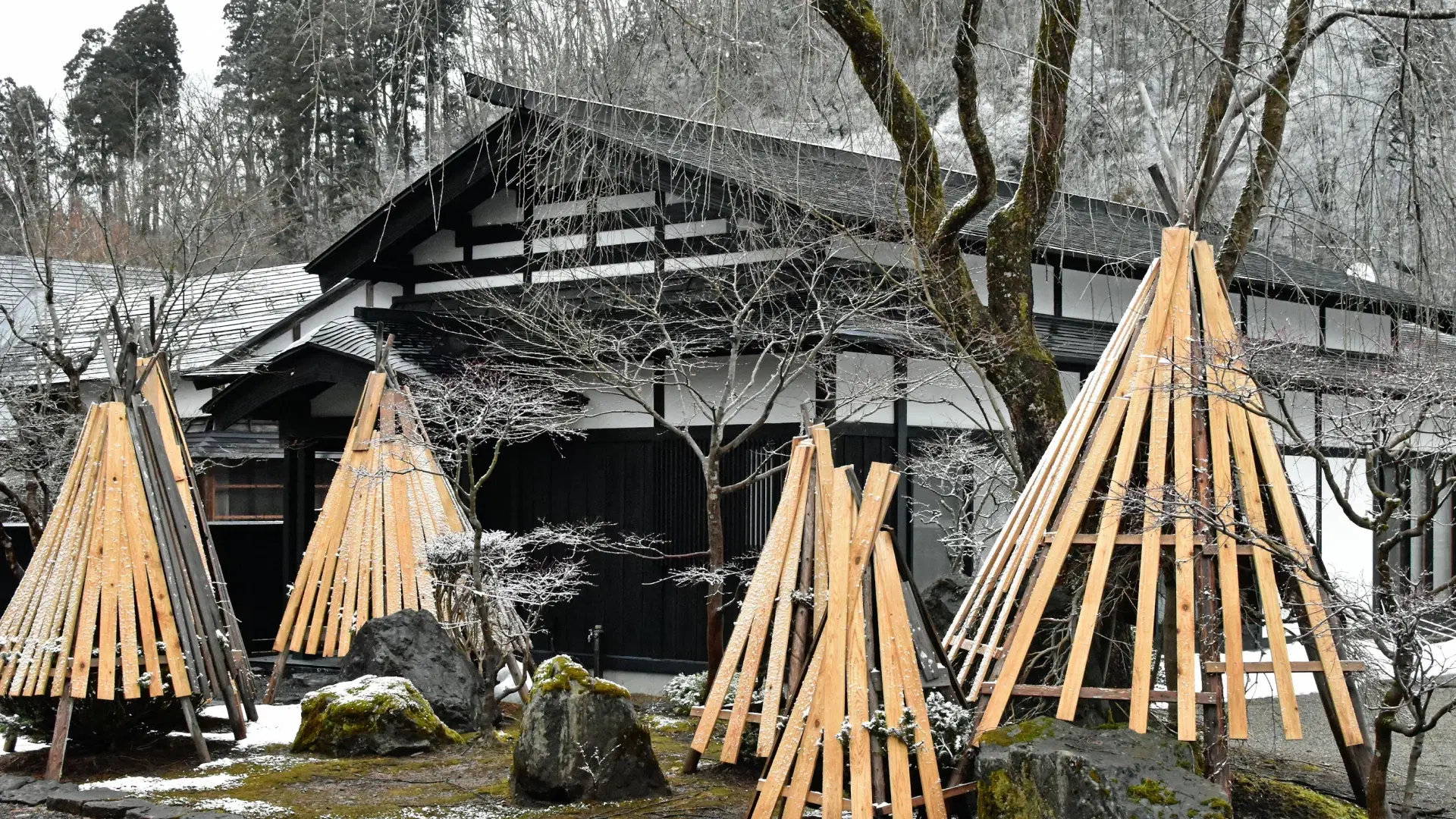
The bukeyashiki, or samurai residences, that line Uchimachi street are not reconstructions. They are original structures, maintained across generations by the families that still inhabit several of them, their darkened timber, thatched roofs, and enclosed gardens forming a streetscape that registers as something profoundly older than the modern town surrounding it. The weeping cherry trees that arch over the walls of the Aoyagi and Ishiguro residences were brought from Kyoto three centuries ago, a transplantation that speaks to the cultural ambitions of a provincial warrior class determined to bring the refinements of the capital to the northern frontier.
Kakunodate's reputation rests on a quality that is increasingly rare in Japan's heritage destinations: authenticity without performance. There are no costumed guides, no themed attractions, no attempt to recreate an imagined past. The town simply continues, its rhythms shaped by seasons that bring cherry blossoms in spring, deep snow in winter, and a quiet that descends in the intervals between, when the streets belong to residents rather than visitors.
Kakunodate is a town that carries its past not as a burden but as a posture.
Highlights
The samurai district of Uchimachi is the heart of any visit, and the street itself, wide enough for a mounted procession, is the primary experience. Walking its length under the canopy of weeping cherries, past the dark wooden fences and earthen walls of the bukeyashiki, imposes a pace that the rest of modern Japan rarely permits. The Aoyagi Samurai Manor Museum, the most comprehensive of the open residences, contains collections of arms, pottery, and household objects that document the daily life of the samurai class with a granularity that narrative history cannot achieve. The Ishiguro Residence, the oldest surviving samurai house in Kakunodate, offers a more intimate experience, its garden and interiors preserved with a restraint that reflects the aesthetic values of its original occupants.
The Hinokinai River embankment, a two-kilometer stretch lined with somei-yoshino cherry trees, provides Kakunodate's other great seasonal spectacle. Unlike the weeping cherries of the samurai district, which are shidarezakura of aristocratic lineage, the riverside trees are the common variety that defines hanami across Japan, and their simultaneous bloom creates a tunnel of white and pale pink that draws visitors from across the Tohoku region.
The Denshokan museum, housed in a building that combines Meiji-era Western architecture with traditional Japanese interiors, documents Kakunodate's distinctive craft of kabazaiku, the art of working with wild cherry bark. This technique, developed by lower-ranking samurai as a supplementary income during the Edo period, produces tea canisters, trays, and decorative objects with a lustrous, deep-brown surface that improves with age and handling.
Culinary Scene
Kakunodate's food culture is rooted in the provisions of a mountain domain where long winters demanded preservation and ingenuity. Inaniwa udon, the thin, hand-stretched wheat noodles produced in the nearby town of Inaniwa, are among the most refined noodle traditions in Japan, their silken texture and translucent appearance the product of a three-day production process that involves repeated stretching, drying, and aging. Served cold with a light dipping sauce in summer or in warm broth during the colder months, these noodles represent the pinnacle of Akita's wheat-working heritage. The best restaurants in Kakunodate serve them with a simplicity that allows the noodle's character to speak without distraction.
Kiritanpo, the iconic Akita preparation of freshly pounded rice formed around cedar skewers and grilled over charcoal, is served here in its most traditional context. In the kiritanpo nabe, a hot pot preparation, the grilled rice sticks absorb a rich broth made from hinai-jidori chicken, burdock root, maitake mushrooms, and seri, the wild parsley that grows along Akita's waterways. This is cold-weather food of the highest order, a dish that transforms simple ingredients into something greater through technique and the quality of its components.
The local sake, brewed from Akita's celebrated rice varieties and the soft, mineral-rich water that flows from the mountains, is among the finest in northern Honshu. Several small breweries in and around Kakunodate produce junmai and junmai ginjo expressions that pair naturally with the region's cuisine, their clean, slightly sweet profiles reflecting the character of the water and the skill of brewers who have worked these recipes for generations.
Ryokans in Akita
There are no ryokans in our guide listed in Kakunodate. See our selection across Akita.
View ryokans in Akita