Kintaikyo Bridge Festival
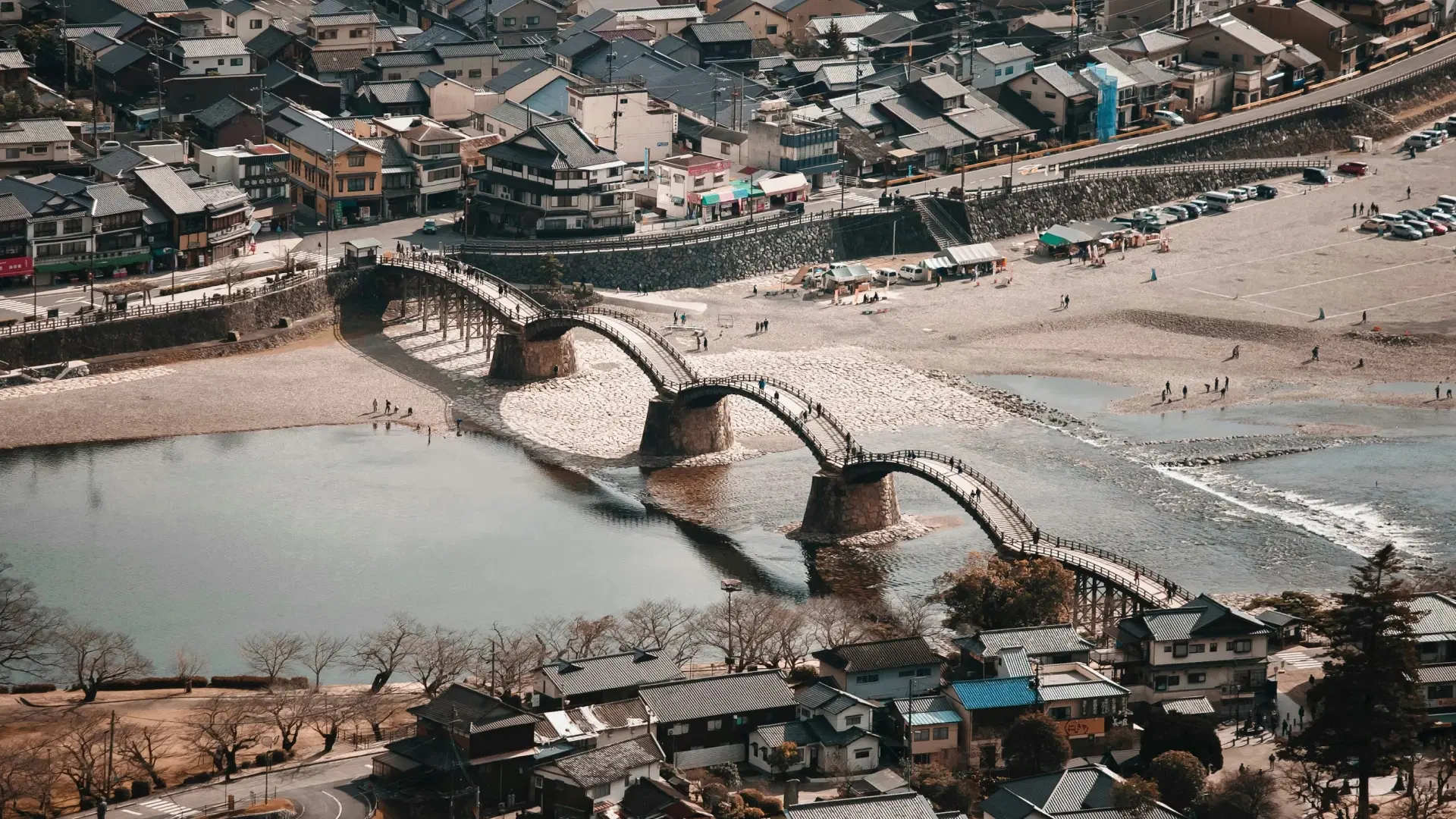
錦帯橋まつりThe Kintaikyo Bridge Festival celebrates one of the most beautiful works of civil engineering in Japan, a five-arched wooden bridge whose graceful curves span the Nishiki River in the city of Iwakuni with a structural elegance that has captivated visitors since its original construction in 1673. The bridge, destroyed and rebuilt multiple times over the centuries, most recently in 2001-2004 using traditional construction methods, achieves a visual harmony between its wooden arches, the river below, the castle on the hilltop above, and the surrounding mountains that places it among the most perfectly composed architectural landscapes in the country. The festival, held annually on April 29, brings this landscape to life with processions, performances, and the particular spectacle of a daimyo parade crossing the bridge in period costume, the costumed figures and the wooden arches combining in compositions that seem to belong to a woodblock print rather than the contemporary world.
The bridge's beauty is inseparable from its engineering. The five arches, three rising in steep curves over the river's center and two flatter spans connecting them to the banks, are constructed entirely of wood, their structural integrity achieved through an interlocking system of beams, brackets, and iron clamps that distributes the weight and stress of each arch without the use of nails in the primary structure. This engineering, conceived by the Iwakuni domain's lord Kikkawa Hiroyoshi in the seventeenth century after he studied the arched bridges depicted in Chinese paintings, represents a fusion of aesthetic aspiration and technical innovation that is characteristic of the finest Japanese architecture.
The festival's timing in late April places it within the cherry blossom season, when the trees that line the riverbank beneath the bridge create a canopy of pink that frames the wooden arches in seasonal color. The combination of blossoms, bridge, river, and the reconstructed castle visible on the hilltop above produces a scene of such concentrated beauty that it has become one of the most photographed and painted landscapes in western Japan.
The Kintaikyo Bridge Festival celebrates one of the most beautiful works of civil engineering in Japan, a five-arched wooden bridge whose graceful curves span the Nishiki River in the city of Iwakuni with a structural elegance that has captivated visitors since its original construction in 1673.
History & Significance
The original Kintaikyo was completed in 1673, designed by Kikkawa Hiroyoshi, the third lord of the Iwakuni domain, as a structure that could withstand the Nishiki River's powerful floods. Previous bridges at the site had been repeatedly destroyed by the river's seasonal torrents, and Kikkawa's solution, inspired by illustrations of Chinese arched bridges and developed through consultation with engineers and carpenters, produced a structure whose elevated arches allowed floodwaters to pass beneath without exerting the destructive lateral force that had toppled its predecessors. The bridge survived for nearly three centuries, maintained through regular repairs and partial reconstructions that preserved its original design and construction methods.
The bridge was destroyed in September 1950 by Typhoon Kijia, whose floodwaters exceeded the structure's engineered capacity. The loss was felt as a communal trauma by the people of Iwakuni, and the reconstruction, completed in 1953, was undertaken with the determination to replicate the original as faithfully as possible. This reconstruction served the city for half a century before the decision was made in 2001 to undertake a complete rebuilding using the same species of timber, the same construction techniques, and the same structural principles as the 1673 original. The 2001-2004 reconstruction, which involved the complete disassembly and replacement of the bridge's wooden elements, demonstrated the continuing viability of traditional Japanese joinery and engineering at a scale that few contemporary projects have attempted.
The festival has been held in various forms since the bridge's reconstruction, its annual observance marking both the bridge's significance as a work of architecture and its role as the symbol of Iwakuni's civic identity. The April 29 date, a national holiday, ensures broad attendance and has established the festival as one of the most visited events in Yamaguchi Prefecture.
What to Expect
The festival's centerpiece is the Sankin Kotai procession, a recreation of the daimyo procession in which the lord of the Iwakuni domain and his retinue cross the Kintaikyo in full period costume. The participants, dressed in the formal attire of the Edo-period warrior class, ascend the steep wooden arches of the bridge in a slow, ceremonial march whose visual impact is amplified by the setting: the river below, the cherry blossoms above, and the castle on the hilltop providing a backdrop of natural and architectural beauty that transforms the procession into a moving tableau of feudal Japan. The procession crosses the bridge multiple times throughout the day, allowing visitors multiple opportunities to view and photograph the spectacle from different positions along the riverbank.
Traditional performing arts, including Iwakuni's distinctive kagura dance and taiko drumming, are presented on stages erected near the bridge, and demonstrations of martial arts, tea ceremony, and traditional crafts provide cultural context for the historical spectacle of the procession. The cherry trees along the riverbank, typically at or near peak bloom during the festival's late April date, create a secondary spectacle that draws its own devoted viewers, and the combination of hanami and festival creates an atmosphere of layered celebration that is particularly Japanese in its capacity to appreciate multiple forms of beauty simultaneously.
Food stalls line the approaches to the bridge and the riverbank, offering local specialties including Iwakuni-zushi, a pressed sushi layered with lotus root, egg, and fish in a wooden box, and regional soft-serve flavors that reflect the seasonal character of the setting. The festival's atmosphere is familial and accessible, the bridge itself providing the organizing principle around which all activities are arranged and to which all attention inevitably returns.