Matsue
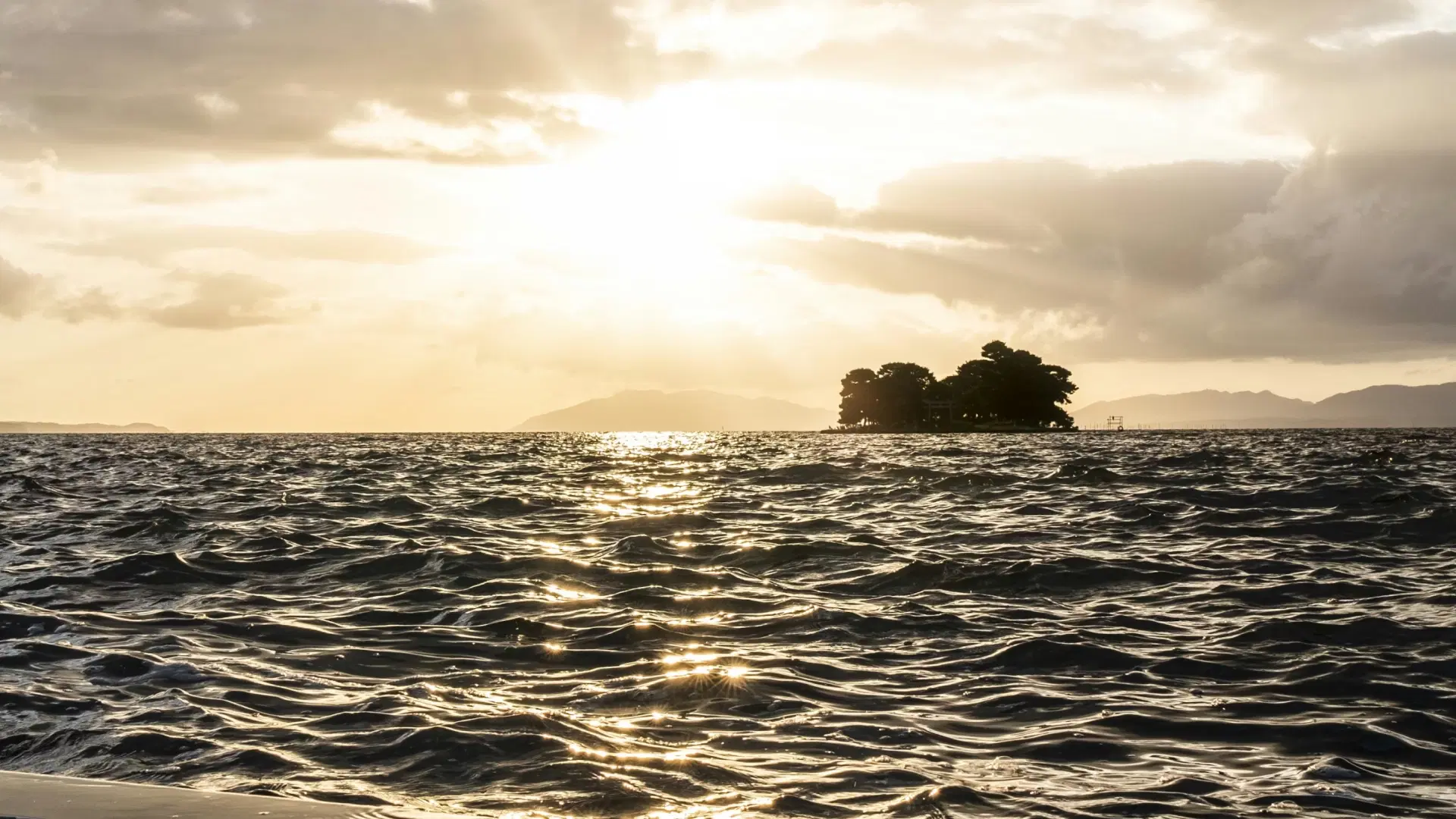
松江Matsue is the city of water, its identity determined by a geography that places it between two bodies: Lake Shinji to the west, whose sunset view across the brackish surface is considered one of the most beautiful in Japan, and Lake Nakaumi to the east, whose connection to the Japan Sea through a narrow strait makes it a transitional zone between fresh and salt water. The Ohashi River links the two lakes through the center of the city, and the canals that extend from it into the surrounding neighborhoods create a townscape where water is never more than a few minutes' walk from any point. The castle, the samurai district, the merchant quarters, and the temple grounds are all oriented toward and shaped by this aquatic geography, and the experience of Matsue is inseparable from the presence of water, its reflections, its sounds, its effect on the quality of the light.
The city's castle, one of only twelve original-construction castles remaining in Japan and designated a National Treasure, rises from a pine-covered hillock at the city's center, its dark wooden walls and broad, spreading rooflines giving it a profile that has earned the nickname "Black Castle" and distinguishing it from the white-walled elegance of Himeji or the grey stone severity of Kumamoto. The castle was built in 1611 by Horio Yoshiharu, and its survival through the Meiji-era destruction of feudal fortifications, the wartime bombing that devastated most Japanese cities, and the postwar drive for modernization makes it a continuous thread connecting the present city to the feudal order that created it. From the castle's upper floors, the view encompasses both lakes, the city's canal network, and the distant profile of Mount Daisen, a panorama that explains why successive lords chose this site as the seat of power for the Izumo region.
Matsue's cultural identity is inseparable from Lafcadio Hearn, the Greek-born, Anglo-Irish writer who arrived in Japan in 1890 and settled in Matsue, where he married into a local samurai family, adopted the Japanese name Koizumi Yakumo, and produced the literary works that introduced Japanese folklore, ghost stories, and cultural observation to the Western world. Hearn's Matsue, the city of mists and ghosts and twilight beauty that he described in his essays, still exists beneath the modern surface, its canal-side walks, its castle silhouette at dusk, and its atmosphere of gentle, melancholic refinement preserving the qualities that captivated the writer and that continue to distinguish Matsue from every other Japanese city of similar size.
Highlights
Matsue Castle is the architectural and emotional center of the city, its original keep a monument to the durability of Japanese timber construction and to the aesthetic sensibility that shaped military architecture into something approaching art. The castle's dark wooden exterior, clad in weathered boards rather than the white plaster that characterizes most surviving Japanese castles, gives it a brooding, massive presence that is enhanced rather than diminished by the passage of four centuries. The interior, accessible to visitors, reveals the structural logic of a building designed for defense: the steep stairways, the hidden chambers, the gun ports and arrow slits arranged to cover every approach. The top floor's observation platform provides the definitive view of Matsue's geography, the two lakes flanking the city like parentheses around a text written in water and wood and stone.
The Shiomi Nawate samurai district, preserved along a street immediately north of the castle moat, presents a row of residences whose earthen walls, gate structures, and garden plantings evoke the daily life of the warrior class that governed the city under the feudal order. The Lafcadio Hearn Former Residence and the adjacent Lafcadio Hearn Memorial Museum occupy this street, and the small Japanese garden visible from the study where Hearn wrote his most celebrated essays remains exactly as he described it, its pine tree, stone lantern, and miniature landscape composing a world within a world whose contemplation sustained his literary imagination.
The sunset over Lake Shinji is Matsue's daily masterpiece, a spectacle that transforms the lake's broad surface into a mirror of molten color. The view from the Shimane Art Museum terrace, positioned at the lake's eastern shore, is the most celebrated vantage point, the museum's architecture designed to frame the sunset through its glass facade as a work of art equal in stature to anything hanging on its walls. The progression of color, from the warm gold of early evening through the deeper oranges and reds of the sun's descent to the purple afterglow that lingers above the mountain silhouette, unfolds over roughly thirty minutes, a duration that rewards patience and discourages the hurried glance.
Culinary Scene
Matsue is one of Japan's three great tea ceremony cities, alongside Kyoto and Kanazawa, a distinction earned through the influence of Matsudaira Fumai, the eighteenth-century lord of the Matsue domain whose passion for tea ceremony elevated the practice from aristocratic hobby to civic institution. Fumai's aesthetic, which favored a restrained, introspective style of tea that reflected the San'in region's contemplative character, shaped the wagashi confectionery tradition that persists in Matsue today. The city's wagashi artisans produce seasonal sweets of exceptional beauty and subtlety, their forms drawn from the natural world, their flavors calibrated to complement the bitterness of matcha, their textures ranging from the yielding softness of nerikiri to the crisp delicacy of higashi dry sweets. A tea and wagashi experience at one of Matsue's traditional tea houses is not a tourist activity but an encounter with a living practice whose standards have been maintained for over two centuries.
The brackish waters of Lake Shinji produce the shijimi clam, a small, dark-shelled bivalve whose deep, umami-rich broth forms the foundation of one of Japan's most celebrated miso soups. Shijimi miso soup, served as a matter of course at Matsue's ryokan and morning tables, is a deceptively simple preparation whose depth of flavor, its mineral sweetness, its suggestion of the lake's own brackish character, rewards the attention of anyone willing to taste rather than merely eat. The clams are harvested by small boats that work the shallow lake waters in the early morning, their catches arriving at the city's markets while the shells are still tightly closed, the freshness assured by the proximity of source to table.
The Japan Sea coast, less than thirty minutes north, supplies Matsue's dinner tables with the seasonal parade of fish that defines San'in cuisine. Nodoguro, the oil-rich blackthroat seaperch that has become the region's most celebrated luxury fish, appears in preparations from salt-grilled to sashimi, its delicate, fatty flesh a revelation of the flavors that the cold, deep waters of the Japan Sea can produce. Matsuba crab in winter, buri yellowtail, and the smaller species of the coastal catch supplement the lake's offerings, creating a culinary landscape whose range, from the freshwater shijimi to the deep-sea nodoguro, spans the full spectrum of aquatic flavor.