Sakaiminato
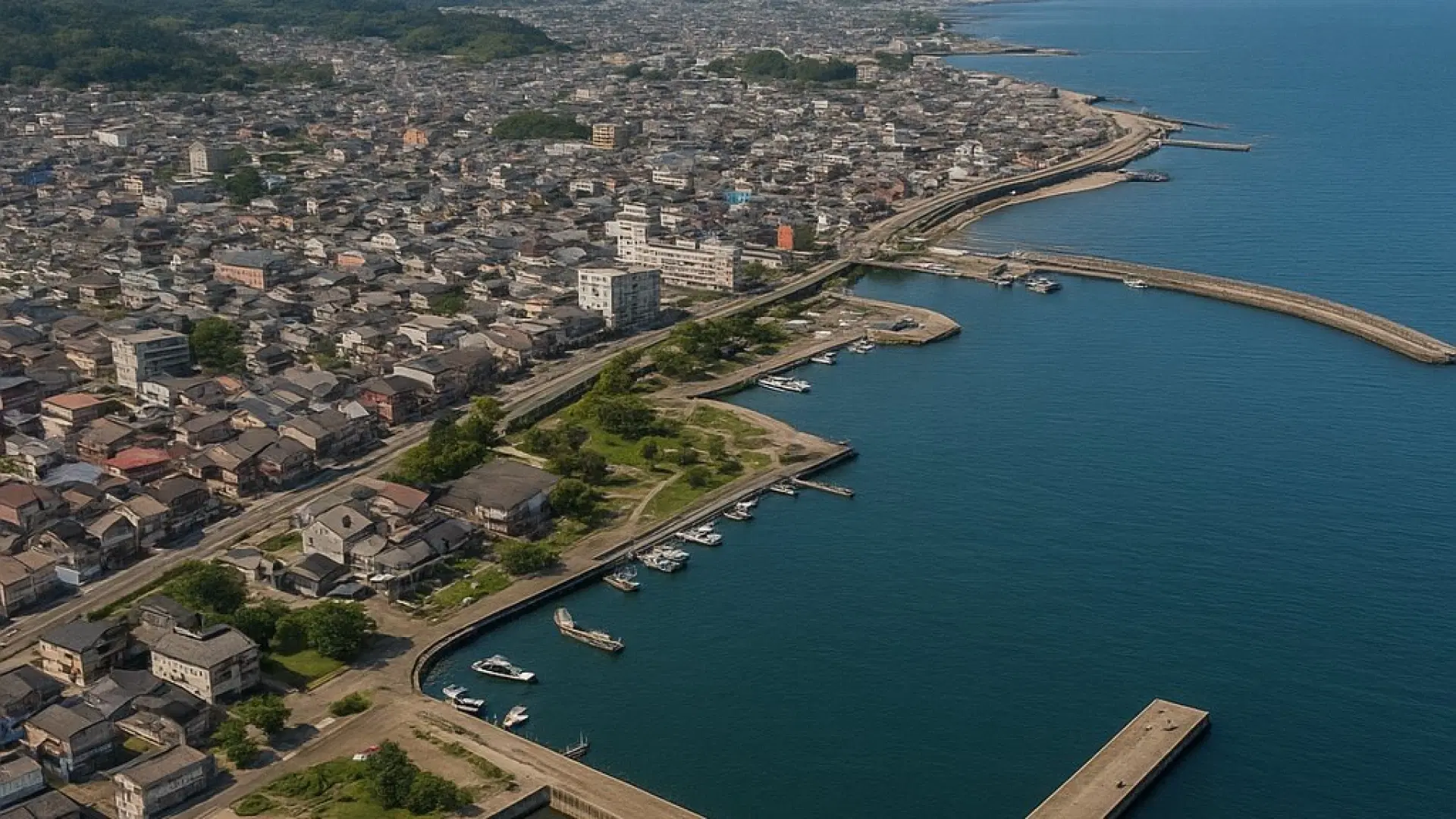
境港Sakaiminato sits at the westernmost point of Tottori Prefecture, where the Yumigahama sand spit separates the brackish waters of Lake Nakaumi from the open Japan Sea, and the town's identity is split between two obsessions: fish and yokai. As a fishing port, Sakaiminato has ranked consistently among the top harbors in Japan for total catch volume, its fleet working the rich waters where the Tsushima Current meets the cold Oyashio to produce one of the most biodiverse marine environments in the Japan Sea. The morning fish market, where the day's harvest is auctioned in a spectacle of speed and expertise, provides the foundation for a seafood dining culture whose quality-to-price ratio surpasses that of almost any coastal town in western Japan.
The town's other identity is the creation of a single artist: Mizuki Shigeru, the manga creator whose GeGeGe no Kitaro series populated Japanese popular imagination with a cast of yokai, the supernatural beings of Japanese folklore, whose adventures have been animated, merchandised, and beloved for over five decades. Mizuki was born and raised in Sakaiminato, and the town has embraced his legacy with an enthusiasm that has transformed its commercial center into an open-air gallery of yokai culture. Mizuki Shigeru Road, the main street leading from Sakaiminato Station to the harbor, is lined with over 170 bronze statues of yokai characters, each figure rendered with a craftsmanship and wit that elevates what might have been mere tourist kitsch into a sustained work of public art.
The coexistence of these two identities, the working fishing port with its predawn auctions and diesel-scented wharves and the whimsical yokai wonderland of the shopping street, creates a town of unusual character. The supernatural and the practical exist side by side without contradiction, the fishermen heading to sea past bronze kappa and tanuki, the tourist shops selling yokai merchandise alongside boxes of dried squid and crab-flavored snacks. This fusion of the real and the fantastical, the industrial and the imaginative, gives Sakaiminato a personality that no other town in Japan can replicate.
Sakaiminato sits at the westernmost point of Tottori Prefecture, where the Yumigahama sand spit separates the brackish waters of Lake Nakaumi from the open Japan Sea, and the town's identity is split between two obsessions: fish and yokai.
Highlights
Mizuki Shigeru Road is an 800-meter promenade of popular imagination, its sidewalks populated by bronze yokai whose variety and expressiveness reward slow, attentive walking. The statues range from the beloved characters of the Kitaro series, the one-eyed boy hero and his father Medama-Oyaji, a reincarnated eyeball who rides on his son's head, to the obscure creatures of deep Japanese folklore whose existence has been preserved in Mizuki's encyclopedic illustrated guides to the supernatural world. The Mizuki Shigeru Museum, at the road's terminus, presents the artist's life and work in exhibitions that reveal both his extraordinary draftsmanship and the wartime experiences on the tropical front that shaped his philosophy of resilience, compassion, and humor in the face of absurdity.
The fishing port, best experienced at dawn when the auction is in progress, provides a counterweight of muscular reality. The catch varies by season but consistently includes the species that define the Japan Sea's bounty: maguro tuna, buri yellowtail, nodoguro blackthroat seaperch, matsuba crab in winter, and the smaller species of squid, shrimp, and shellfish whose freshness at this proximity to the source produces flavors that transport and storage inevitably diminish. The auction itself, conducted in the rapid-fire cadence of professional fish buying, is theater of a commercial kind, its urgency and expertise as compelling in their way as any staged performance.
The Yumigahama sand spit, the narrow strip of land that connects Sakaiminato to the Tottori mainland, offers views across the calm waters of Lake Nakaumi to the south and the open Japan Sea to the north. Mount Daisen, the volcanic peak that dominates the San'in landscape, is visible from the spit on clear days, its snow-capped winter profile rising above the low-lying coast with a grandeur that anchors the entire western Tottori landscape.
Culinary Scene
Sakaiminato's kitchen begins at the fish auction and ends at tables where the interval between ocean and plate is measured in hours rather than days. The town's signature culinary experience is the kaisendon, a bowl of rice crowned with an assortment of raw seafood whose variety and freshness reflect the morning's catch rather than a fixed menu. On a given day, the bowl might feature strips of maguro tuna, slices of kanpachi amberjack, sweet shrimp arranged in translucent fans, and a cap of ikura salmon roe whose individual eggs burst with the clean, briny sweetness of the Japan Sea. The best kaisendon restaurants operate near the port, their supply chain a matter of meters rather than miles.
Matsuba crab, the winter sovereign of San'in cuisine, reaches exceptional quality in Sakaiminato, where the fleet's proximity to the prime crab fishing grounds and the port's high-volume processing infrastructure ensure that the crabs arrive at the kitchen in optimal condition. Full-course crab dinners at the town's ryokan and restaurants progress through the canonical sequence of preparations, from the austere purity of raw sashimi through grilled, boiled, and hot-pot presentations, each method revealing a different dimension of the crab's sweetness and texture.
Nodoguro, the blackthroat seaperch whose oil-rich flesh has been called the most luxurious white fish in the Japan Sea, appears on Sakaiminato's menus from autumn through spring, prepared most often as shioyaki, salt-grilled over charcoal until the skin crisps and the fat beneath it renders into a sauce of concentrated marine richness. The fish's Japanese name, meaning "black throat," refers to the dark interior of its mouth, a feature that provides the identification mark by which fishermen distinguish this prize from its less distinguished relatives.
Ryokans in Tottori
There are no ryokans in our guide listed in Sakaiminato. See our selection across Tottori.
View ryokans in Tottori