Miyoshi
祖谷渓・三好The Iya Valley is Japan's hidden country, a landscape of vertiginous gorges, vine bridges, and thatched-roof farmhouses that seems to belong to a century the rest of the nation left behind. Located in the mountainous interior of western Tokushima, within the municipal boundaries of Miyoshi, the Iya Valley was for centuries one of the most inaccessible places in Japan, its sheer-sided ravines and single-track mountain paths making it a natural refuge for those fleeing the political upheavals of the lowlands. The Heike refugees who are said to have settled here after their defeat at Dan-no-ura in 1185 found a landscape that offered concealment as a geographic fact, not a metaphor, and the isolation that protected them persisted well into the modern era, preserving architectural forms, agricultural practices, and a quality of silence that have largely disappeared elsewhere.
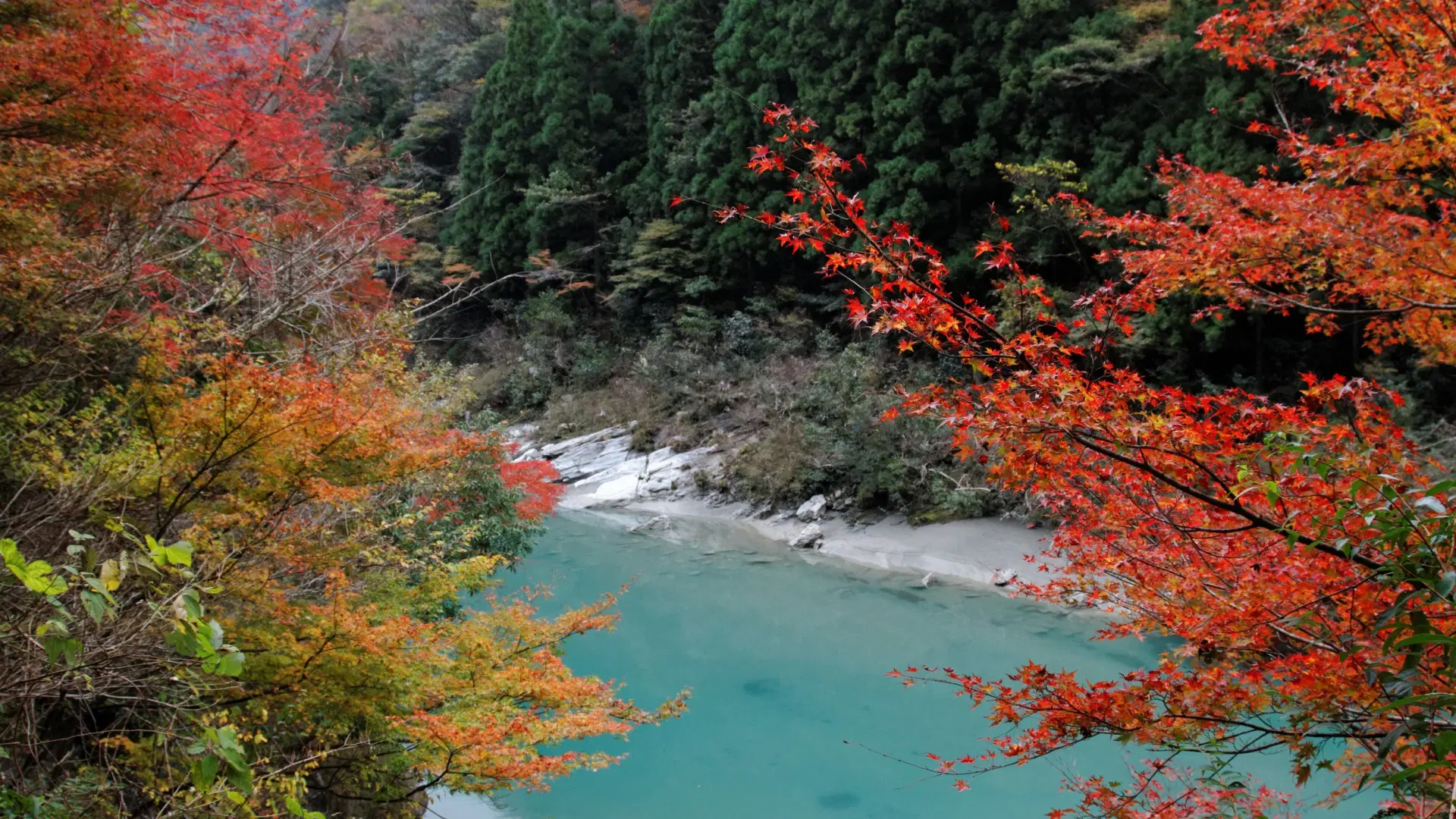
The Iya River has carved a gorge of extraordinary depth and narrowness through the mountains, its emerald water visible hundreds of meters below the roads that now cling to the cliff faces above. The valley's most famous landmarks, the kazurabashi vine bridges that span the gorge on cables of woven mountain vines, are engineering feats disguised as folk art, their construction requiring a knowledge of natural materials and structural forces that has been passed between generations for centuries. Crossing a kazurabashi, feeling the bridge sway beneath your feet as the gorge opens below, is an experience that engages the body's most primitive responses and makes the crossing a physical encounter with the landscape rather than a mere viewing of it.
Miyoshi, the municipal entity that encompasses the Iya Valley and the surrounding mountain territory, is the largest municipality by area in Tokushima Prefecture, and its landscape ranges from the cultivated terraces of the lower valleys to the alpine wilderness of the Tsurugi mountain range, whose peaks exceed 1,900 meters and support vegetation communities found nowhere else on Shikoku.
The Iya Valley is Japan's hidden country, a landscape of vertiginous gorges, vine bridges, and thatched-roof farmhouses that seems to belong to a century the rest of the nation left behind.
Highlights
The Iya Kazurabashi, the most famous of the vine bridges, spans the Iya River in a single arc of woven shirakuchi kazura vines, its planks spaced widely enough to reveal the rushing water far below. The bridge, rebuilt every three years using traditional techniques, is designated an Important Tangible Folk Cultural Property, and the crossing, approximately forty-five meters of deliberate, careful steps above the gorge, is one of the most memorable physical experiences available to the traveler in Japan. A second pair of vine bridges, the Oku-Iya Niju Kazurabashi, located deeper in the valley and far less visited, offers a quieter and in many ways more atmospheric crossing, the surrounding forest pressing close and the sound of the river filling the gorge.
The Manneken Pis of Iya, a small statue perched on a rock outcropping above the deepest section of the gorge, marks the viewpoint known as Iya Valley's most vertiginous overlook. The statue is a playful addition to a landscape of genuine grandeur, and the view from the overlook, straight down the cliff face to the river threading through the canyon floor, communicates the scale of the geological forces that created this terrain.
Mount Tsurugi, the second-highest peak in western Japan at 1,955 meters, rises at the southern edge of the Miyoshi territory and offers hiking that ranges from a gentle chair-lift-assisted ascent to challenging multi-day traverses of the ridgeline. The summit provides views across the mountain wilderness of central Shikoku, an ocean of forested peaks extending to every horizon, and the alpine meadows below the peak support wildflower displays in summer that attract botanists and photographers from across the country. The scarecrow village of Nagoro, where artist Tsukimi Ayano has populated the depopulated hamlet with life-sized cloth figures, offers a poignant and strangely beautiful meditation on rural depopulation.
Culinary Scene
The Iya Valley's cuisine reflects its mountain isolation, built on ingredients that could be cultivated, foraged, or hunted in a landscape where the sea was days away and the growing season was compressed by altitude and cold. Iya soba, the buckwheat noodles that are the valley's signature dish, are made from grain grown on the steep terraces that line the gorge walls, their flavor earthier and their texture more rustic than the refined soba of the lowland cities. Served in a simple dashi broth or cold on a bamboo mat with dipping sauce, they carry the mineral character of the mountain soil in which the buckwheat grew.
Dekomawashi, skewered blocks of firm tofu, konnyaku, and potato roasted over an open hearth, is the Iya Valley's most characteristic snack, its name referring to the rotation of the skewers as they cook. The preparation is elemental in its simplicity, the smoky char of the open fire transforming humble ingredients into something deeply satisfying, and the experience of eating dekomawashi beside an irori hearth in a thatched-roof farmhouse connects the visitor to a culinary tradition that has remained essentially unchanged for centuries.
Wild game, river fish, and mountain vegetables complete the Iya table. Ayu from the clear mountain streams, wild boar hunted in the surrounding forests, and sansai gathered from the hillsides in spring provide the proteins and vegetables that sustained valley life before modern transport made coastal ingredients available. The best lodgings in the valley serve meals that draw entirely on this mountain larder, creating a cuisine of place whose every ingredient can be traced to the landscape visible from the dining room window.