Tosashimizu
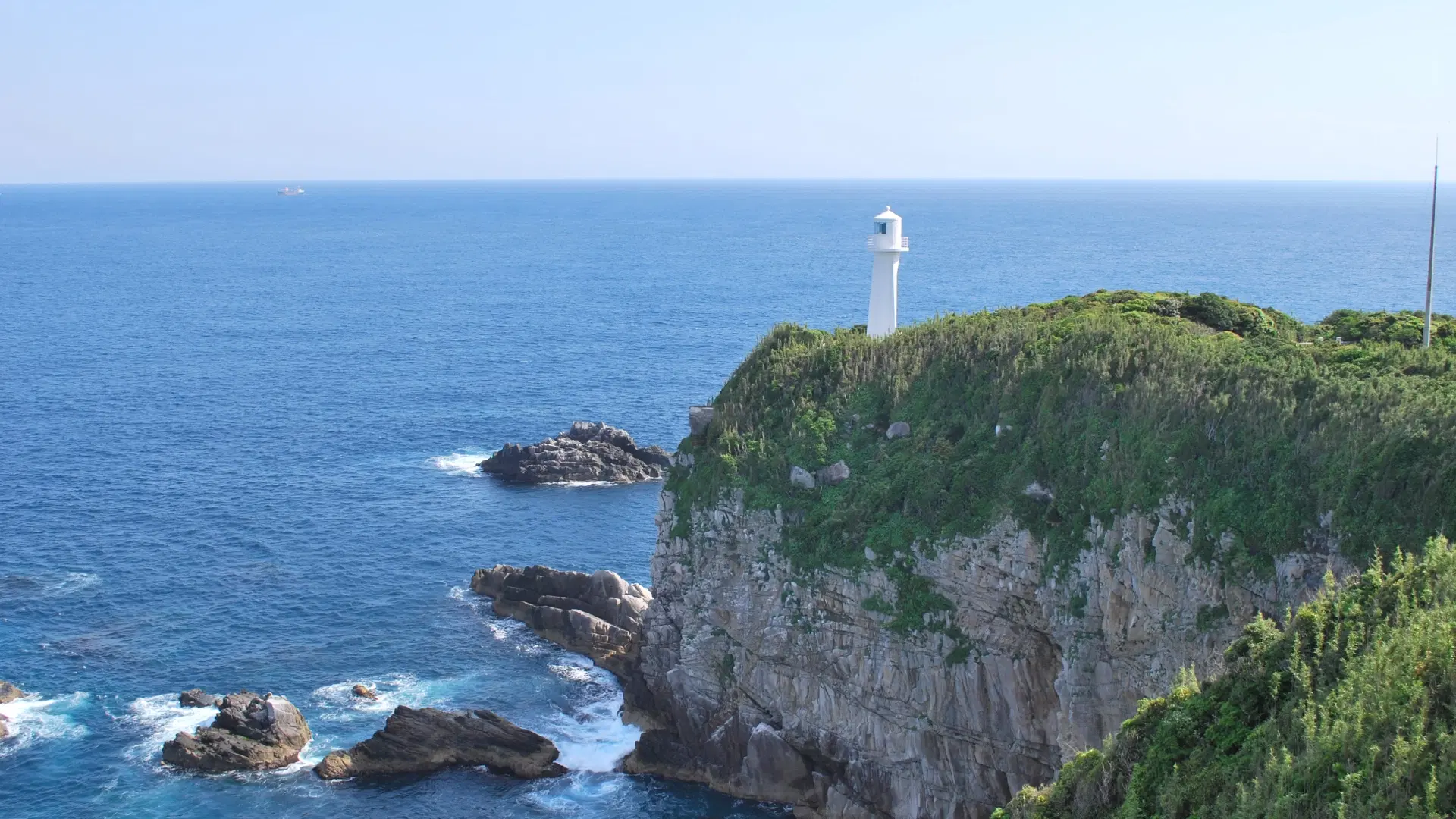
土佐清水Tosashimizu is the end of the line, the last significant settlement before the land gives way to the open Pacific at Cape Ashizuri, the southernmost point of Shikoku. This small fishing city, remote even by the standards of a prefecture that prides itself on being far from everything, possesses a quality of edge-of-the-world intensity that its geography naturally produces: the cliffs drop sheer into the ocean, the Kuroshio Current sweeps past in a river of warm water that brings subtropical marine life to temperate shores, and the lighthouse at the cape's tip stands sentinel over a seascape whose scale and emptiness remind the viewer that the next land in this direction is far away.
The remoteness that defines Tosashimizu has preserved a fishing culture of unusual authenticity. The city's fleet pursues bonito, tuna, and other pelagic species in the deep waters off the cape, and the seafood that reaches the city's tables and processing facilities is among the freshest and finest in Kochi, a prefecture already renowned for the quality of its marine harvest. The dried bonito flakes, katsuobushi, produced in Tosashimizu are considered the finest in Japan, and the traditional production process, in which the fish is smoked, dried, and cured over a period of months, concentrates the bonito's flavor into an ingredient of such umami intensity that it forms the foundation of dashi and, by extension, of the entire structure of Japanese cuisine.
Cape Ashizuri, the headland that terminates the Ashizuri Peninsula in a series of dramatic cliffs, is a place of wild beauty and spiritual significance. The cape is the site of Kongofukuji, Temple Thirty-Eight of the Shikoku Pilgrimage, whose location at the continent's southern edge gives it a quality of finality and solitude that distinguishes it from the temples of the pilgrimage's more populated stretches. The view from the cape's observation point, where the granite cliffs fall eighty meters to the white surf below and the horizon curves with the earth's curvature, is one of the most powerful coastal panoramas in Japan.
Tosashimizu is the end of the line, the last significant settlement before the land gives way to the open Pacific at Cape Ashizuri, the southernmost point of Shikoku.
Highlights
Cape Ashizuri is the destination that justifies the journey to Tosashimizu, a landscape of such raw geological power that it redefines the traveler's sense of scale. The cliffs, composed of granite and sandstone sculpted by the Pacific's relentless energy, rise in bands of stratified color from the churning water below, and the vegetation that clings to their faces, including subtropical species brought by the Kuroshio Current's warmth, gives the rock a green overlay that softens its severity without diminishing its drama. The lighthouse, a white cylindrical tower first lit in 1914, provides the cape's visual focal point, and the walk along the cliff-edge path between the lighthouse and the observation points reveals the coastline's form from multiple angles, each more dramatic than the last.
Kongofukuji, Temple Thirty-Eight, occupies a forested plateau near the tip of the cape, its grounds shaded by towering trees and its atmosphere shaped by the sound of the Pacific, audible but invisible from the temple's interior. The temple's position at the southernmost point of the pilgrimage route gives it a symbolic significance that its architecture, modest but well-maintained, supports: this is a place of arrival and of turning, a spiritual marker at the edge of the land where the pilgrim pauses before beginning the long northward walk that will eventually complete the circuit.
Tatsukushi Marine Park, along the coast west of Cape Ashizuri, offers a different coastal experience: a rocky shoreline where geological formations of fantastic shape, sculpted by wave erosion over millennia, create a landscape that seems designed by an imagination rather than by physical process. Glass-bottomed boat tours reveal the subtropical coral and tropical fish brought to these temperate waters by the Kuroshio, and the underwater world, visible in the clear water, adds a dimension of life and color to the mineral drama of the surface.
Culinary Scene
Katsuobushi, the dried and smoked bonito that is the foundation of dashi and one of the most important ingredients in the Japanese culinary system, reaches its highest expression in Tosashimizu. The traditional production process, which begins with the filleting and simmering of fresh bonito and proceeds through repeated cycles of smoking over oak and cherry wood, drying in the sun, and curing with the beneficial mold Aspergillus glaucus, takes several months to complete and produces a product of crystalline hardness and concentrated umami. Shaving katsuobushi from a whole block using a traditional plane, watching the translucent curls fall onto rice or tofu, and tasting the pure distillation of oceanic flavor that results, is an experience that reveals the depth of craft behind an ingredient often taken for granted.
Fresh katsuo, before its transformation into katsuobushi, is the centerpiece of the Tosashimizu table. The bonito caught off Cape Ashizuri, hauled from the deep water where the Kuroshio's warmth concentrates the schools, is served as tataki in the Kochi style, seared over straw flame and dressed with garlic and ponzu, but also as sashimi of exceptional freshness, the deep red flesh cut thick enough to appreciate its firm, clean texture. The difference between katsuo eaten within hours of the catch and the same fish consumed a day or two later is significant, and Tosashimizu's proximity to the fishing grounds ensures a freshness that even Kochi City's excellent markets cannot guarantee.
The sea urchin, abalone, and turban shell gathered from the rocky coastline near the cape appear on local tables in preparations that reflect the simplicity appropriate to ingredients whose quality speaks for itself. A bowl of rice topped with fresh uni from the nearby reefs, its sweetness and creaminess needing no accompaniment beyond a few drops of soy sauce, represents the Tosashimizu kitchen at its most elemental.
Ryokans in Kochi
There are no ryokans in our guide listed in Tosashimizu. See our selection across Kochi.
View ryokans in Kochi