Naoshima
直島Naoshima is the island where contemporary art and the Japanese landscape entered into a conversation that has not ended since it began. This small island in the Seto Inland Sea, roughly eight square kilometers and home to a population of around three thousand, has been transformed over the past three decades into one of the most significant destinations for contemporary art in the world, a place where the work of internationally celebrated artists is housed in buildings by internationally celebrated architects, and where the relationship between art, architecture, and the natural environment is explored with a rigor and a sensitivity that have made the island a pilgrimage site for the aesthetically engaged.
The transformation began in 1992, when the Benesse Corporation opened the Benesse House Museum, designed by Tadao Ando, on a hillside overlooking the Inland Sea. Ando's building, with its characteristic concrete forms and its masterful manipulation of light, established the principle that would govern all subsequent development on the island: that architecture should not impose itself upon the landscape but enter into dialogue with it, creating spaces in which art and nature amplify each other. The collection within, featuring works by artists including Cy Twombly, Bruce Nauman, and Richard Long, was selected and installed with a curatorial intelligence that treated the relationship between each work and its setting as a creative act in itself.
The decades since have seen the island accumulate an extraordinary density of art and architecture. The Chichu Art Museum, also by Ando, houses permanent installations by Claude Monet, Walter De Maria, and James Turrell in underground galleries that receive only natural light. The Lee Ufan Museum provides a contemplative space for the Korean-born artist's minimalist sculptures and paintings. And the Art House Project, in which artists have transformed abandoned buildings in the island's traditional village of Honmura into site-specific installations, demonstrates that art can revitalize a community without erasing its character.
Naoshima is the island where contemporary art and the Japanese landscape entered into a conversation that has not ended since it began.
Highlights
The Chichu Art Museum is Naoshima's most architecturally and artistically ambitious space, a museum built almost entirely underground so that its presence does not alter the island's topography. Ando's concrete corridors and stairways lead visitors through a sequence of galleries lit entirely by natural light, whose intensity and angle shift through the day and the seasons, making each visit a unique encounter with the works within. Monet's Water Lilies, displayed in a white marble room whose dimensions and illumination were designed specifically for these late paintings, achieve a luminosity and a presence that many viewers find more moving than the same works in conventional gallery settings. Turrell's Open Sky, a room with a rectangular opening in the ceiling through which the sky becomes a framed artwork, is one of the most profound spatial experiences in contemporary art.
The Art House Project in Honmura village transforms the visit from museum-going to exploration, as the art installations are distributed among houses, a temple, and a shrine throughout the traditional settlement. Tatsuo Miyajima's Sea of Time in the Kadoya house, where LED numbers count at different speeds in a dark pool of water, and James Turrell's Backside of the Moon in the Minamidera, where visitors sit in complete darkness until their eyes adjust to reveal a faintly luminous screen, are experiences that challenge perception and dissolve the boundary between viewing and inhabiting art.
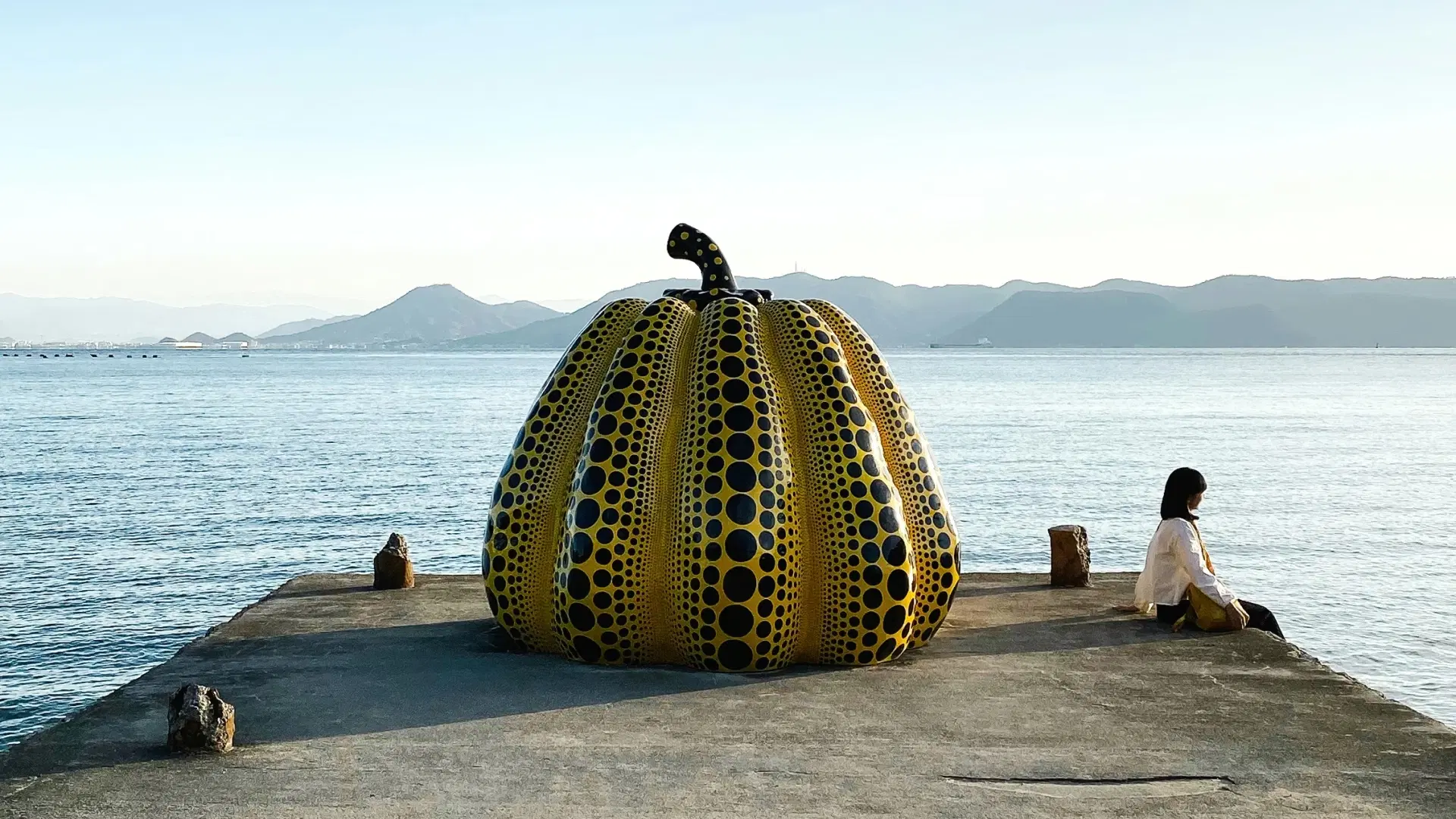
Yayoi Kusama's yellow pumpkin sculpture, positioned on a concrete pier extending into the Inland Sea, has become the island's most photographed icon, its polka-dotted surface vibrating against the blue of the water and the green of the hillside behind it. The sculpture's playfulness provides a counterpoint to the more austere works elsewhere on the island, and its position at the water's edge, where the tides shift around its base, gives it a relationship with the natural environment that evolves with each visit.
Culinary Scene
Naoshima's dining options reflect the island's dual identity as a traditional fishing community and an international art destination. The island's cafes and restaurants, many of them occupying renovated village buildings, serve meals that draw on the Inland Sea's abundant seafood and Kagawa's udon tradition while incorporating the global sensibilities of the international visitor base. The Benesse House restaurant, open to overnight guests, offers seasonal kaiseki-influenced cuisine composed from local ingredients and served in a dining room whose windows frame the Inland Sea, the meal itself becoming an aesthetic experience continuous with the art on the walls and the landscape beyond the glass.
The village of Honmura, where the Art House Project installations are located, is home to several small cafes and restaurants whose owners have invested the same creative attention in their food as the artists have in their installations. Freshly caught fish from the waters surrounding the island, Kagawa's sanuki udon noodles, and seasonal vegetables from the island's small farms appear in preparations that are simple, fresh, and attentive to the quality of their ingredients. The experience of eating a bowl of noodles or a plate of grilled fish in a converted village house, between visits to art installations that occupy similar buildings on the same street, gives dining on Naoshima a contextual richness that no mainland restaurant can replicate.
The island's proximity to Shodoshima, the source of Japan's finest olive oil and soy sauce, brings these premium condiments to the Naoshima table with a freshness that enhances even the simplest preparations.
Ryokans in Kagawa
There are no ryokans in our guide listed in Naoshima. See our selection across Kagawa.
View ryokans in Kagawa